
Method for discriminating alpha/gamma mixed radiation field particles in real time based on digital waveform
A radiation field and waveform technology, which is applied in the field of nuclear radiation measurement and particle measurement, can solve the problems of complex system, poor stability, and low efficiency of digital off-line waveform screening, and overcome the problems of large size, good stability, and low efficiency. Effect
- Summary
- Abstract
- Description
- Claims
- Application Information
AI Technical Summary
Problems solved by technology
Method used
Image

Examples
Embodiment Construction
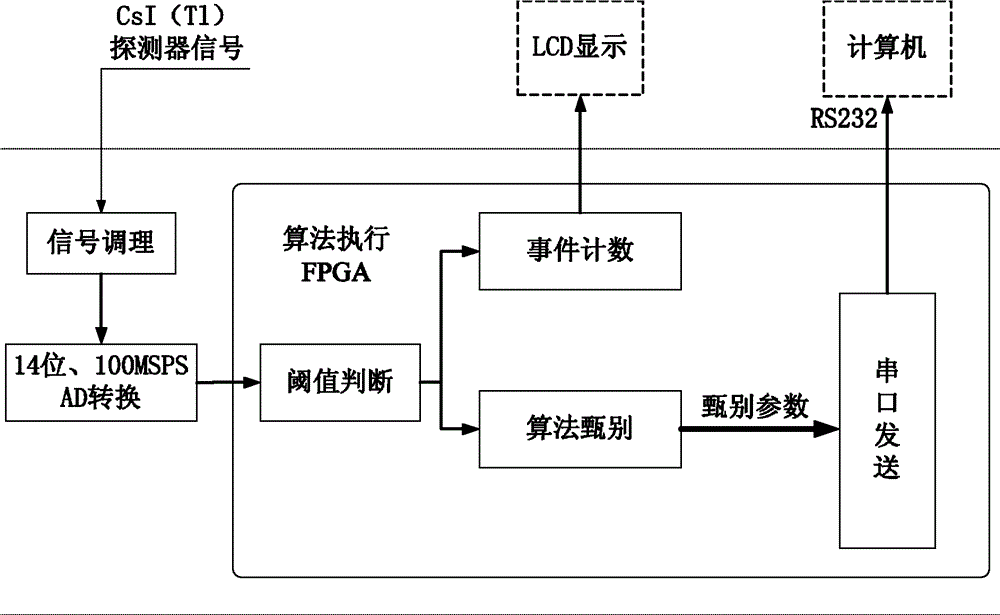
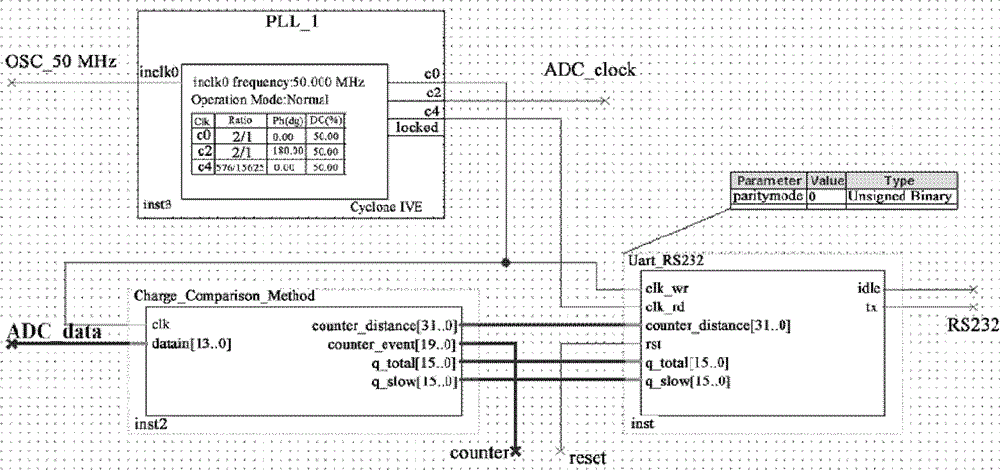
[0039] Starting from the principles of the present invention, the method for real-time screening of α / γ mixed radiation field particles based on digital waveforms proposed by the present invention will be further introduced in conjunction with the accompanying drawings and embodiments:
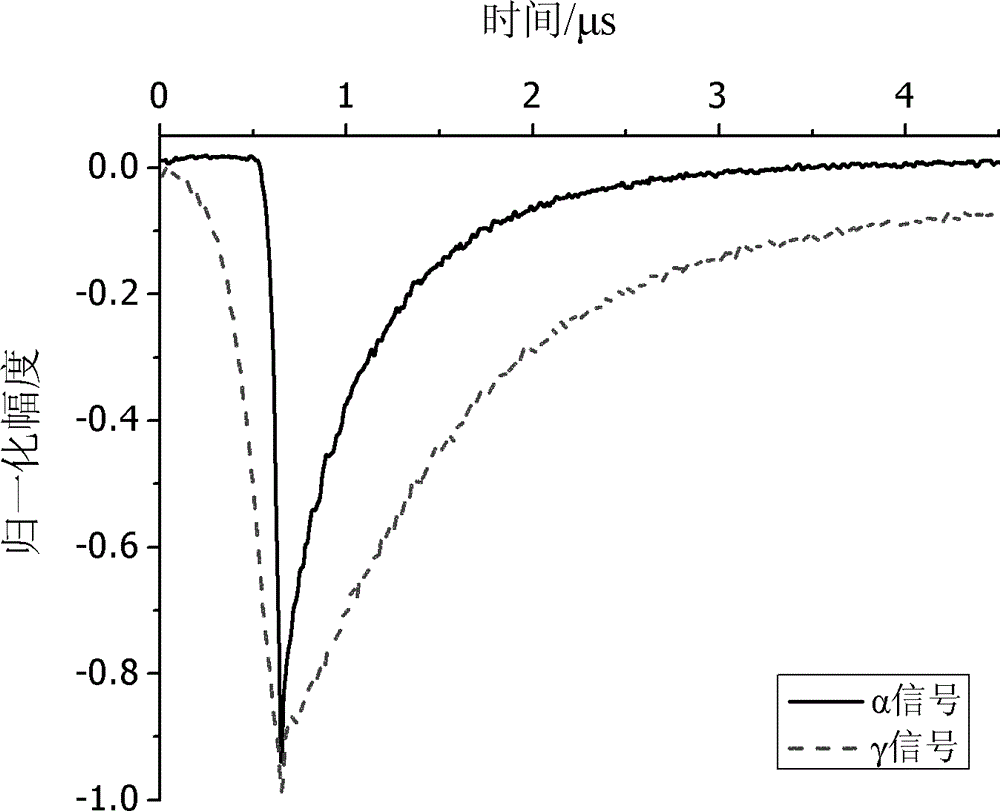
[0040] CsI(Tl) is an inorganic scintillation crystal doped with thallium cesium iodide, with high density, high average atomic number, and emission spectrum peak between 540nm and 550nm. A CsI(Tl) crystal is coupled with a photomultiplier tube with matched spectral response to form a CsI(Tl) inorganic scintillation detector. When α and γ are incident on the CsI(Tl) detector, the ionization densities of the two particles in CsI(Tl) are different. When α particles are incident on the scintillator, the energy deposition density is relatively large, and the decay time of the excited fluorescence pulse is short; while when the gamma ray is incident, the energy deposition density is small, and the d...
PUM
 Login to View More
 Abstract
Description
Claims
Application Information
 Login to View More