A real-time prediction method for urban road traffic accident risk

A traffic accident and accident risk technology, applied in the field of traffic safety, can solve the problems of low accuracy and inability to apply real-time prediction of urban road traffic accidents, and achieve the effect of improving the accuracy of prediction

CN104732075BInactive Publication Date: 2017-07-07SUN YAT SEN UNIV
5 Cites 0 Cited by

Patent Information

Authority / Receiving Office
CN · China
Patent Type
Patents(China)
Current Assignee / Owner
Publication Date
2017-07-07
Estimated Expiration
Not applicable · inactive patent

Smart Images

  • Figure 1
    Figure 1
  • Figure 2
    Figure 2
  • Figure 3
    Figure 3
Patent Text Reader

Abstract

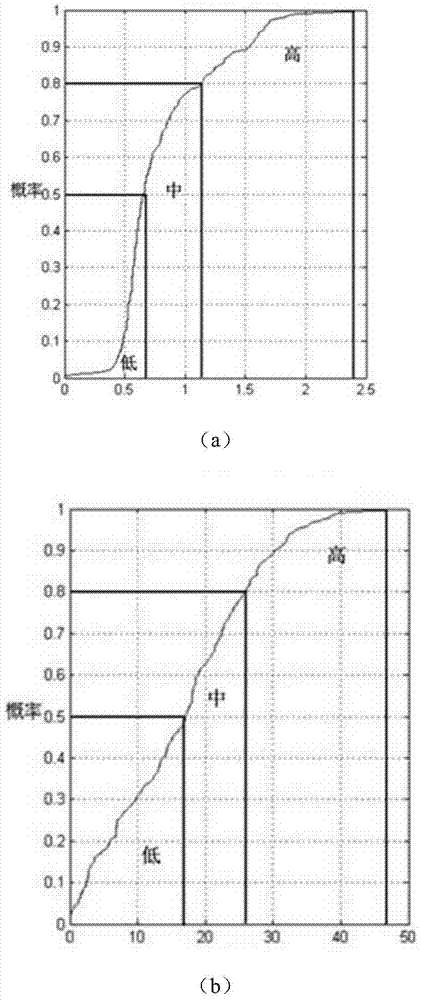
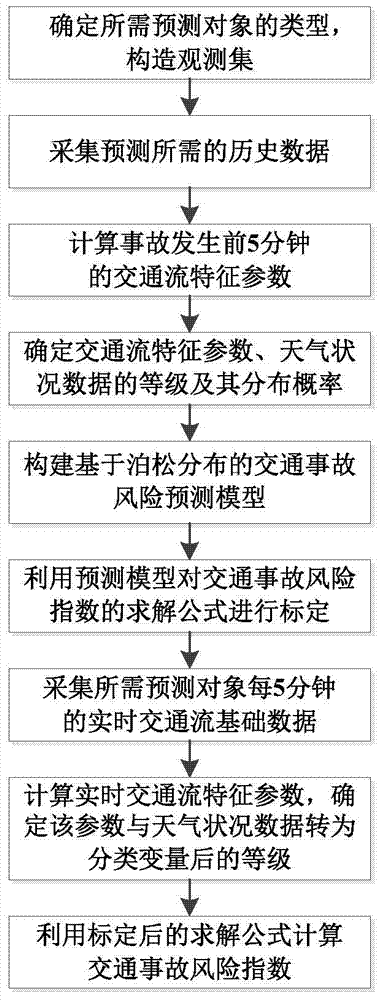
The invention provides a real-time prediction method of urban road traffic accident risk, which calculates by extracting the geometric linear data of each observation object in the observation set, the basic data of historical traffic flow n minutes before the occurrence of the traffic accident, and the historical weather condition data to obtain traffic The characteristic parameters of traffic flow n minutes before the accident and weather condition data are transformed into grades of categorical variables and the distribution probability of this grade, and then a real-time prediction model of urban road traffic accidents based on Poisson distribution is established, using the determined traffic flow characteristic parameters The level of weather condition data and the distribution probability of this level are used to calibrate the prediction model. When predicting the traffic accident risk of the required prediction object, it is only necessary to calculate the real-time traffic flow characteristic parameters and weather conditions of the required prediction object in real time. The level after the data is converted into a categorical variable and the distribution probability of the level can be used to predict the traffic accident risk of the desired prediction object using the calibrated formula.
Need to check novelty before this filing date? Find Prior Art

Description

technical field

[0001] The invention relates to the technical field of traffic safety, and more specifically, to a method for real-time prediction of urban road traffic accident risks. Background technique

[0002] With the continuous development of our country's social economy and the substantial increase of the number of domestic motor vehicles, the number of road traffic accidents in our country is also showing an increasing trend. In 2012, the number of road traffic accidents in my country was 204,000, and the casualties caused by road traffic accidents reached 284,000. This shows that my country's road traffic safety situation is still very serious. As an important part of my country's road traffic system, urban roads are essential public infrastructure for people's lives, and their traffic accidents account for more than 40% of the total accidents every year. The prediction of urban road traffic accidents can estimate and speculate the risk state of the road, find ou...

Examples

Embodiment Construction

[0047] The accompanying drawings are for illustrative purposes only and cannot be construed as limiting the patent;

[0048] The invention provides a real-time prediction method for urban road traffic accident risk, such as figure 1 As shown, the method includes the following steps:

[0049] S1. Determine the type of the required prediction object, and select several urban roads of the same type as observation objects to form an observation set. The types of urban roads include: road sections and intersections;

[0050] S2.. Extract the geometric linear data, historical traffic accident data and historical weather condition data of each object in the observation set, and obtain the precise time of each traffic accident according to the historical traffic accident data. After obtaining the precise time of the traffic accident, obtain Basic traffic flow data and weather condition data n minutes before each traffic accident;

[0051] S3. For each observation object, calculate t...