
Cultivation method of persimmon in Karst rock-desertification areas
A cultivation method and rocky desertification technology are applied in the field of persimmon fruit cultivation in karst rocky desertification mountains, which can solve the problems of lack of large-scale implementation, and achieve the effects of rich nutritional value, large branches and vigorous growth.
- Summary
- Abstract
- Description
- Claims
- Application Information
AI Technical Summary
Problems solved by technology
Method used
Image

Examples
Embodiment Construction
[0045] The karst mountain persimmon fruit cultivation method of the present invention includes the following steps:
[0046] Breeding
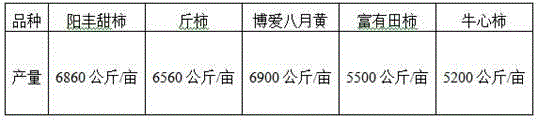
[0047] Choose varieties: "Yangfeng Sweet Persimmon", "Jin Shi" and "Boai August Yellow".
[0048] Source of "Yangfeng Sweet Persimmon" variety: It was bred by Anyunjin Branch of Fruit Tree Test Center of the Ministry of Agriculture, Forestry and Fisheries of Japan. The parent is Fuyu×Jiro. The Japanese variety was registered in 1991; but its comprehensive quality has far exceeded Fuyu and Jiro, becoming a substitute for Fufu and Jiro. , Nishimura, Izu, Matsumoto, and other traditional varieties are the best choice. This variety has a large fruit shape, with an average fruit weight of 230 grams, and a maximum fruit weight of 400 grams. The size is generally very neat; the fruit is oblate, without cracking, and has good coloring. When mature, the surface of the fruit is orange-red, the top of the fruit is red, gorgeous and charming, and the flesh Ora...
PUM
 Login to View More
 Abstract
Description
Claims
Application Information
 Login to View More