
Anacardic acid as an inhibitor of glyceraldehyde triphosphate dehydrogenase in echinococcosis and as a drug for echinococcosis
A technology of glyceraldehyde triphosphate dehydrogenase and anacardic acid, which is applied in the direction of drug combination, medical preparations containing active ingredients, anti-infective drugs, etc., can solve the inhibitory effect of anacardic acid on echinococcosis GAPDH and echinococcosis Function and other issues
- Summary
- Abstract
- Description
- Claims
- Application Information
AI Technical Summary
Problems solved by technology
Method used
Image

Examples
Embodiment 1
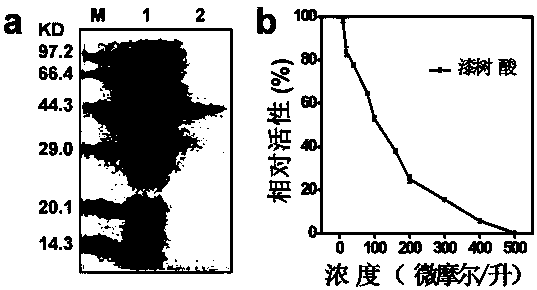
[0029] Example 1: Effect of Anacardic Acid on the Enzyme Activity of Echinococcus Glyceraldehyde Triphosphate Dehydrogenase
[0030] Purpose and principle: In order to verify that anacardic acid can inhibit glyceraldehyde triphosphate dehydrogenase in Echinococcus, the principle of GAPDH enzyme activity detection is glyceraldehyde 3-phosphate+H3PO4+NAD+↔1,3-glycerol diphosphate+NADH+H+. As NADH is produced in the reaction mixture, its absorbance at 340 nm increases. Therefore, the inhibitory effect of anacardic acid on GAPDH can be judged according to the 340nm OD value recorded in the reaction between different concentrations of anacardic acid and GAPDH.
[0031] Method: Reagents included 0.01mol / L sodium pyrophosphate, 0.02 mol / L sodium phosphate, 0.25 mmol / L NAD, 3 μmol / L DTT, 0.25 mmol / L 3-phosphoglyceraldehyde (D-G3P), 5 μg purified GAPDH, the reaction temperature is 25°C. Record the OD value at 340nm wavelength for 0-5min to obtain the catalytic activity of GAPDH. The...
Embodiment 2
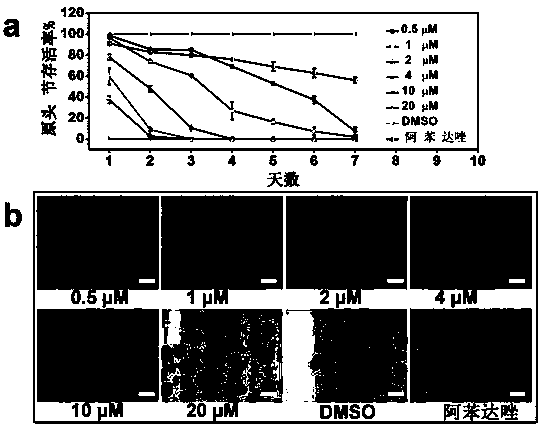
[0034] Example 2: Effect of anacardic acid on Echinococcus granulosus
[0035] Purpose and principle: To observe the survival rate of protoscoleum treated with drugs in vitro by trypan blue staining method, so as to observe the effect of drugs on Echinococcus granulosus. Normal living cells have a complete membrane structure, which can repel trypan blue and prevent it from entering the cell; while cells with inactive or incomplete membranes have increased membrane permeability and can be stained blue by trypan blue color. It is generally considered that the integrity of the cell membrane is lost, that is, it is considered dead.
[0036] Method: The cleaned protoscole of Echinococcus granulosus was added to the 24-well plate, and the control group and drug-dosed group were set up. The control group was added with solvent, and the drug-dosed group was added with anacardic acid with different concentrations. Pan blue staining was used to record the survival rate of the protosco...
Embodiment 3
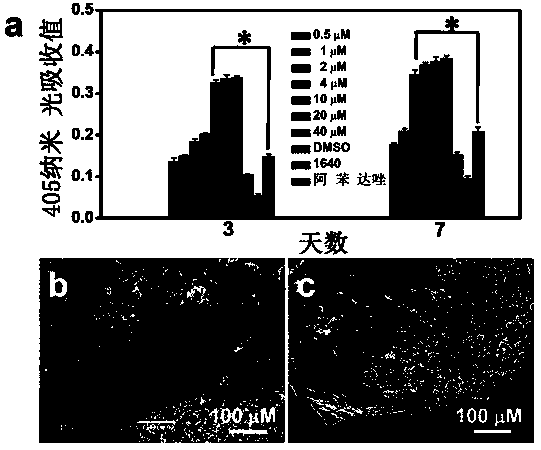
[0039] Example 3: Effect of anacardic acid on alveolar echinococcosis
[0040] Purpose and principle: The effect of anacardic acid on alveolar echinococcosis was determined by alkaline phosphatase. The determination experiment of alkaline phosphatase must use the indirect measurement of the content of alkaline phosphatase to reflect the damage degree of alveolar Echinococcus tissue. The detection principle is that alkaline phosphatase will be released into the supernatant when the alveolar Echinococcus tissue is damaged, but not released when it is not damaged, so the degree of damage is directly proportional to alkaline phosphatase.
[0041] Method: Add the vesicles of the cultured alveolar coccus tissue into the 24-well plate, set up the control group and the dosing group, add the solvent in the control group, add anacardic acid with different concentrations in the dosing group, and incubate on the 3rd and 7th day At the time, the supernatant was aspirated, and the content ...
PUM
 Login to View More
 Abstract
Description
Claims
Application Information
 Login to View More