

Signal edge detection method based on short-time Fourier transform data link
A short-time Fourier and edge detection technology, which is applied in the field of signal processing, can solve problems such as difficult to accurately extract edges, and achieve the effect of accurate edge detection and low signal-to-noise ratio
- Summary
- Abstract
- Description
- Claims
- Application Information
AI Technical Summary
Problems solved by technology
Method used
Image



Examples
Embodiment Construction
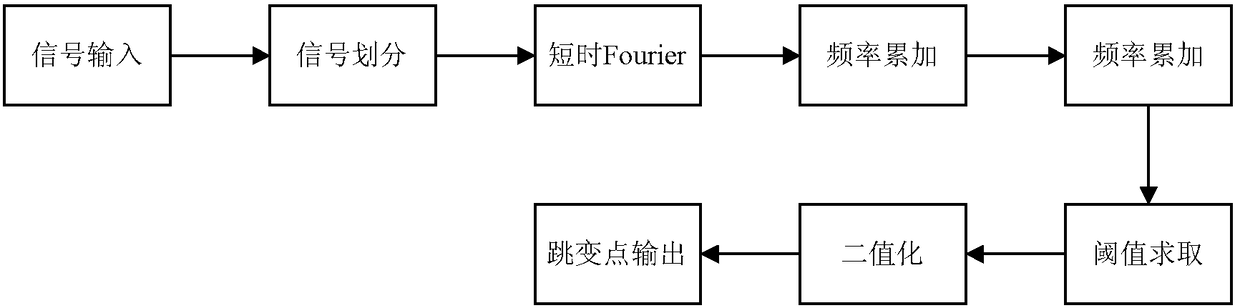
[0026] In the case of non-cooperation, the present invention utilizes the specific frequency information contained in the data link signal and proposes to use the short-time Fourier transform to detect the edge of the reconnaissance receiving data link signal and extract the target signal in the noise background. The basic idea of short-time Fourier transform: Divide the signal into many small time intervals, and analyze each time interval with Fourier transform to determine the frequency that the signal exists in the time interval. The processing method is to apply a sliding window w(t-τ) to the signal f(t) (τ is a shift factor, reflecting the position of the sliding window), and then perform Fourier transform, that is
[0027]
[0028] For a burst signal, when the non-cooperative received signal does not contain the target signal, there is only noise, and when the target signal is included, since the target signal contains certain frequency information, then compared to ...
PUM
 Login to View More
 Abstract
Description
Claims
Application Information
 Login to View More