
A method for removing broad bean wilt virus No. 2 from pepper seeds
A technology for seeds and peppers, applied in the field of removing broad bean wilt virus No. 2 in pepper seeds, can solve the problem of difficulty in determining the quantity and activity of seed viruses, inability to accurately control the technical indicators of passivation viruses, and no detoxification effect of pepper seeds has been seen. Evaluation and other issues, to achieve the effect of fast detection efficiency, shortening detection time, and improving germination potential
- Summary
- Abstract
- Description
- Claims
- Application Information
AI Technical Summary
Problems solved by technology
Method used
Image

Examples
Embodiment 1
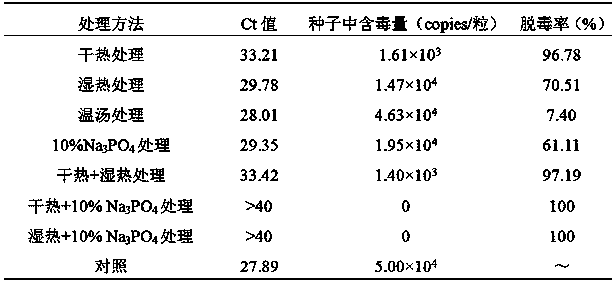
[0036] Example 1. Comparison of detoxification effects of several detoxification methods
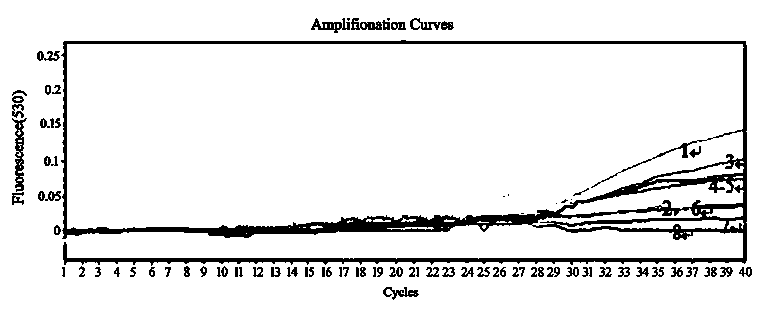
[0037] In this embodiment, seven detoxification methods are designed to detoxify pepper seeds, with non-detoxified pepper seeds as a control, and the amount of seeds for each treatment is about 300 full and poisonous pepper seeds. After the seeds were detoxified, the TaqMan probe real-time fluorescent quantitative PCR detection method was used to quantitatively detect BBWV2 in pepper seeds, and the detoxification effects of various detoxification methods were compared.
[0038] 1. The detoxification method is designed as follows:
[0039] (1) Dry heat treatment method: Place the pepper seeds to be detoxified in an oven, heat-air for 48 hours at 70 ℃, and then stand to cool.
[0040] (2) Humidity heat treatment method: soak the pepper seeds to be detoxified in 5 times the volume of boiling water, and quickly shake to cool to 40-45 ℃, drain the aqueous solution, and put the treated seeds on the ne...
Embodiment 2
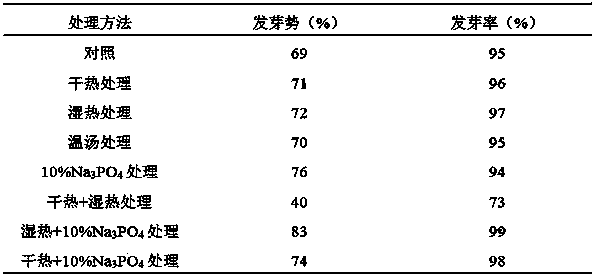
[0063] Example 2. The effect of several detoxification methods on the germination rate and germination potential of pepper seeds
[0064] Randomly select 150 capsicum seeds of each detoxification treatment and non-detoxification treatment in Example 1, and divide them into 3 groups. After soaking in cold water for 4 hours, use a petri dish filter paper constant temperature germination method to seed in a 28℃ constant temperature incubator For the germination test, from the 3rd day after the treatment, the germination situation was observed and counted daily, and the germination number was recorded. The germination potential was determined by the germination number of each detoxification treatment on the 7th day, and the germination test was ended on the 10th day. Germination rate (%) = (number of germinated seeds / number of tested seeds)×100; germination potential (%)=(number of seeds germinated within the specified time / number of tested seeds)×100.
[0065] The results of the seed ...
PUM
 Login to View More
 Abstract
Description
Claims
Application Information
 Login to View More