
Information source adaptive dynamic selection-based efficient fusion identification method
A fusion recognition and adaptive technology, applied in the field of target recognition, can solve problems such as poor robustness, high cost, optimization of non-local optimum, etc., to achieve the effects of avoiding limitations, saving costs, and reducing quantities
- Summary
- Abstract
- Description
- Claims
- Application Information
AI Technical Summary
Problems solved by technology
Method used
Image

Examples
Embodiment Construction
[0041] The present invention will be described in detail below with reference to the drawings and specific embodiments.
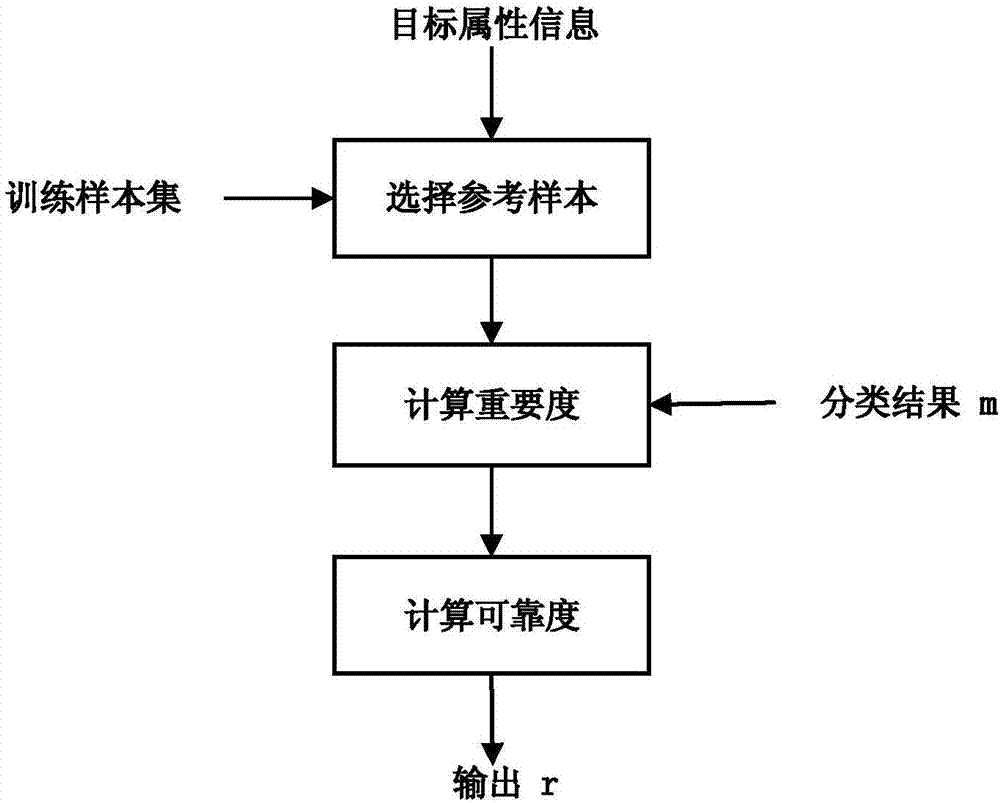
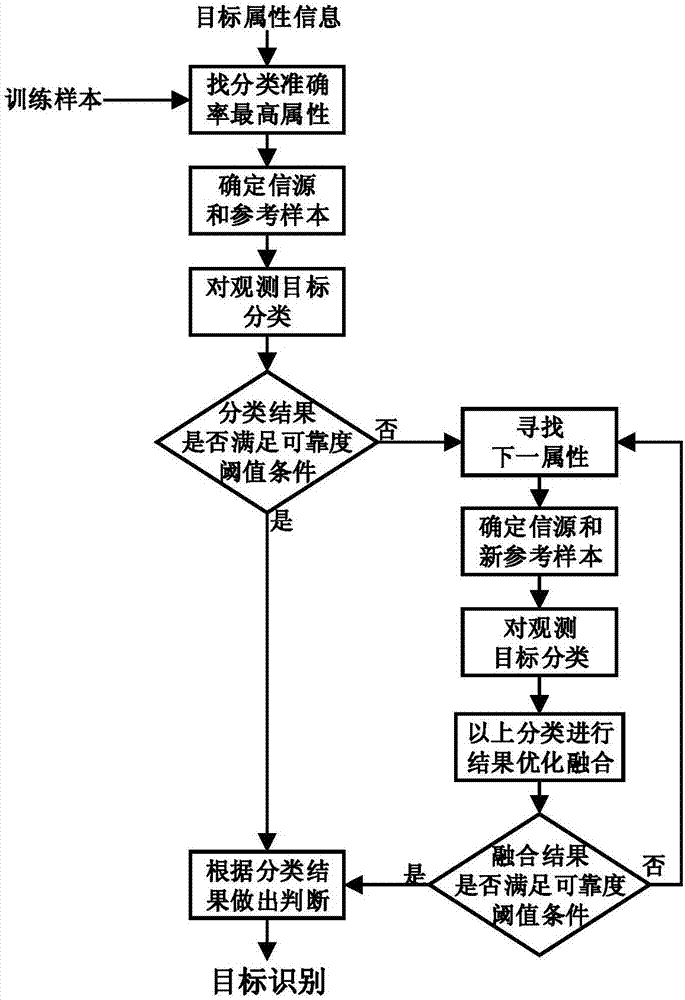
[0042] The invention discloses a method for self-adaptive and dynamic selection of source information for efficient fusion identification, which combines figure 1 , figure 2 As shown, it specifically includes the following steps:
[0043] Step 1. Collect data from the training sample set through multiple sensors, and perform preprocessing and feature extraction on the collected data. For each training sample in the training sample set, its attributes are divided into N attributes according to the same rules Set, namely {a 1 ,a 2 ,...,A N }, where N is an integer greater than 0, a N Represents the Nth attribute set.
[0044] Step 2: Cross-validate the training sample set through each attribute set, and obtain the attribute set that makes the classification accuracy of the training sample set the highest.
[0045] Step 3: Classify the observation target according t...
PUM
 Login to View More
 Abstract
Description
Claims
Application Information
 Login to View More