

Graph structure-aware graph processing method and device
A technology of graph processing and graph structure, applied in the field of data processing, to achieve the effect of reducing the average number of updates, reducing loading, and reducing I/O overhead
- Summary
- Abstract
- Description
- Claims
- Application Information
AI Technical Summary
Problems solved by technology
Method used
Image



Examples
Embodiment 1
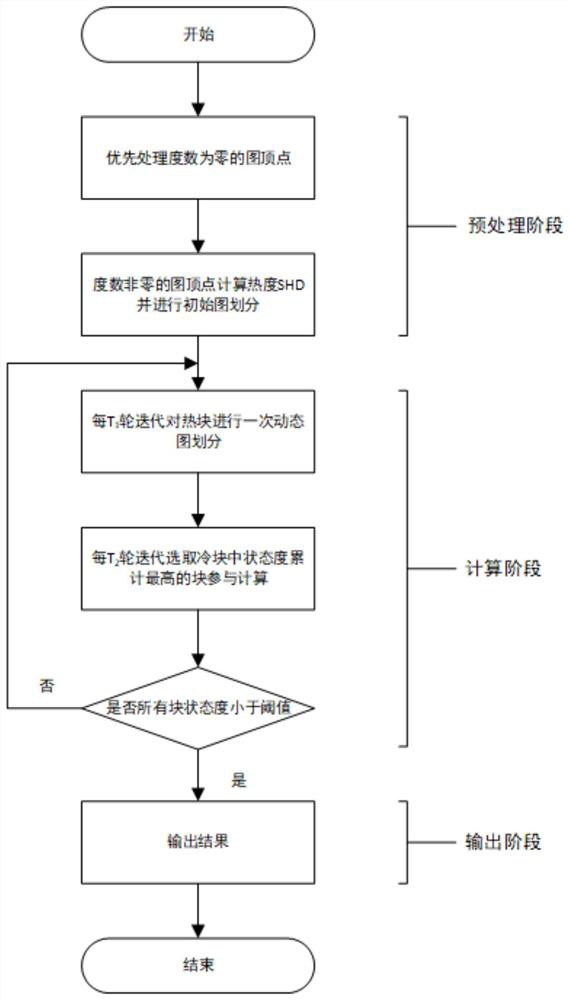
[0036] Such as figure 1 As shown, the present invention provides a graph structure-aware graph processing method, including the following steps:
[0037] S1: Divide hot blocks and cold blocks based on the heat value of the vertex;
[0038] S2: Obtain the block state degree of hot block and cold block respectively based on the iterative calculation results of two adjacent vertices;
[0039] S3: in progress every T 1 In the case of round iterations, the hot blocks are re-divided. If there are still hot blocks after the division, the cold blocks and / or hot blocks are adaptively scheduled for calculation. After the division, there are no hot blocks and the entire graph does not converge Next, every T 2 round iteration;
[0040] S4: Determine the convergence of the entire graph after iterative calculation based on the sum of all block state degrees.
[0041] For ease of understanding, each step of the graph processing method of the present invention will be described in detail...
Embodiment 2
[0064] Embodiment 2 is a further optimization and improvement of Embodiment 1, and the repeated content will not be repeated.
[0065] Before iteratively processing the graph vertices, the graph vertices are preprocessed. Such as image 3 As shown, a method for preprocessing graph vertices includes the following steps:
[0066] S1: Identify and judge all vertices whose degrees are zero, mark them as dead vertices and store them in the dead block sequentially.
[0067] S2: Graph vertex initialization: Create two graph vertex degree tables and two graph vertex value tables. Among them, the two graph vertex degree tables are vertex table and edge table respectively. The point table is used to store the ID, in-degree, out-degree and thermal value of graph vertices. The edge table is used to store graph vertex IDs and neighbor graph vertex IDs. The vertex value table in the first graph is used to store the calculation result of the vertex this time, and the vertex value table ...
Embodiment 3
[0078] This embodiment is a further improvement on Embodiment 1 and Embodiment 2, and repeated content will not be repeated here.
[0079] A graph structure-aware graph processing method, including a graph data preprocessing stage, a graph structure dynamic division stage, and a graph processing adaptive scheduling stage. Among them, in the graph data preprocessing stage, the vertex heat is calculated according to the vertex in-degree and out-degree, the vertex heat is read sequentially, and the corresponding vertices are divided into hot blocks and cold blocks. The dynamic partition stage of the graph structure, each T 1 The round iteration calls the graph partition function to re-partition the hot blocks. In the case of no hot blocks after redivision, judge whether the entire graph is converged. When the entire graph converges, the calculation output results are ended. Only cold block calculations are scheduled when the entire graph has not converged. Preferably, when th...
PUM
 Login to View More
 Abstract
Description
Claims
Application Information
 Login to View More