
Development of a class of hole-transporting polymer materials based on triphenylamine-anthracene structure and its application in perovskite solar cells
A technology of polymer materials and hole transport, applied in photovoltaic power generation, circuits, electrical components, etc., can solve the problems of low mobility and mismatched energy levels of hole transport materials, achieve high carrier mobility, and widely Application prospect, effect of good solution processability
- Summary
- Abstract
- Description
- Claims
- Application Information
AI Technical Summary
Problems solved by technology
Method used
Image

Examples
example 1
[0035] (1) Synthesis of monomer M1
[0036]
[0037] Preparation of 1-iodo-4-n-octyloxybenzene (1)
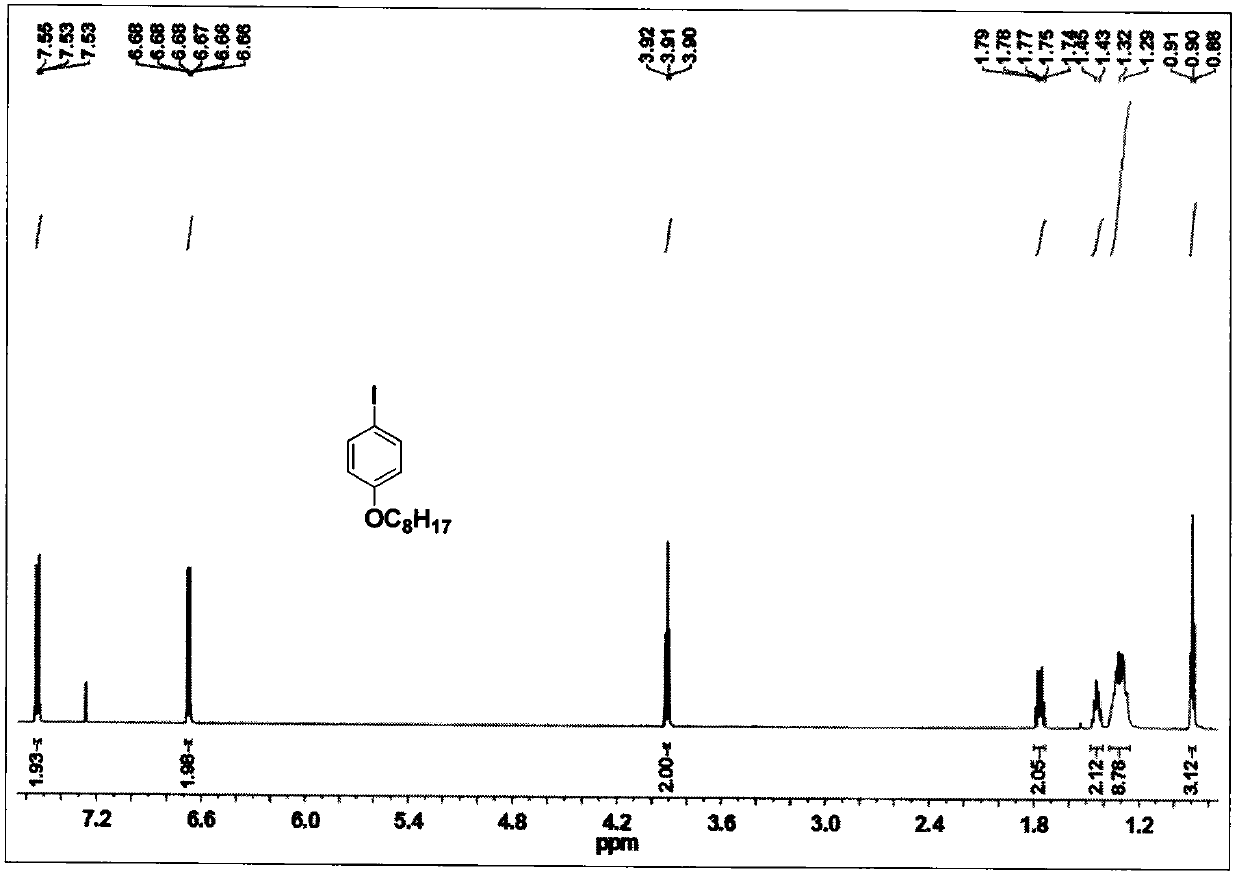
[0038] The mixture of 4-iodophenol (2.20g, 0.10mol), 1-bromooctane (19.00g, 0.10mol) and DMF (volume: 100ml) was in N 2 Joined under the protection of K 2 CO 3 (20.70 g, 150.00 mmol). The reactants were heated to 150°C for 48 hours and then cooled to room temperature. The reactant was extracted with chloroform, and purified by column chromatography (n-hexane) to obtain the product (10.00 g, 30%). 1 H NMR (400MHz, CDCl 3 ): δ7.54(m, 2H), 6.67(m, 2H), 3.91(t, 2H), 1.77(m, 2H), 1.44(m, 2H), 1.31(m, 8H), 0.90(t, 3H).
[0039] Preparation of 4-(n-octyloxybenzene)-N,N-diphenylaniline (2)
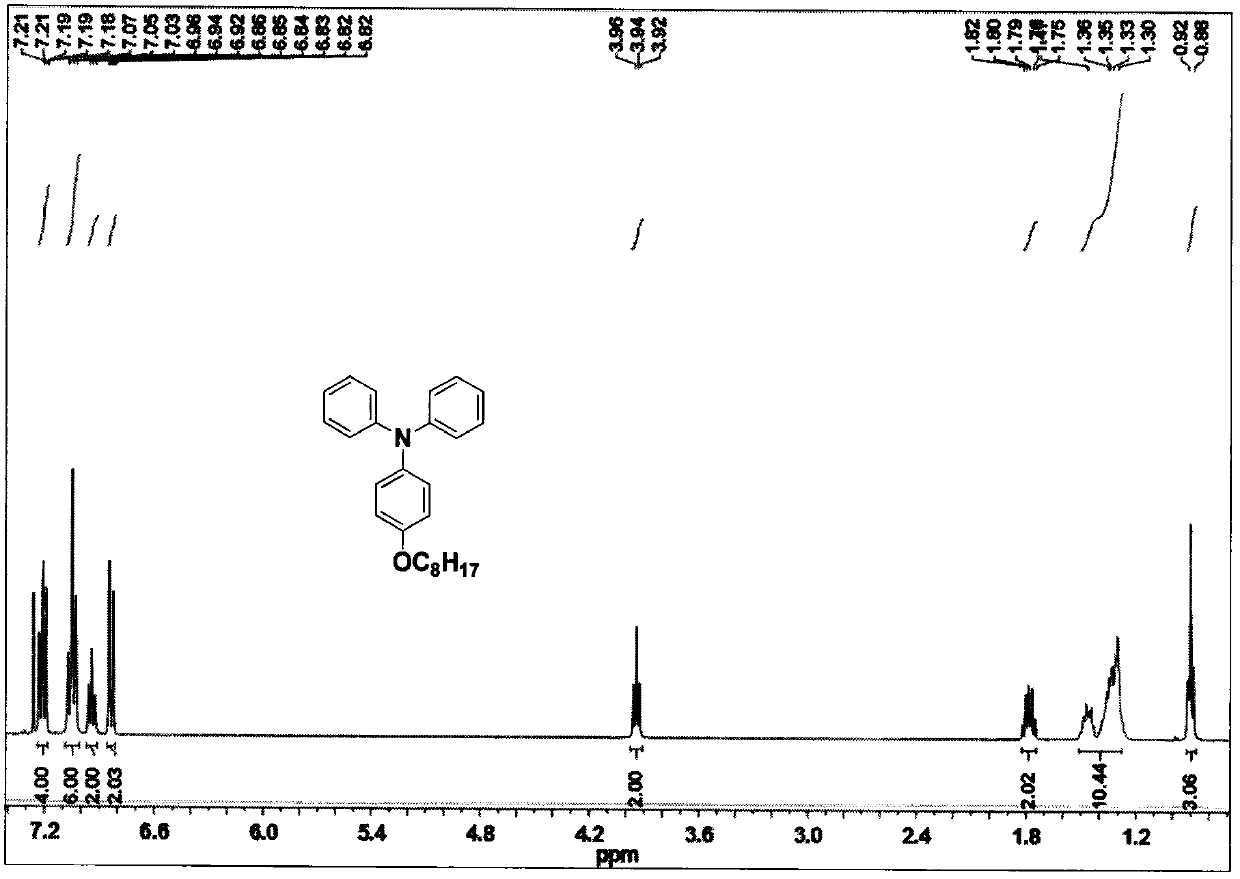
[0040] 1-iodo-4-n-octyloxybenzene (1) (9.90g, 30.00mmol), diphenylamine (6.00g, 36.00mmol), CuCl (0.20g, 2.00mmol), phenanthroline (0.26g, 1.40mmol ), KOH (13.40 g, 24.00 mmol) and toluene (volume: 60 ml) were reacted at 130° C. in the dark for 36 hours. After cooling to room temperatu...
PUM
 Login to View More
 Abstract
Description
Claims
Application Information
 Login to View More