Unlock instant, AI-driven research and patent intelligence for your innovation.

SAR target recognition method based on transfer learning and full connection layer output

A technology of transfer learning and target recognition, applied in neural learning methods, scene recognition, character and pattern recognition, etc., can solve problems such as unfavorable deep network training, large gap between initial value and optimal value, overfitting, etc. The effect of fewer labeled samples

Active Publication Date: 2019-11-15
THE 724TH RES INST OF CHINA SHIPBUILDING IND
View PDF3 Cites 7 Cited by
  • Summary
  • Abstract
  • Description
  • Claims
  • Application Information

AI Technical Summary

Problems solved by technology

[0003] The SAR image target recognition technology based on deep learning faces three problems: (1) Unlike the massive samples of natural scenes, SAR image ground vehicle targets are difficult to obtain samples and the sample size of the data set is small, which is not conducive to the training of deep networks
(2) Designing a new deep network structure and training it directly from scratch will often lead to slower network iterations due to the large gap between the initial value and the optimal value, and it is easy to fall into local extreme values, resulting in overfitting
This processing method will lose the extracted high-dimensional feature information due to the gradual compression of the training features in the fully connected layer, which will affect the generalization ability of the model.

Method used

the structure of the environmentally friendly knitted fabric provided by the present invention; figure 2 Flow chart of the yarn wrapping machine for environmentally friendly knitted fabrics and storage devices; image 3 Is the parameter map of the yarn covering machine
View more

Image

Smart Image Click on the blue labels to locate them in the text.
Viewing Examples
Smart Image
  • SAR target recognition method based on transfer learning and full connection layer output
  • SAR target recognition method based on transfer learning and full connection layer output
  • SAR target recognition method based on transfer learning and full connection layer output

Examples

Experimental program
Comparison scheme
Effect test

Embodiment Construction

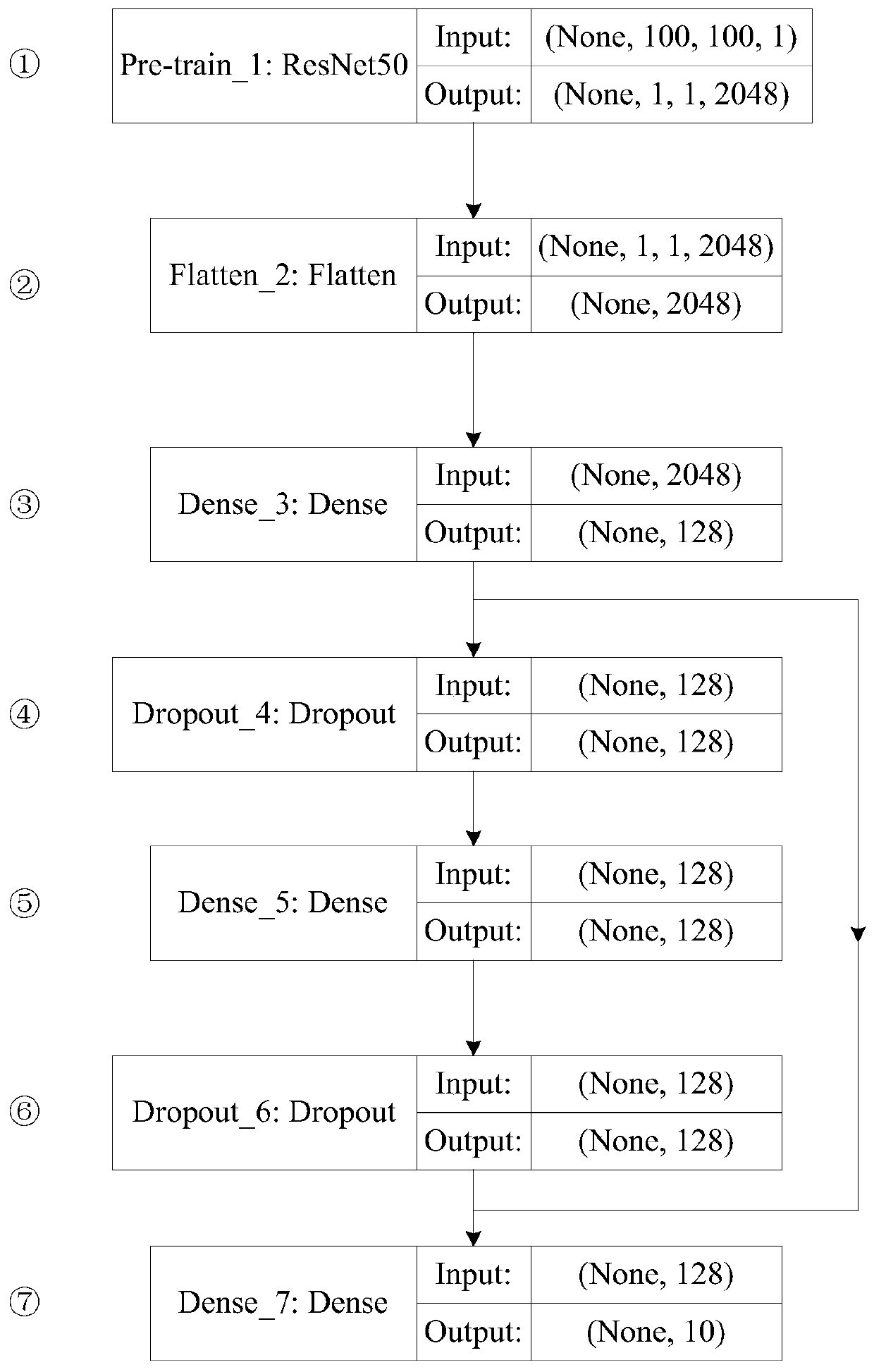
[0012] The SAR target recognition method based on transfer learning and fully connected layer output includes reading data, image cropping, image augmentation and expansion, model building, model migration training, and model testing. Six main steps are as follows:

[0013] Step 1: Read data.

[0014] The computer reads the SAR training and testing remote sensing images. For example read into the attached Figure 4 The moving and stationary target acquisition and recognition (MSTAR, Moving and Stationary Target Acquisition and Recognition) data shown contains a total of 10 types of vehicle targets with a spatial resolution of 0.3m×0.3m.

[0015] Step 2: Image cropping.

[0016] Taking the center of the image target as the center, all images are cropped to the same size, so that the original images of different sizes can be uniform in size while retaining the target information, which is convenient for subsequent network training.

[0017] Step 3: Image Augmentation and Expa...

the structure of the environmentally friendly knitted fabric provided by the present invention; figure 2 Flow chart of the yarn wrapping machine for environmentally friendly knitted fabrics and storage devices; image 3 Is the parameter map of the yarn covering machine
Login to View More

PUM

No PUM Login to View More

Abstract

The invention relates to an SAR image target recognition method based on transfer learning and full connection layer output. The SAR image target recognition method comprises the steps: reading SAR image data, carrying out the target interception, and enabling to-be-recognized target images to be consistent in size; carrying out four kinds of preprocessing on the intercepted image data, includingcutting, rotating, zooming and mirror image overturning transformation, so as to expand a data set; normalizing the numerical value of the expanded data set; designing a full-connection layer full-output deep learning model based on a ResNet50 network; importing ResNet50 network parameters trained by utilizing the optical image data set into a design model, freezing bottom-layer parameters of themodel, and training unfrozen parameters in the model by utilizing labeled training samples of the SAR image data set; and predicting the SAR image to be identified by using the trained model to obtainan identification result.

Description

technical field [0001] The invention relates to SAR remote sensing image processing technology, in particular to the field of SAR remote sensing image ground vehicle target recognition technology. Background technique [0002] Automatic target recognition (ATR) of SAR remote sensing images, especially the recognition of ground tactical vehicle targets, has high military application value. The classic target recognition method needs to manually design image features and classifiers, and its performance is limited. It is gradually replaced by the SAR target recognition method based on deep learning. Deep learning designs a neural network that includes multiple convolutional, pooling, and fully connected layers. Under the premise of training with a large amount of data, it automatically extracts target features and completes classification tasks at the same time. The more layers of the network, the stronger the ability to describe the target features. Therefore, it is necessa...

Claims

the structure of the environmentally friendly knitted fabric provided by the present invention; figure 2 Flow chart of the yarn wrapping machine for environmentally friendly knitted fabrics and storage devices; image 3 Is the parameter map of the yarn covering machine
Login to View More

Application Information

Patent Timeline
no application Login to View More
Patent Type & Authority Applications(China)
IPC IPC(8): G06K9/00G06K9/62G06N3/04G06N3/08
CPCG06N3/08G06V20/13G06N3/045G06F18/241
Inventor 安振宇孟凡君曹德建鲍鹏飞刘硕
Owner THE 724TH RES INST OF CHINA SHIPBUILDING IND