
Magnetic resonance molecular probe for detecting early hepatocellular carcinoma
A molecular probe and hepatocellular carcinoma technology, applied in preparations for in vivo experiments, pharmaceutical formulations, etc., can solve problems such as unclear display of MR imaging lesions, immunogenicity, human toxicity, high price and immunogenicity, etc. Achieve the effect of increasing contrast agent uptake, low toxicity, and good biocompatibility
- Summary
- Abstract
- Description
- Claims
- Application Information
AI Technical Summary
Problems solved by technology
Method used
Image

Examples
Embodiment Construction
[0034] 1.1 Materials and Instruments
[0035] 1.1.1 Main reagents:
[0036] Polypeptide (L5): Arg-Leu-Asn-Val-Gly-Gly-Thr-Tyr-Phe-Leu-Thr-Thr-Arg-Gln (SEQ ID NO: 1).
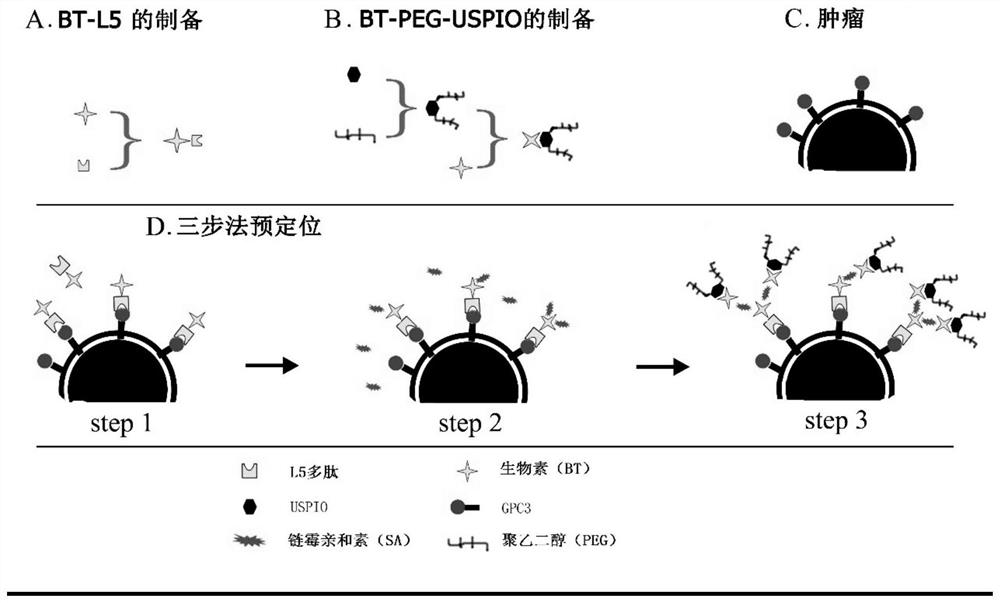
[0037] Artificially synthesized biotin-modified polypeptide (BT-L5), synthesized by Boxin (Xiamen) Biotechnology Co., Ltd. (such as figure 1 shown in A).
[0038] Polyethylene glycol-ultrasmall superparamagnetic iron oxide (PEG-USPIO), purchased from Wandegao (Beijing) Technology Development Co., Ltd. (such as figure 1 shown in B).
[0039] Streptavidin (SA) was purchased from Sigma (USA).
[0040] 0.1M MES buffer, EDC, sulfo-NHS, MTT were purchased from Sigma (USA).
[0041] DMSO, 4% paraformaldehyde, 2-mercaptoethanol, ethanolamine, and agarose were purchased from Aladdin (Shanghai) Co., Ltd.
[0042] GPC3 primary antibody was purchased from Beijing Boaosen Biotechnology Co., Ltd.
[0043] The secondary antibody labeled with fluorescein isothiocyanate was purchased from Beijing Boaosen Biotechnology Co....
PUM
| Property | Measurement | Unit |
|---|---|---|
| particle size | aaaaa | aaaaa |
| particle size | aaaaa | aaaaa |
Abstract
Description
Claims
Application Information
 Login to View More