

Construction method and application of cd155 gene humanized non-human animal
A non-human animal and construction method technology, applied in the field of construction of CD155 genetically modified non-human animal models, can solve the problem that animal models cannot well reflect the real state of the human body.
- Summary
- Abstract
- Description
- Claims
- Application Information
AI Technical Summary
Problems solved by technology
Method used
Image


Examples
Embodiment 1
[0129] Example 1 CD155 Gene Humanized Mice
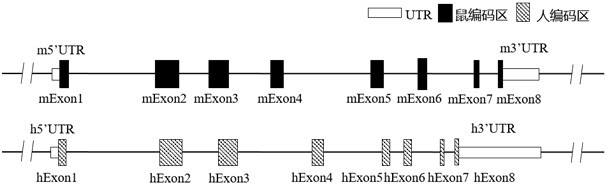
[0130]Mouse CD155 gene (NCBI Gene ID: 52118, Primary source: MGI: 107741, UniProt: Q8K094, located at positions 19637503 to 19655068 of chromosome 7 NC_000073.7, based on the transcript NM_027514.2 and its encoded protein NP_081790.1 ( SEQ ID NO: 1)) and human CD155 gene (NCBI Gene ID: 5817, Primarysource: HGNC: 9705, UniProt ID: A0A0C4DG49, located at positions 44643910 to 44666162 of chromosome 19 NC_000019.10, based on transcripts NM_006505.5 and The comparison diagram of its encoded protein NP_006496.4 (SEQ ID NO: 2)) is shown in figure 1 shown.
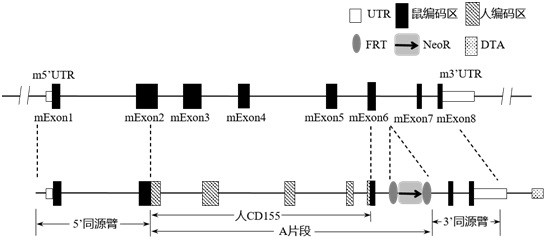
[0131] In order to achieve the purpose of the present invention, the nucleotide sequence encoding human CD155 protein can be introduced into the mouse endogenous CD155 gene locus, so that the mouse expresses human or humanized CD155 protein. Specifically, using gene editing technology, under the control of mouse CD155 gene regulatory elements, the partial sequence of exon 2 to exon 6...
Embodiment 2
[0162] Example 2 Preparation of double humanized or multiple double humanized mice
[0163] Double-humanized or multi-humanized mouse models can also be prepared by using the method or the prepared CD155 mice. For example, in the aforementioned Example 1, the embryonic stem cells used for blastocyst microinjection can be selected from mice containing other genetic modifications such as PD-1, PD-L1, TIGIT, and CD226, or they can also be derived from humanized CD155 On the basis of mice, use the isolation of mouse ES embryonic stem cells and gene recombination targeting technology to obtain CD155 and other genetically modified double-gene or multi-gene modified mouse models. The homozygous or heterozygous CD155 mice obtained by this method can also be mated with other genetically modified homozygous or heterozygous mice, and their offspring can be screened. According to the Mendelian law of inheritance, there is a certain probability of obtaining humanized CD155 Heterozygous mi...
PUM
 Login to View More
 Abstract
Description
Claims
Application Information
 Login to View More