Wound exudate responsive controlled released hydrogen sulfide probe and preparation method and application thereof
What is AI technical title?
AI technical title is built by Patsnap AI team. It summarizes the technical point description of the patent document.
A technology of exudate and hydrogen sulfide, applied in the field of medical materials, can solve problems such as toxic by-products, achieve rapid and efficient release, good repair effect, fast and efficient real-time self-monitoring effect
Active Publication Date: 2021-09-17
SOUTH CHINA UNIV OF TECH
View PDF0 Cites 2 Cited by
Summary
Abstract
Description
Claims
Application Information
AI Technical Summary
This helps you quickly interpret patents by identifying the three key elements:
Problems solved by technology
Method used
Benefits of technology
Problems solved by technology
However, it is difficult for existing materials to realize real-time self-monitoring of hydrogen sulfide release, and the release process may produce toxic by-products
Method used
the structure of the environmentally friendly knitted fabric provided by the present invention; figure 2 Flow chart of the yarn wrapping machine for environmentally friendly knitted fabrics and storage devices; image 3 Is the parameter map of the yarn covering machine
View more
Image
Smart Image Click on the blue labels to locate them in the text.
Viewing Examples
Smart Image
Click on the blue label to locate the original text in one second.
Reading with bidirectional positioning of images and text.
Smart Image
Examples
Experimental program
Comparison scheme
Effect test
preparation example Construction
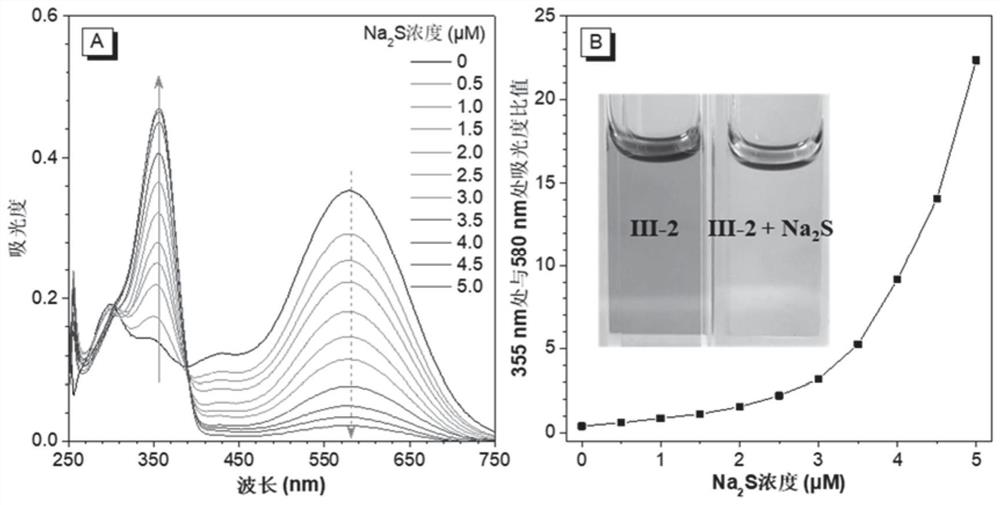
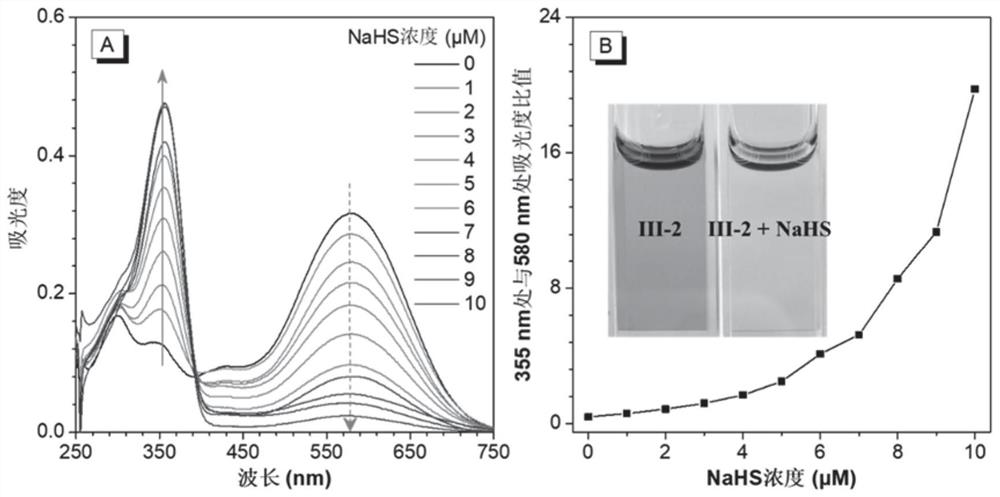
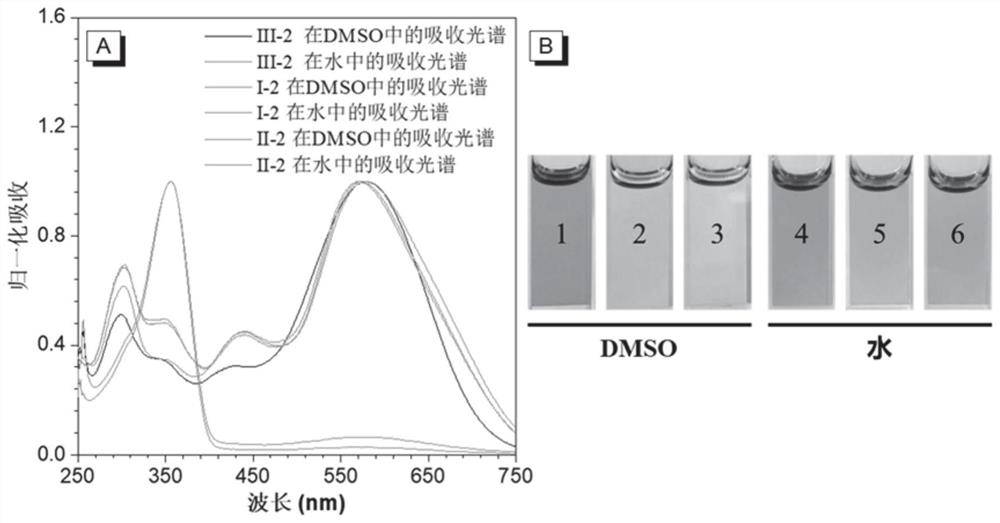
[0048] Preparation of Precursor Compound III-2:
[0049] 5-(4-(Diphenylamine)phenyl)thiophene-2-carbaldehyde (354 mg, 1.0 mmol), 2-(3-cyano-4,5,5-trimethylfuran-2(5H)-ylidene Methyl)malononitrile (301mg, 1.5mmol) was placed in a mixed solvent of ethanol / tetrahydrofuran (6:4 by volume), and stirred under reflux for 5h under a nitrogenatmosphere. After the reaction was completed, purification was carried out by silica gelcolumn chromatography to obtain III-2 with a yield of ~59%. 1 H NMR (CDCl 3 , 400MHz): δ7.81(d, J=16.0Hz, 1H), 8.20(dt, J 1 =8.8Hz,J 2 = 4.4Hz,J 3 =2.4Hz, 2H), 7.44(d, J=4.4Hz, 1H), 7.34(d, J=1.6Hz, 1H), 7.33-7.28(m, 4H), 7.19-7.09(m, 6H), 7.06 (d, J=8.8Hz, 2H), 6.62(d, J=15.6Hz, 1H), 1.76(s, 6H); 13 C NMR (CDCl 3 ,101MHz):δ175.65,173.06,153.94,149.56,146.67,139.61,137.89,137.47,129.57,127.19,125.48,124.26,124.06,121.89,112.08,112.00,111.30,110.87,104.97,97.05,96.71,77.33, 77.22, 77.01, 76.69, 29.70, 26.54. ESI-HRMS: m / z [M+H + ] Theory C 34 h 25 N ...
Embodiment 1
[0052] Preparation of probe I-2:
[0053] Weigh 10mg of precursor compound III-2, dissolve it with DMSO and configure it into a 10.5mmol / L solution; weigh 5mgNa 2 S, dissolved in ultrapure water and made into a 100mmol / L solution; take 950μL of the 10.5mmol / L solution of III-2, add 50μL Na 2 100mmol / L solution of S and mix well to obtain probe I-2.
[0054] The structure of I-2 is:
[0055]
Embodiment 2
[0057] Preparation of probe II-2:
[0058] Weigh 10mg of precursor compound III-2, dissolve it in DMSO and make it into a 10.5mmol / L solution; weigh 5mg of NaHS, dissolve it in ultrapure water and make it into a 200mmol / L solution; take III-2’s 10.5mmol / L Solution 950μL, add 50μL NaHS 200mmol / L solution and mix well to obtain probe II-2.
[0059] The structure of II-2 is:
[0060]
the structure of the environmentally friendly knitted fabric provided by the present invention; figure 2 Flow chart of the yarn wrapping machine for environmentally friendly knitted fabrics and storage devices; image 3 Is the parameter map of the yarn covering machine
Login to View More
PUM
Login to View More
Abstract
The invention belongs to the technical field of medical materials, and discloses a wound exudate responsive controlled released hydrogensulfide probe and a preparation method and application thereof. The wound exudate responsive controlled released hydrogensulfide probe is more than one of a formula I or a formula II; R in the formula I and R in the formula II are respectively phenylene, thienyl, furylidene, pyrrolidene and phosphoropentadiene without two hydrogen atoms; R1 and R2 are independent hydrogen, C1-6 alkyl groups, C1-6 alkyloxy groups and C1-6 alkyl sulfenyl groups. The method comprises the following steps: 1) dissolving a precursor compound in an organic solvent to obtain a precursor compound solution; preparing a compound containing S < 2-> or HS <-> into a solution to obtain a sulfur-containing solution; and 2) mixing the precursor compound solution with a sulfur-containing solution to obtain the probe. The probe provided by the invention can realize quick and efficient release of hydrogen sulfide in response to wound exudate or water and real-time self-monitoring; the wound repair can be promoted, and the repair effect is good.
Description
technical field [0001] The invention belongs to the technical field of medical materials, and in particular relates to a wound exudate-responsive controlled-release hydrogen sulfide probe, a preparation method and application thereof. Background technique [0002] The skin is in direct contact with the external environment. It is the largest organ of the human body, and also the largest and most active immune organ. It is the first defense barrier of the human body. The skin protects the various tissues within from pathogens, mechanical damage, and temperature extremes. In addition, the skin plays a vital role in thermoregulation, sensory perception, vitamin D synthesis, and protection from external insults, including UV rays, trauma, and microorganisms. As the outermost layer of the human body, skin is highly susceptible to various types of injuries such as trauma, cuts, burns, chemical injuries, ulcers and cancer, which have a major impact on patients and healthcare econo...
Claims
the structure of the environmentally friendly knitted fabric provided by the present invention; figure 2 Flow chart of the yarn wrapping machine for environmentally friendly knitted fabrics and storage devices; image 3 Is the parameter map of the yarn covering machine
Login to View More
Application Information
Patent Timeline
Application Date:The date an application was filed.
Publication Date:The date a patent or application was officially published.
First Publication Date:The earliest publication date of a patent with the same application number.
Issue Date:Publication date of the patent grant document.
PCT Entry Date:The Entry date of PCT National Phase.
Estimated Expiry Date:The statutory expiry date of a patent right according to the Patent Law, and it is the longest term of protection that the patent right can achieve without the termination of the patent right due to other reasons(Term extension factor has been taken into account ).
Invalid Date:Actual expiry date is based on effective date or publication date of legal transaction data of invalid patent.


 Login to View More
  Login to View More