Carrier rocket orbit parameter reconstruction method based on iterative guidance

A technology of launch vehicles and orbital parameters, which is applied to launchers, self-propelled missiles, offensive equipment, etc., can solve the problems of lack of fault detection and isolation, flight reconfiguration, and insufficient adaptability, and achieves simple method design, clear principle, The effect of reducing economic losses

CN113899257AActive Publication Date: 2022-01-07SHANGHAI AEROSPACE SYST ENG INST
10 Cites 0 Cited by

Patent Information

Authority / Receiving Office
CN · China
Current Assignee / Owner
Publication Date
2022-01-07

Smart Images

  • Figure 1
    Figure 1
  • Figure 2
    Figure 2
  • Figure 3
    Figure 3
Patent Text Reader

Abstract

The invention relates to a carrier rocket orbit parameter reconstruction method based on iterative guidance, and belongs to the field of carrier rocket guidance control. The method comprises the following steps of 1, collecting carrier rocket state information; 2, calculating the consumption of a propellant entering a target orbit according to the state information, if the consumption of the propellant is less than the available amount, normally flying to an original target orbit, and if the consumption of the propellant is greater than the available amount, performing orbit parameter reconstruction; 3, searching parameters of a reconstructed orbit on line, and taking the reconstructed orbit obtained by searching as a new target orbit; and 4, controlling a carrier rocket to fly towards the new target orbit. The method is based on iterative guidance, the principle is simple, engineering implementation is convenient, whether the carrier rocket can enter the target orbit or not can be judged according to the state information, orbit parameters are searched for and reconstructed on line when necessary, the carrier rocket has the autonomous orbit reconstruction capacity, economic losses are avoided or reduced under the fault condition, and the launch task performance capacity is improved.
Need to check novelty before this filing date? Find Prior Art

Description

technical field

[0001] The invention relates to a method for reconfiguring orbital parameters of a launch vehicle based on iterative guidance, and belongs to the field of guidance and control of launch vehicles. Background technique

[0002] Traditional launch vehicles have insufficient adaptability in the event of non-fatal failures such as an abnormal drop in engine thrust during the ascent phase, and basically do not have the capabilities of fault detection and isolation, flight reconfiguration, etc. to save missions or reduce losses. In the case of non-fatal failures in the power system, how to quickly and accurately evaluate and judge the reachability of the predetermined target orbit according to the state information of the launch vehicle, and how to perform online orbit parameter reconstruction when the predetermined mission target orbit is unreachable Technical problems that need to be solved urgently in the field can avoid or reduce economic losses. Contents of t...

Examples

Embodiment Construction

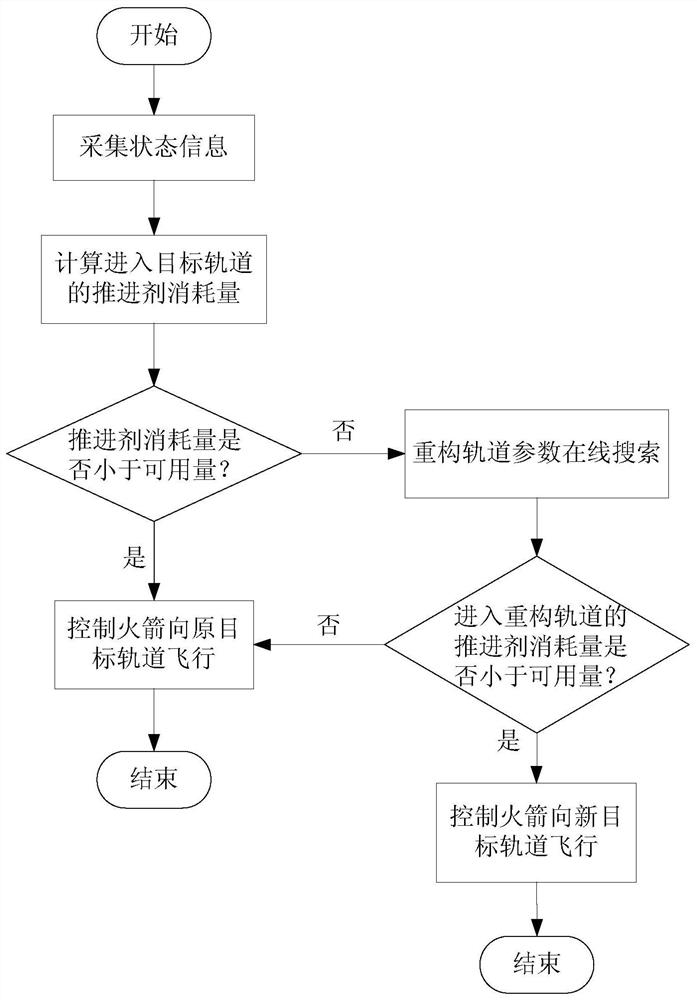
[0032] The present invention is based on the iterative guidance launch vehicle trajectory parameter reconstruction method, and its specific implementation process is as follows figure 1 shown, including the following steps:

[0033] Step 1: Collect the initial state information of the launch vehicle, the initial state information includes: initial velocity [V x0 ,V y0 ,V z0 ], initial position [x 0 ,y 0 ,z 0 ] and available propellant m 0 ;

[0034] Step 2: Calculate the propellant consumption m to enter the original target orbit according to the initial velocity and initial position described in step 1) 1 ;

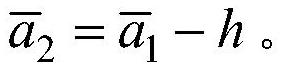
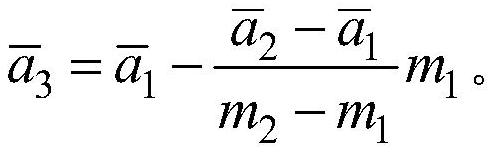
[0035] Step 3: Judging the propellant consumption m 1 Is it less than the usable amount of propellant m 0 ; if m 1 ≤m 0 , then go to step 6); if m 1 >m 0 , then go to step 4);

[0036] Step 4: Search online for the semi-major axis of the reconstructed orbit Make the launch vehicle enter the semi-major axis of The propellant consumption of the reconstru...