[0009]The object of the present invention is to provide an option of improving the handling of such a stripping plate and, in particular, of enabling trouble-free operation, in particular reliable height adjustment.
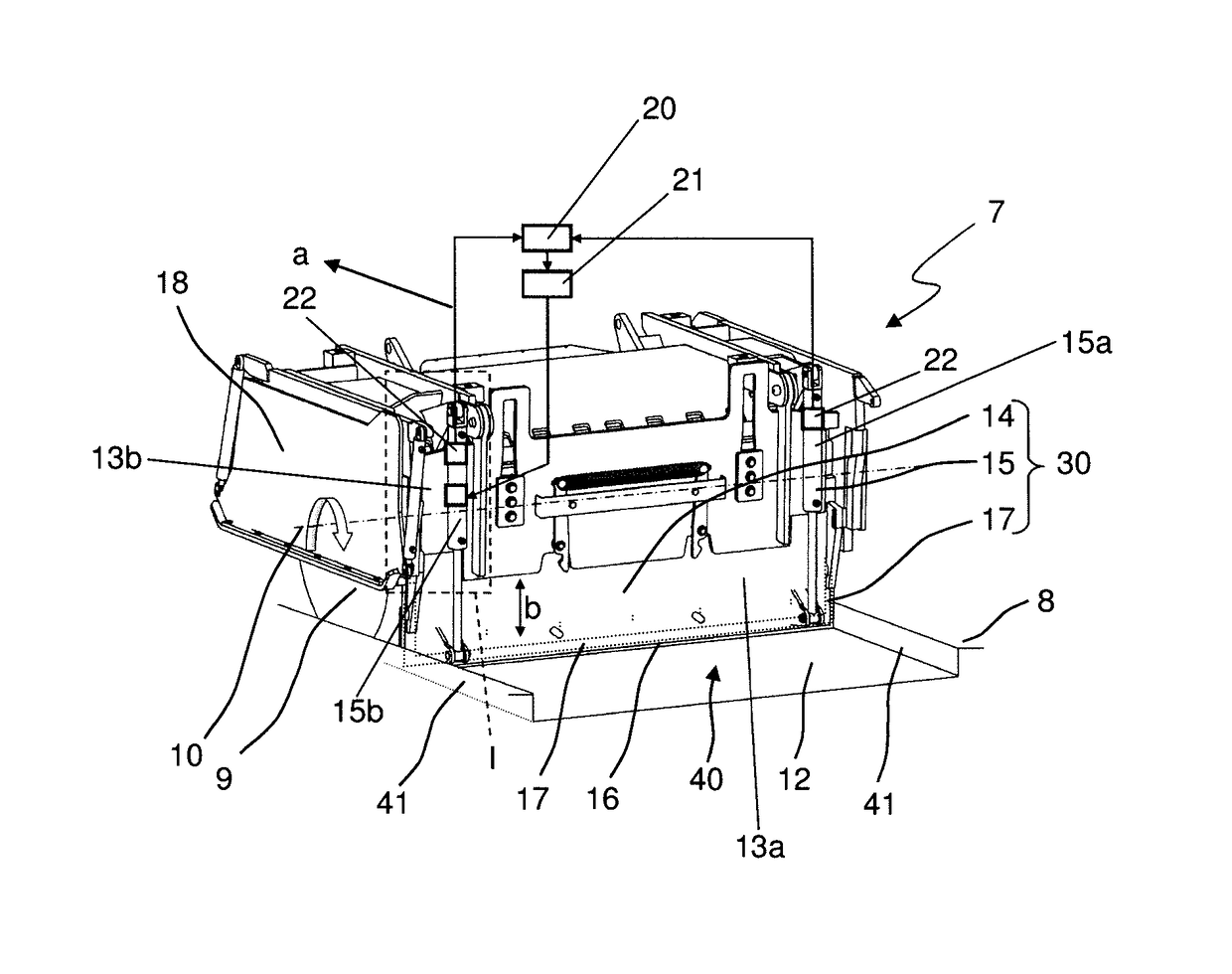
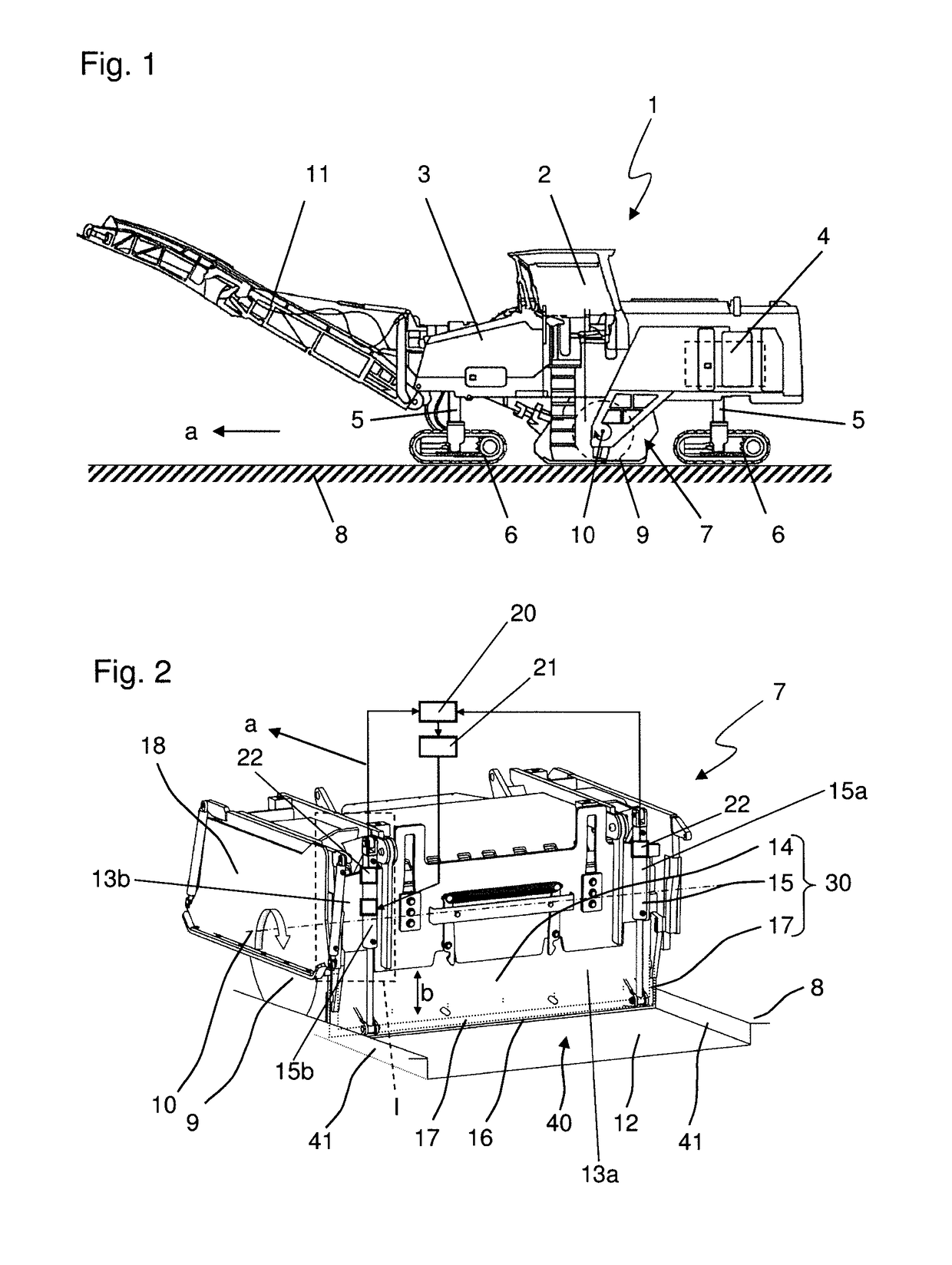
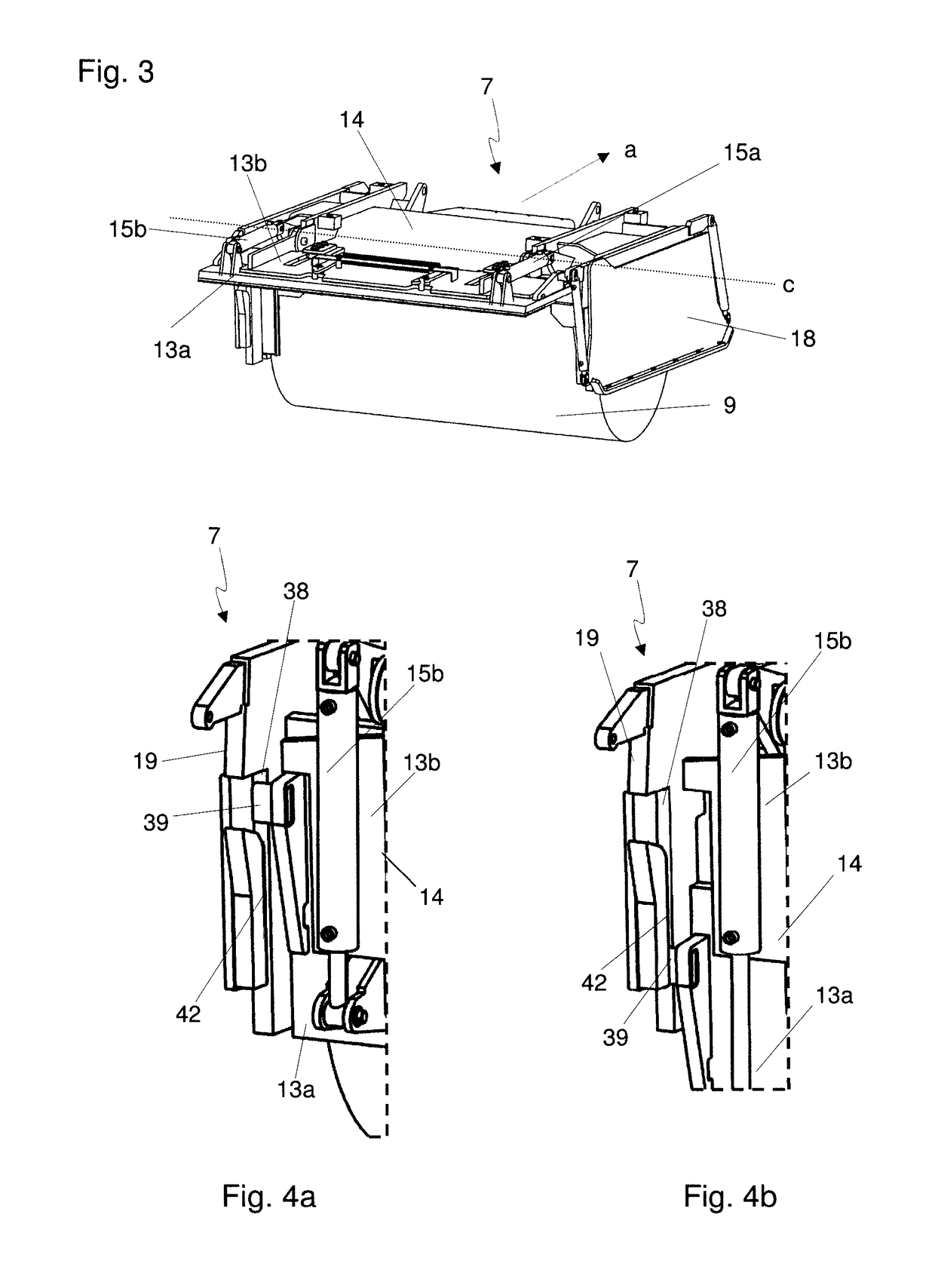
[0010]One aspect of the present invention is the fact that a monitoring device having at least one sensor is provided which is configured for monitoring the adjustment of the stripping plate. Specifically, the adjustment position and / or the adjustment speed are monitored. Thus, the monitoring device is basically configured in such a way that it detects the position and / or adjustment speed of the stripping plate by means of the at least one sensor. Adjustment of the stripping plate may include height adjustment of the stripping plate on the milling drum box, particularly the height adjustment of the bottom plate relative to the upper plate, and, additionally or alternatively, the pivot-up and pivot-down movement of the stripping plate relative to the remaining milling drum box, for example, in the case of maintenance work. The term monitoring device refers to the entirety used for detecting the adjustment position and / or the adjustment speed of the stripping plate. A further aspect of the present invention lies with a control device controlling the actuation movement of at least one of the actuators depending on the adjustment of the stripping plate determined by the monitoring device. Control of the adjustment movement is effected such that the stripping plate is adjusted in a most parallel manner, i.e., that ideally the at least two actuators are activated in such an inter-coordinated manner that, for example, a height adjustment of the stripping plate, and particularly of the bottom plate relative to the upper plate, is effected continuously on both sides without the stripping plate getting jammed, for example. If possible, also the pivot-up and pivot-down movement of the stripping plate is to be effected as continuously as possible in order to ensure reliable engagement of possible present locking elements, which lock the stripping plate in the pivot-down position on the milling drum box, on both sides in a safe manner. One aspect of the present invention thus lies with the interplay between the monitoring device and the control device, wherein the control device controls the adjustment process of the stripping plate depending on the sensor data determined by the monitoring device, in order to enable a continuous, synchronous and inter-coordinated operation of the at least two actuators of the stripping plate. Changes of friction values or comparable effects, which change or influence the adjustment movement caused by an actuator, are thus automatically considered when controlling the at least two actuators, so that a regular manual adjustment is no longer required.
[0012]In order to be able to monitor the adjustment process and particularly also the control process performed by the control device in an optimum manner, it is preferred that in each case one sensor is assigned to each of the at least two actuators. The monitoring device thus detects the movements of the two actuators at the same time. This arrangement enables a particularly synchronous operation of both actuators since the control device is capable of considering changes in the operating properties of both actuators and adapting them to one another.
[0014]For the use of hydraulic cylinders as actuators it is preferred that the control device controls a valve, particularly a proportional valve, connected upstream of at least the second actuator. In this way, a particularly robust solution may be obtained for how the control commands generated by the control device can actually be implemented at the second actuator. Such valves, particularly proportional valves, are already well established and are particularly characterized also by their high functional reliability. Furthermore, generic ground milling machines per se usually comprise one or multiple hydraulic systems so that such a configuration can be integrated in existing systems in a relatively simple manner.
[0017]In a refinement of the method according to the present invention, provision is further made for the monitoring device to monitor the adjustment of both actuators by means of suitable sensors. This way it is ensured that the control of the second actuator has the desired effect, i.e., continuous adjustment of both actuators.
[0019]Ideally, controlling by the control device comprises actuating a valve, particularly a proportional valve, connected upstream the second actuator. The actuators are hydraulic cylinders in this case. Control via valves, particularly proportional valves, enables a particularly reliable performance of the method according to the present invention.



 Login to View More
  Login to View More