Check patentability & draft patents in minutes with Patsnap Eureka AI!

Method for producing anodic composite material for lithium secondary battery, method for producing electrode using same, and method for charging and discharging electrode

a lithium secondary battery and composite material technology, applied in the direction of nickel compounds, cell components, sustainable manufacturing/processing, etc., can solve the problems of high cost, high basic capacity of materials, and the dramatic increase of the driving distance of electric cars, etc., to achieve superior charge and discharge properties, high capacity, and high basic capacity

Active Publication Date: 2018-07-10
KOREA INST OF IND TECH
View PDF12 Cites 0 Cited by
  • Summary
  • Abstract
  • Description
  • Claims
  • Application Information

AI Technical Summary

Problems solved by technology

However, as such materials have a low basic capacity or are not yet satisfactory in safety, safe materials with high energy density for commercialization of medium- and large-size batteries are sought.
Traditional LMO, NMC or olivine-based anode materials have an energy density of about 120 to 150 mAh / g, which is insufficient to dramatically increase the driving distance of an electric car.
However, due to low basic capacity, batteries of these traditional LMO, NMC and olivine-type LiFePO4 materials have limitations in improving the driving distance on a single charge of an electric car.
Traditional anode materials have a basic energy density of about 120 to 150 mAh / g, which is insufficient, and thus have limitations in commercialization of applications thereof that need a high energy density, such as electric cars.
Traditional anode materials have problems in terms of safety, cost and high energy density.
Specifically, nickel-based materials, such as LiNiO2 (LNO), having excellent capacity, are not practical in safety; manganese LMO materials are not practical in capacity and durability; NMC materials have problems in safety and cost; and iron phosphate materials have problems in energy density and cost.
In particular, manganese materials are excellent in safety but have a low capacity and are not sufficiently identified in terms of durability, and thus research and development of manganese materials are vigorously being conducted.
Also, although studies on a nanotechnology for iron phosphate materials to obtain high-capacity electrode performance are being carried out, the nanotechnology for the materials involves an additional cost increase.
Thus, batteries of these traditional materials are charged and discharged in a range of about 2.0 to 4.2 V to secure safety in view of properties of the materials and thus basically have limitations in discharge capacity.

Method used

the structure of the environmentally friendly knitted fabric provided by the present invention; figure 2 Flow chart of the yarn wrapping machine for environmentally friendly knitted fabrics and storage devices; image 3 Is the parameter map of the yarn covering machine
View more

Image

Smart Image Click on the blue labels to locate them in the text.
Viewing Examples
Smart Image
  • Method for producing anodic composite material for lithium secondary battery, method for producing electrode using same, and method for charging and discharging electrode
  • Method for producing anodic composite material for lithium secondary battery, method for producing electrode using same, and method for charging and discharging electrode
  • Method for producing anodic composite material for lithium secondary battery, method for producing electrode using same, and method for charging and discharging electrode

Examples

Experimental program
Comparison scheme
Effect test

example 1

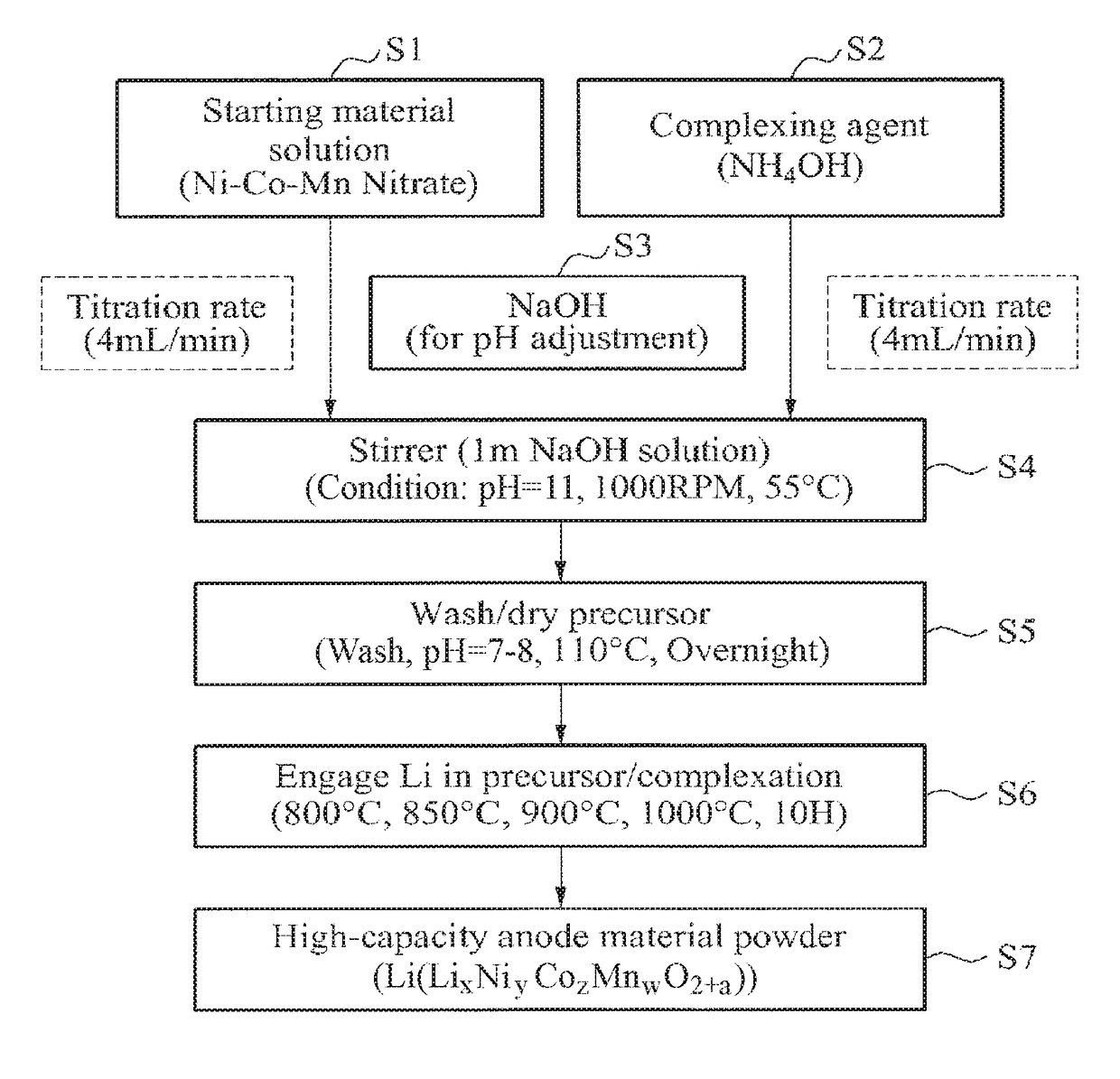
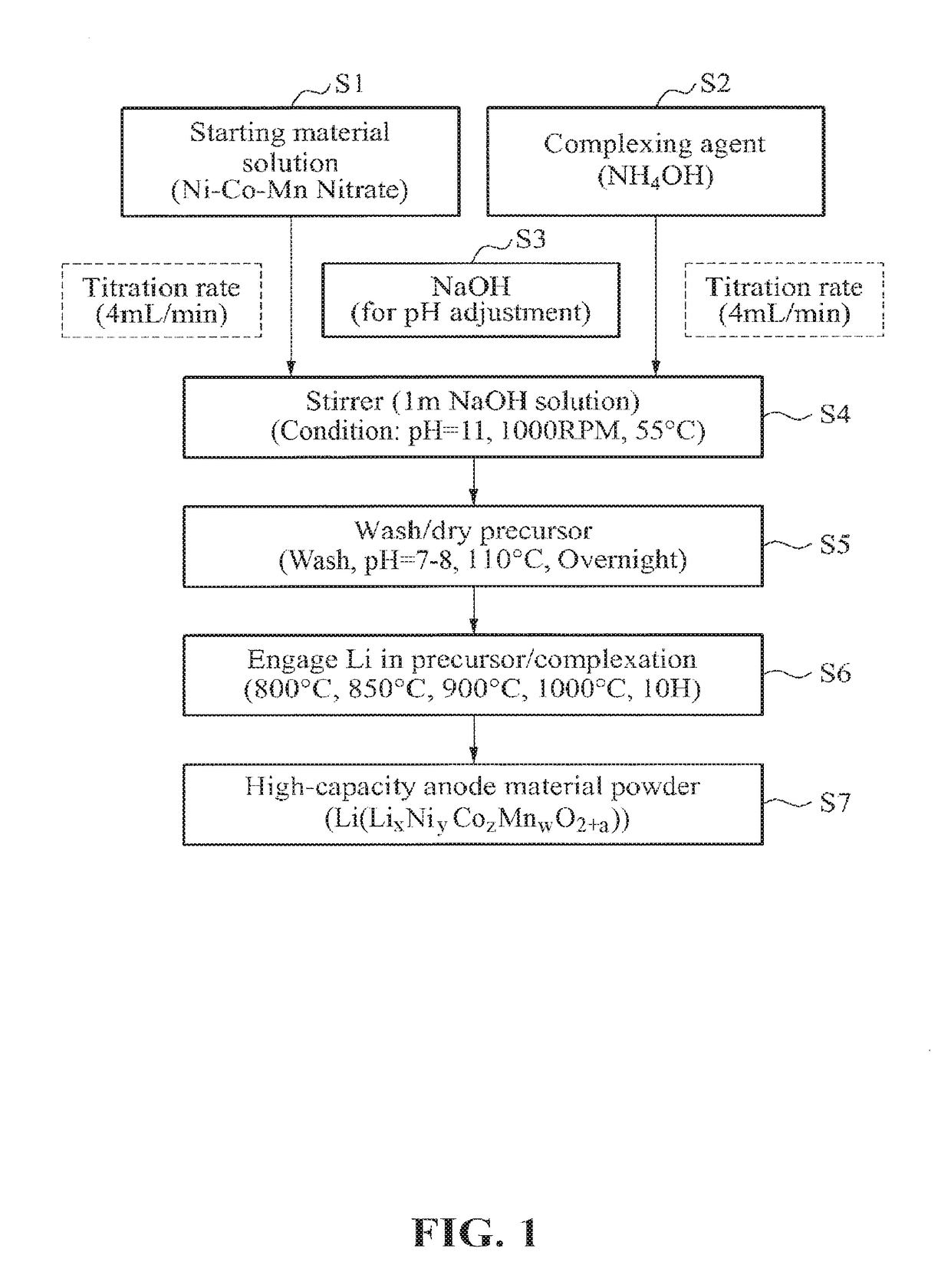
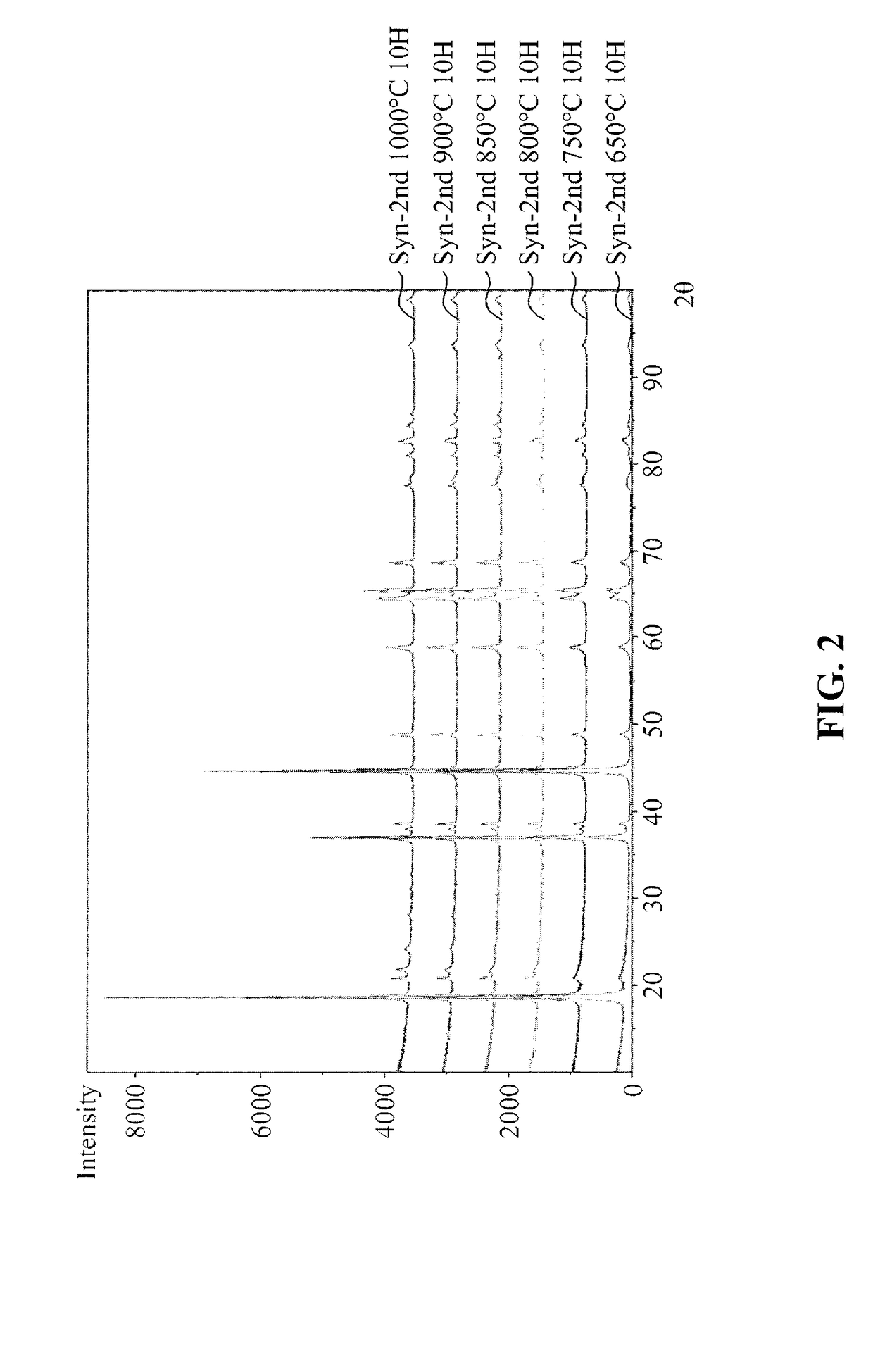
[0050]An electrode and a cell were manufactured using an Li2MnO3-based anode composite material Li(LixNiyCozMnwO2+α) powdery substance prepared by subjecting anode composite material powder synthesized by coprecipitation according to embodiments of the present disclosure to heat treatment at a sintering temperature of 800° C.

[0051]An Li2MnO3-based anode composite material as an anode active material, a conductive agent, and a binder were prepared at a ratio of 80:10:10 wt % and mixed under conditions (2000 rpm and 30 minutes), thereby preparing slurry. The prepared slurry was formed into a film on Al foil with a thickness of 20 μm by a casting process, in which the slurry was uniformly applied with a constant force in a fixed direction. The electrode with the slurry applied was immediately dried thoroughly (overnight) in a general dryer at 110° C. The thoroughly dried electrode was adjusted to have a thickness of about 100 to 110 μm and subjected to pressing using a press (roll pres...

example 2

[0052]An electrode and a cell were manufactured under the same conditions as in Example 1 except for heat treatment conditions of the anode composite material in Example 1 (heat treatment was performed at 850° C. in Example 2).

example 3

[0053]An electrode and a cell were manufactured under the same conditions as in Example 1 except for the heat treatment conditions of the anode composite material in Example 1 (heat treatment was performed at 900° C. in Example 3).

the structure of the environmentally friendly knitted fabric provided by the present invention; figure 2 Flow chart of the yarn wrapping machine for environmentally friendly knitted fabrics and storage devices; image 3 Is the parameter map of the yarn covering machine
Login to View More

PUM

PropertyMeasurementUnit
temperatureaaaaaaaaaa
Login to View More

Abstract

This disclosure synthesizes an anodic composite material Li(LixNiyCozMnwO2+α) of Li2MnO3 series whose theoretical capacity is a level of about 460 mAh / g, and to produce an electrode of a high capacity using the synthesized anodic composite material. Also provided is a method for charging and discharging the electrode. Here, the method for producing an anodic composite material for a lithium secondary battery includes the steps of: mixing a nickel nitrate solution, a manganese nitrate solution, and a cobalt nitrate solution to produce a starting material solution; and mixing the starting material solution with a complexing agent so as to produce an anodic composite material Li(LixNiyCozMnwO2+α) of Li2MnO3 series by means of coprecipitation.

Description

CROSS-REFERENCE TO RELATED APPLICATIONS[0001]This application is a national phase entry under 35 U.S.C. § 371 of International Patent Application PCT / KR2013 / 007462, filed Aug. 20, 2013, designating the United States of America and published as International Patent Publication WO 2014 / 126312 A1 on Aug. 21, 2014, which claims the benefit under Article 8 of the Patent Cooperation Treaty and under 35 U.S.C. § 119(e) to Korean Patent Application Serial No. 10-2013-0015090, filed Feb. 13, 2013, the disclosure of each of which is hereby incorporated herein in its entirety by this reference.TECHNICAL FIELD[0002]Exemplary embodiments relate to a high-capacity anode composite material for an Li2MnO3-based lithium secondary battery, which enables high-energy density by high capacity, a method of manufacturing an electrode using the anode composite material, and a method of charging and discharging the manufactured electrode.BACKGROUND[0003]A lithium secondary battery is expected to be applied ...

Claims

the structure of the environmentally friendly knitted fabric provided by the present invention; figure 2 Flow chart of the yarn wrapping machine for environmentally friendly knitted fabrics and storage devices; image 3 Is the parameter map of the yarn covering machine
Login to View More

Application Information

Patent Timeline
no application Login to View More
Patent Type & Authority Patents(United States)
IPC IPC(8): H02J7/00H01M4/485H01M10/44H01M4/38H01M10/052H01M4/131C01G53/00H01M4/04H01M10/04H01M4/505H01M4/525H01M4/1391H01M2/16H01M4/02H01M50/417
CPCH01M4/0471H01M4/0404H01M4/0435H01M4/131H01M4/1391H01M4/382H01M4/485H01M4/505H01M4/525H01M10/0427H01M10/052H01M10/44C01G53/50Y02T10/7011C01P2002/72C01P2006/40H01M2/1653H01M2004/027Y02E60/10Y02P70/50H01M50/417H01M4/139Y02T10/70
Inventor KIM, HO SUNGYANG, SUN WOOKIM, KYEONG WANJEONG, CHAE HWANKIM, TAE WONCHANG, DUCK RYEKIM, MIN YOUNG
Owner KOREA INST OF IND TECH
Features
  • R&D
  • Intellectual Property
  • Life Sciences
  • Materials
  • Tech Scout
Why Patsnap Eureka
  • Unparalleled Data Quality
  • Higher Quality Content
  • 60% Fewer Hallucinations
Social media
Patsnap Eureka Blog
Learn More