
Duty-ratio controller
a controller and duty-ratio technology, applied in the direction of energy industry, efficient power electronics conversion, electric variable regulation, etc., can solve the problems of complex additional network, prone to noise, and negative influence on the harmonic distortion of input current, and achieve the effect of low cost hardware and simple design
- Summary
- Abstract
- Description
- Claims
- Application Information
AI Technical Summary
Benefits of technology
Problems solved by technology
Method used
Image

Examples
Embodiment Construction
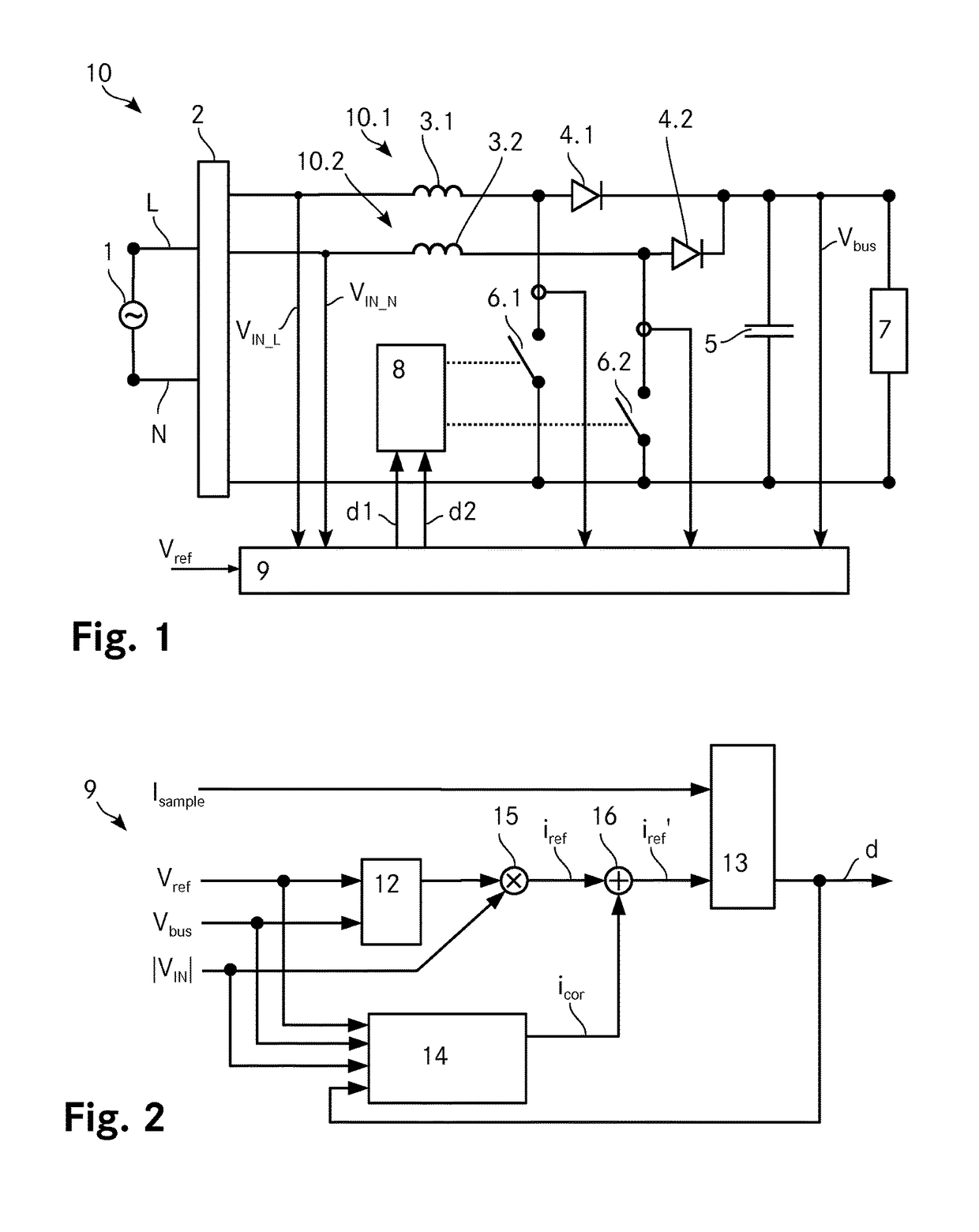
[0062]FIG. 1 shows a schematic depiction of a boost converter 10 according to the invention that includes two interleaved PFC converters. The boost converter 10 converts an AC input voltage to a DC output voltage. The two lines N (neutral line) and L (phase line) of the boost converter 10 are connected to an AC input source 1. At the input, the boost converter 10 includes an input stage 2, which includes a rectifier and for example an EMI (electromagnetic interference) filter. The rectifier is for example a bridge rectifier such as a full bridge diode rectifier or any other suitable rectifier that provides a DC voltage at the output of the input stage 2. The input stage 2 is followed by the two interleaved boost stages 10.1, 10.2 that are connected in parallel and the phases of which are shifted by about 180°.
[0063]Each boost stage 10.1, 10.2 includes a boost inductance 3.1, 3.2 connected to the input stage 2, followed by a boost diode 4.1, 4.2 where the anode of each boost diode 4....
PUM
 Login to View More
 Abstract
Description
Claims
Application Information
 Login to View More