

Anomaly detection for medical samples under multiple settings
a technology for medical samples and anomalies, applied in the field of anomaly detection for medical samples, can solve the problems of imposing limitations on accurately segmenting and classifying anomalies, limited by image acquisition and processing speed, and image quality degradation
- Summary
- Abstract
- Description
- Claims
- Application Information
AI Technical Summary
Benefits of technology
Problems solved by technology
Method used
Image

Examples
Embodiment Construction
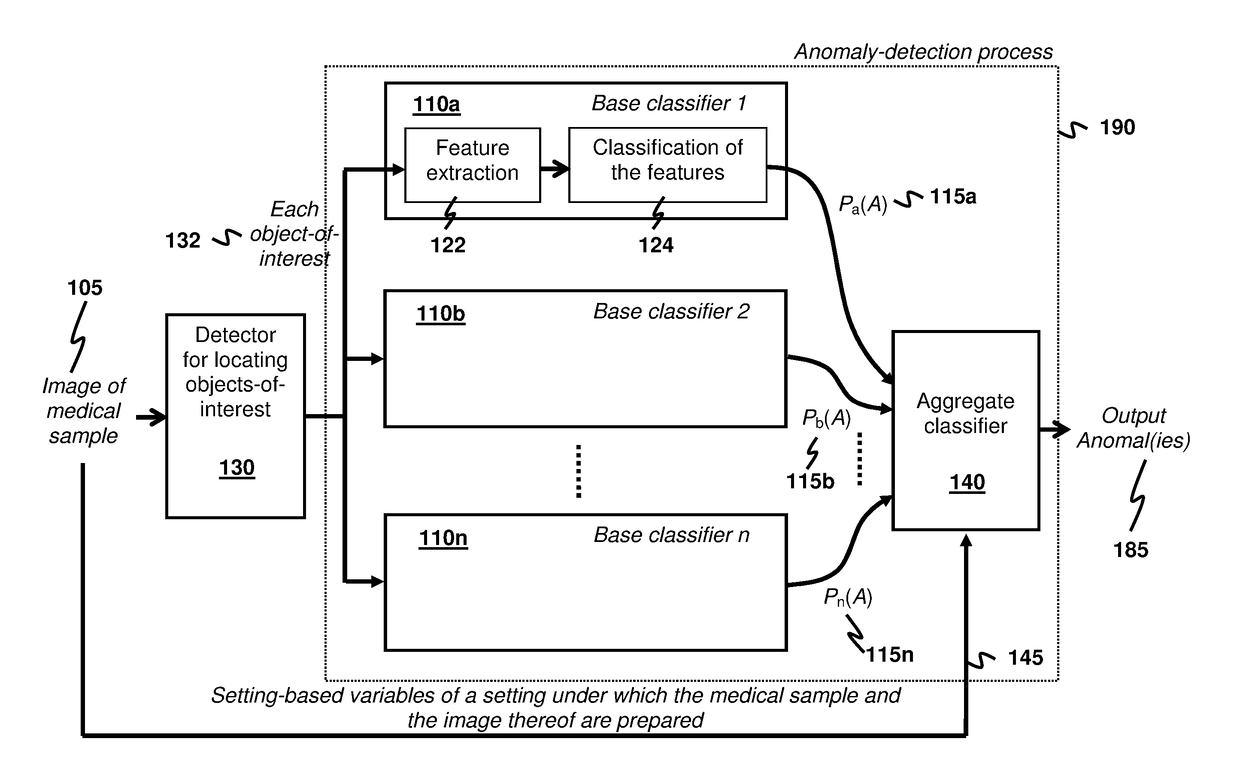
[0014]The present invention addresses the need for a technique that supports multiple imaging modes in detecting anomalies on a medical sample and makes use of resultant multiple detection results to enhance accuracy in detecting the anomalies. In addition, the present invention is particularly useful for WSI screening by improving detection accuracy while still allowing the use of low-magnification images in the detection. WSI screening means that an entire slide on which a medical sample resides is imaged to give an image and the image is analyzed for anomaly detection. Nonetheless, the application of the present invention is not limited only to WSI screening.
[0015]The Inventors have observed that different classifiers have different performances on medical samples prepared under different experimental conditions and imaged for analysis under different imaging conditions. Usually, one classifier has performance in anomaly detection better than another classifier for a medical samp...
PUM
| Property | Measurement | Unit |
|---|---|---|
| color image | aaaaa | aaaaa |
| color histograms | aaaaa | aaaaa |
| grayscale | aaaaa | aaaaa |
Abstract
Description
Claims
Application Information
 Login to View More