
Cerebrospinal fluid shunt for treatment of hydrocephalus
a cerebrospinal fluid and hydrocephalus technology, applied in the direction of wound drains, engine components, mechanical equipment, etc., can solve the problems of headache, unconsciousness, gait and balance disturbances and cognitive decline, drainage may be too low or too large,
- Summary
- Abstract
- Description
- Claims
- Application Information
AI Technical Summary
Benefits of technology
Problems solved by technology
Method used
Image

Examples
Embodiment Construction
[0053]In the following, various embodiments of the shunt will be described in further detail.
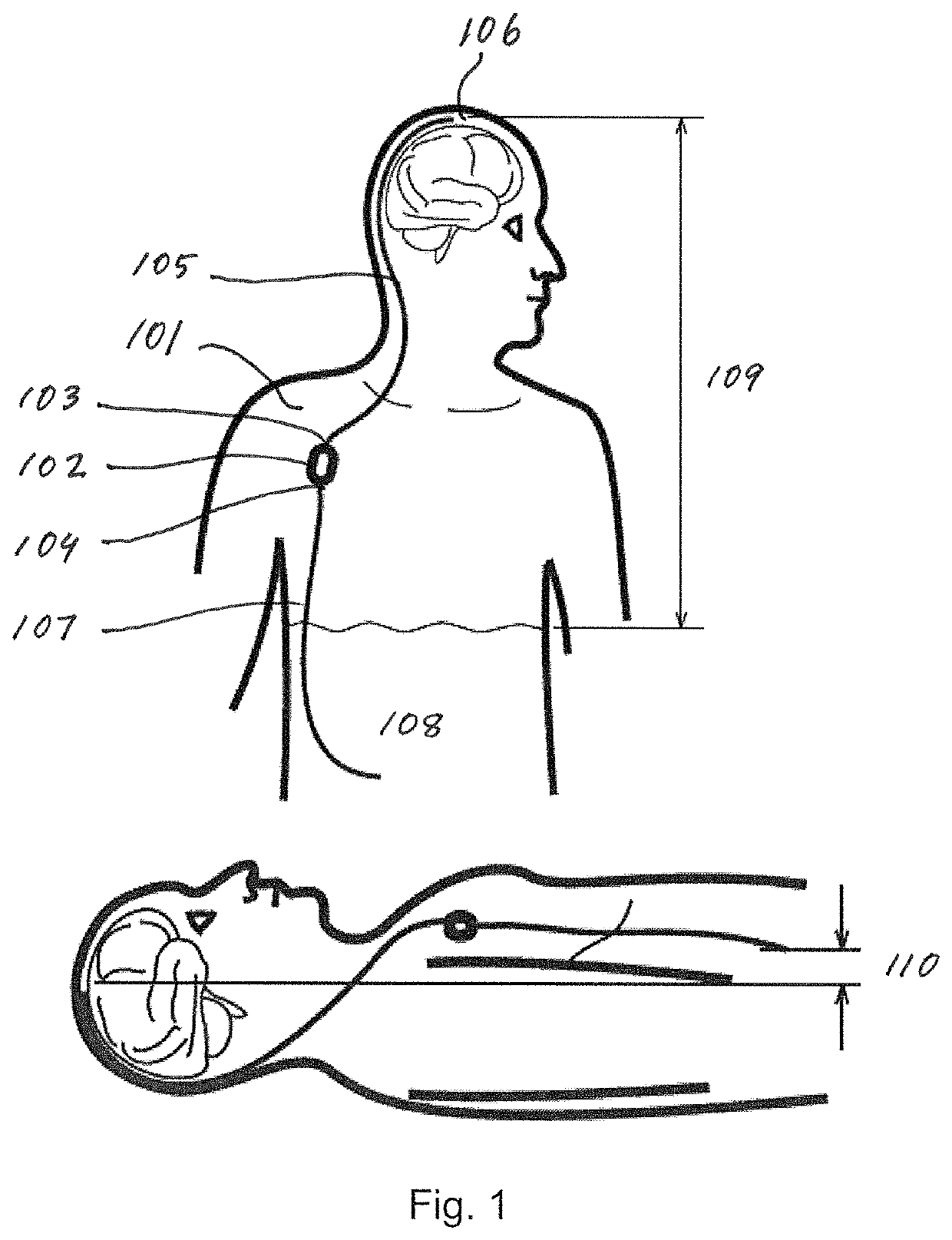
[0054]Existing hydrocephalus shunts 101 as shown in FIG. 1 comprise a valve 102 provided with two flow ports, one inlet 103 and one outlet 104. A ventricular catheter 105 is connected to the inlet and extends to a ventricular space 106 in the patient. A distal catheter 107 is connected to the outlet and extends to the abdomen 108 of the patient. The valve of the shunt system is configured to open at a predefined over pressure in order to drain CSF from the ventricular space to the abdomen for resorbtion. However, due to effects of gravity the pressure of the CSF at the level of the valve will be significantly affected by the body position of the patient. In FIG. 1, the hydrostatic pressure difference is illustrated for an upright position 109 and a lying position 110.
[0055]Given that the hydrostatic pressure difference between inlet and outlet in a traditional shunt system may be up to 50 cm...
PUM
 Login to View More
 Abstract
Description
Claims
Application Information
 Login to View More