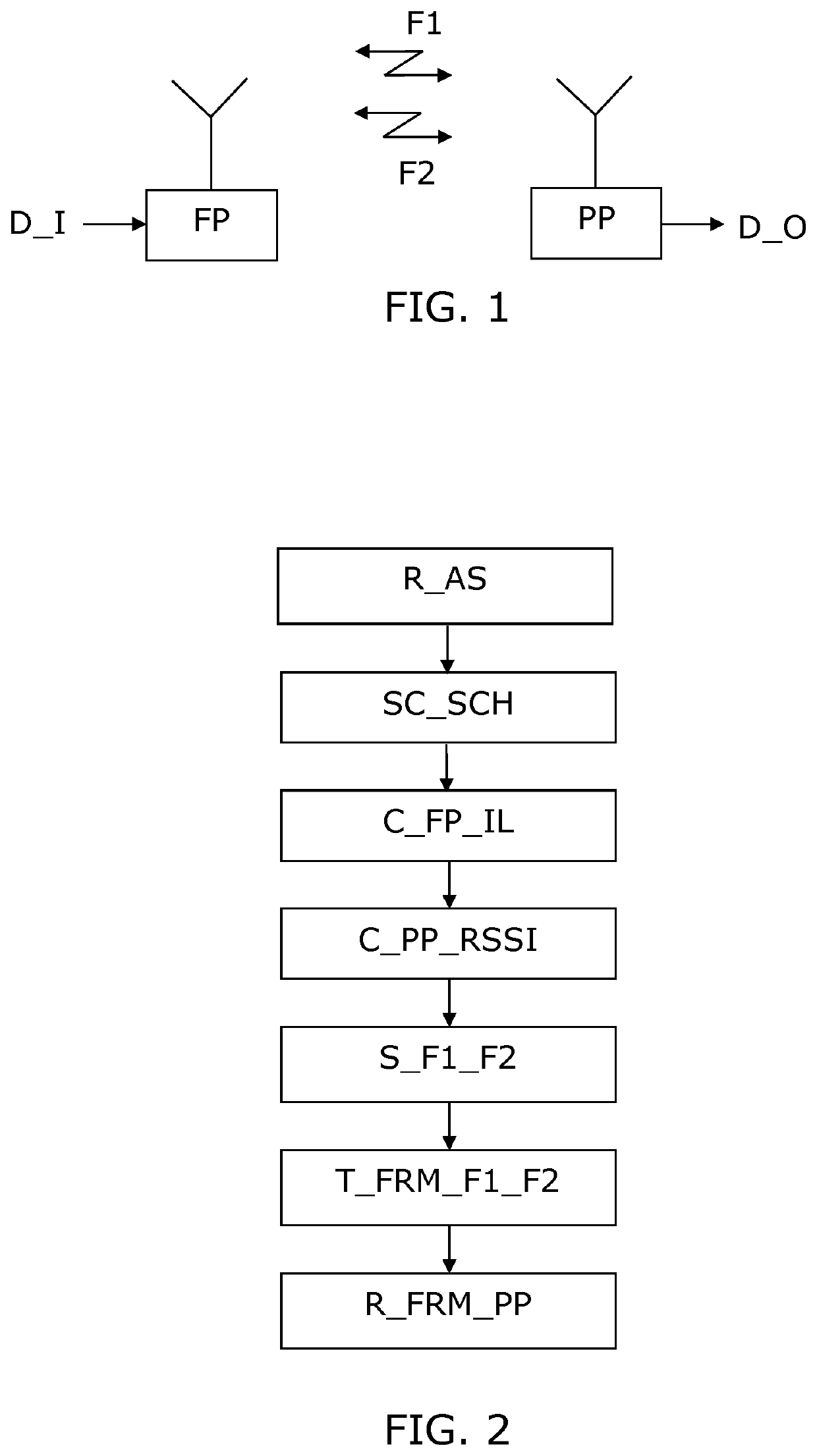
[0005]Thus, according to the above description, it is an object of the present invention to provide a wireless communication protocol for reliable wireless transmission of a digital signal in data packets, e.g. audio data, with a low latency. E.g. to allow wireless transmission of signals for gaming devices or other devices requiring a low latency.
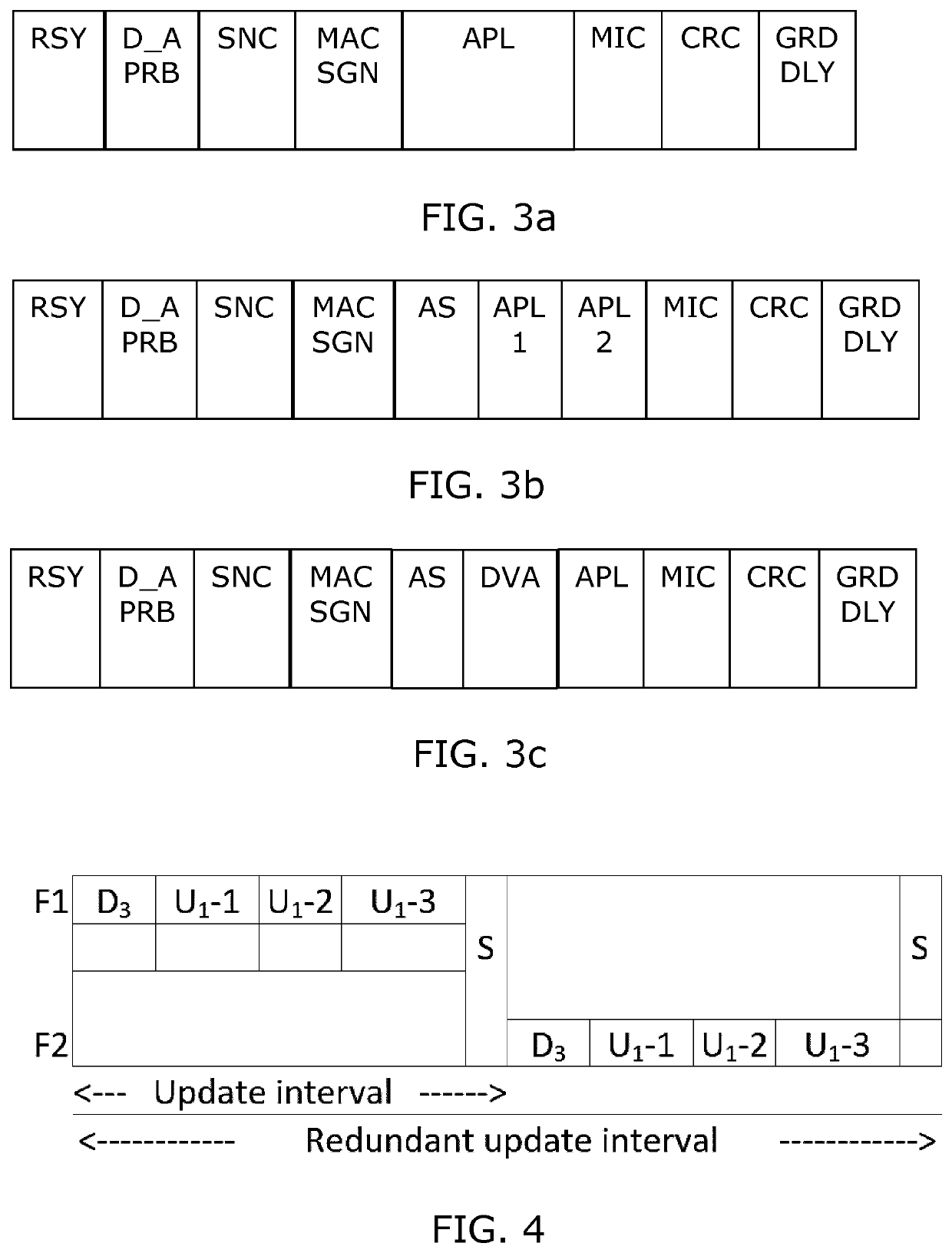
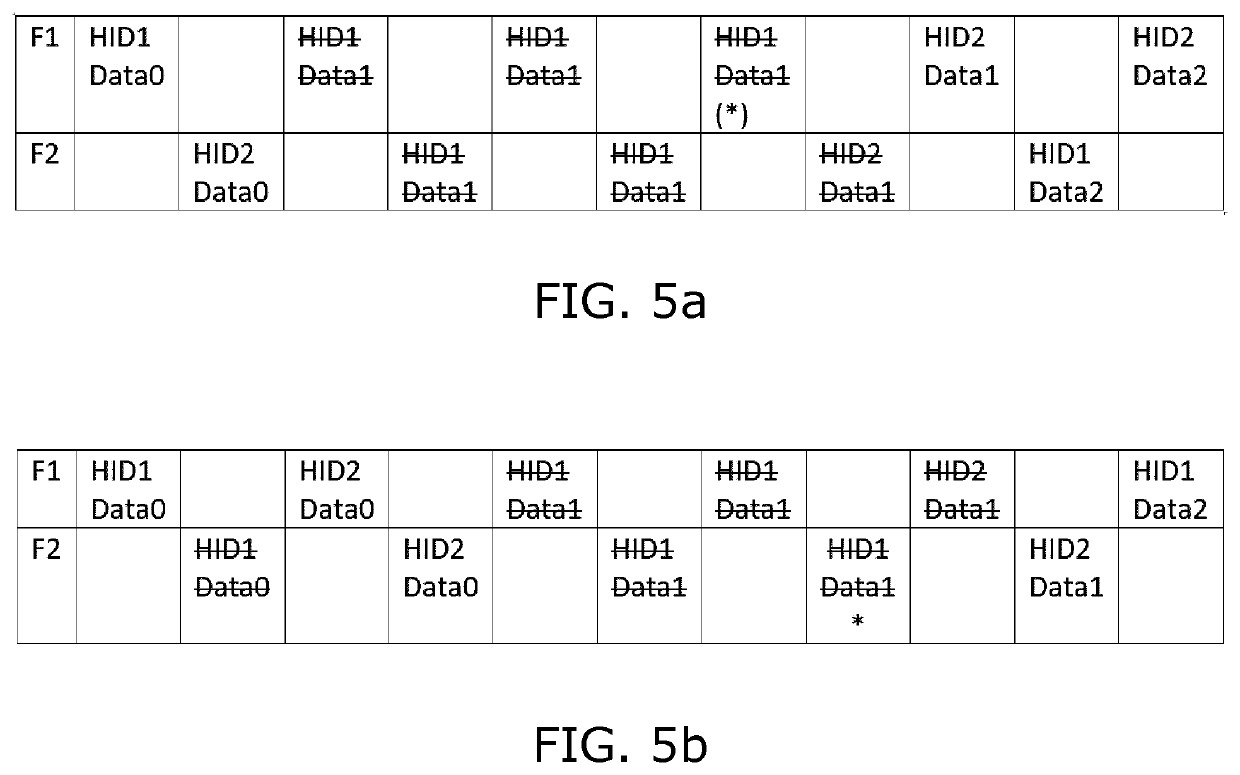
[0011]Such method is advantageous, since the method is based on transmitting redundant data on two RF bearers with different frequencies. The data packets can be such as Human Interface Device (HID) data and / or audio data. The two RF bearers are even selected based on measures of actual interference levels, thus it is possible to select two frequencies among e.g. 40 supported channels, with the minimal RF interference. The frequencies of the two duplex bearers are to be understood to be dynamically allocated and reallocated in order avoid or minimize interference and to cause minimum interference to other users of the same frequency band. Especially, it is preferred that each frame has at least one, preferably two time slots allocated for scanning. This minimizes the risk of packet losses during RF transmission, and it is possible to use RF bearer frequency bands known to have interfering RF sources, and still a reliable data packet transfer can be obtained with a low latency. Especially, frame length of such as 1 ms to 3 ms are possible.
[0012]Preferably, the method maintains two duplex RF bearers operating on the two selected channels. The application payload and the information in the control and signalling field are typically duplicated for transmission on both bearers for redundancy. This provides high reliability of data transfer in frequency bands with presences of interference from other RF devices. The other users may be systems of same technology or systems of other wireless technologies, e.g. based on WiFi or Bluetooth. The frequency selection procedure is preferably dynamically, i.e. continuously, performed, and thus the system will be adaptive and robust also to changes in RF interference. Also, an effect is that the transmission distance is longer than with traditional transmission methods.
[0025]A channel where data are retransmitted until acknowledged by the receiver is denoted a reliable channel. Sequence numbering prevents duplicated delivery of same data to the application.
[0045]To further increase communication range and transmission reliability, antenna diversity can be used, i.e. using two or more antennas on both FP and PP for transmitting and receiving, which adds space diversity additionally. In preferred embodiments, each time slot preferably has an antenna probe field, in which the transmitter emits power, either modulated or unmodulated. The receive performs RSSI measurement during this field on one or more of the supported receive antennas in sequential manor. In the antenna probe fields of following frames, RSSI measurements are performed on the other antennas. After N frames, RSSI measurements have been done on all supported receive antennas, and a decision can be made of which antenna that provides the strongest receive signal. This antenna will be used for reception of packet signalling and applications payload. When a packet has been received correctly on a selected antenna, the same antenna will be used for transmission in the following frames. A change of antenna for transmission may be delayed (synchronized) such that it does not interfere with the antenna decision process of the receiver in the peer.


 Login to View More
  Login to View More