However, it is often difficult for a hotel or travel provider to maintain the terms of the various contracts and balance the required contracted room allotments.
Disadvantageously, the prior art distribution systems have several drawbacks.
First, prior art distribution systems only allow for straight allotment of hotel rooms or airline seats.
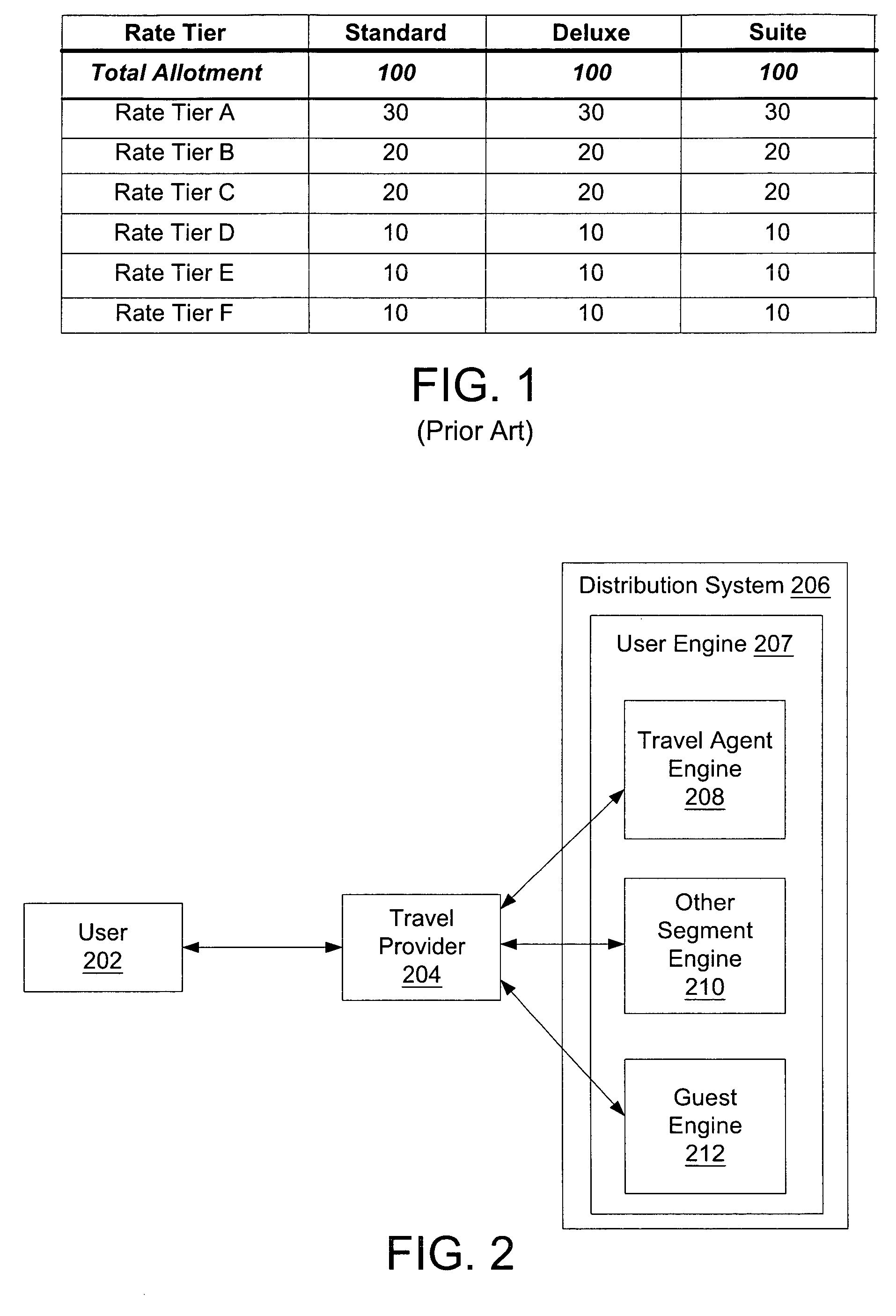
If the hotel assigns more than 100 total rooms in a category to the rate tiers, overbooking may occur.
However, not every
client may be allowed guaranteed room allotments since there may not be enough rooms to allot (e.g., if there are 10 clients each desiring a contract for 20 rooms in their allotment, a hotel with only 100 rooms cannot accommodate every one of these clients).
Another problem associated with straight room allotment is that rooms are not efficiently allotted.
However, these 12 standard rooms cannot be accessed by Travel Agent X, and may remain unreserved even though Travel Agent X has travelers wanting to reserve these rooms.
Thus, in the above example, the hotel would need to monitor the
distribution system, and potentially move available standard rooms from rate tier F to rate tier B. Disadvantageously, this monitoring process is
time consuming, costly to maintain, and potentially creates lost opportunity in sales.
A further
disadvantage of prior art systems is that only one room allotment and one single pricing (i.e., one rate for everyone accessing the system) for a particular room category or airline reservation can be offered.
A yet further
disadvantage of prior art distribution systems is that one reservation transaction may incur a plurality of fees.
However, the
client can only access one rate and one allotment per category to be shared among all market segments.
However, there are disadvantages to maintaining dedicated reservation systems.
These dedicated reservation systems are often expensive and timely to maintain.
Thus, independent and non-
franchise hotels are typically unable to take
advantage of this option.
Further, dedicated
reservation system still suffer from the disadvantages of single pricing (i.e., every user gets the same rate) and room allotment (i.e., every user has access to the same limited number of rooms) problems.
However, it is often difficult for a hotel or travel provider to maintain the terms of the various contracts and balance the required contracted room allotments.
However, oftentimes the guests search and book reservations through on-line travel agencies, such as Travelocity® and Expedia®.
Further, these on-line agencies still suffers from the
disadvantage of straight room allotment.
Thus, if Travelocity® has reserved their entire allotment of rooms, Travelocity® customers cannot access rooms still available through Expedia®.
This may result in the hotel having unreserved, empty rooms even though travelers want to reserve those rooms.
A final disadvantage of prior art distribution systems is that no one centralized system can accommodate all types of reservations.
Thus, the hotel may not have an accurate accounting of all their rooms at all times.



 Login to View More
  Login to View More