
Low noise multi-wavelength light source and wavelength division multiplexing system using same
a multi-wavelength light source and wavelength division multiplexing technology, applied in multiplex communication, semiconductor lasers, instruments, etc., can solve the problems of increasing the size of the wavelength division multiplexed optical communication system, increasing the manufacturing cost, and not only the single-wavelength light source must be provided to the system, so as to achieve low relative noise and low manufacturing cost
- Summary
- Abstract
- Description
- Claims
- Application Information
AI Technical Summary
Benefits of technology
Problems solved by technology
Method used
Image

Examples
first embodiment
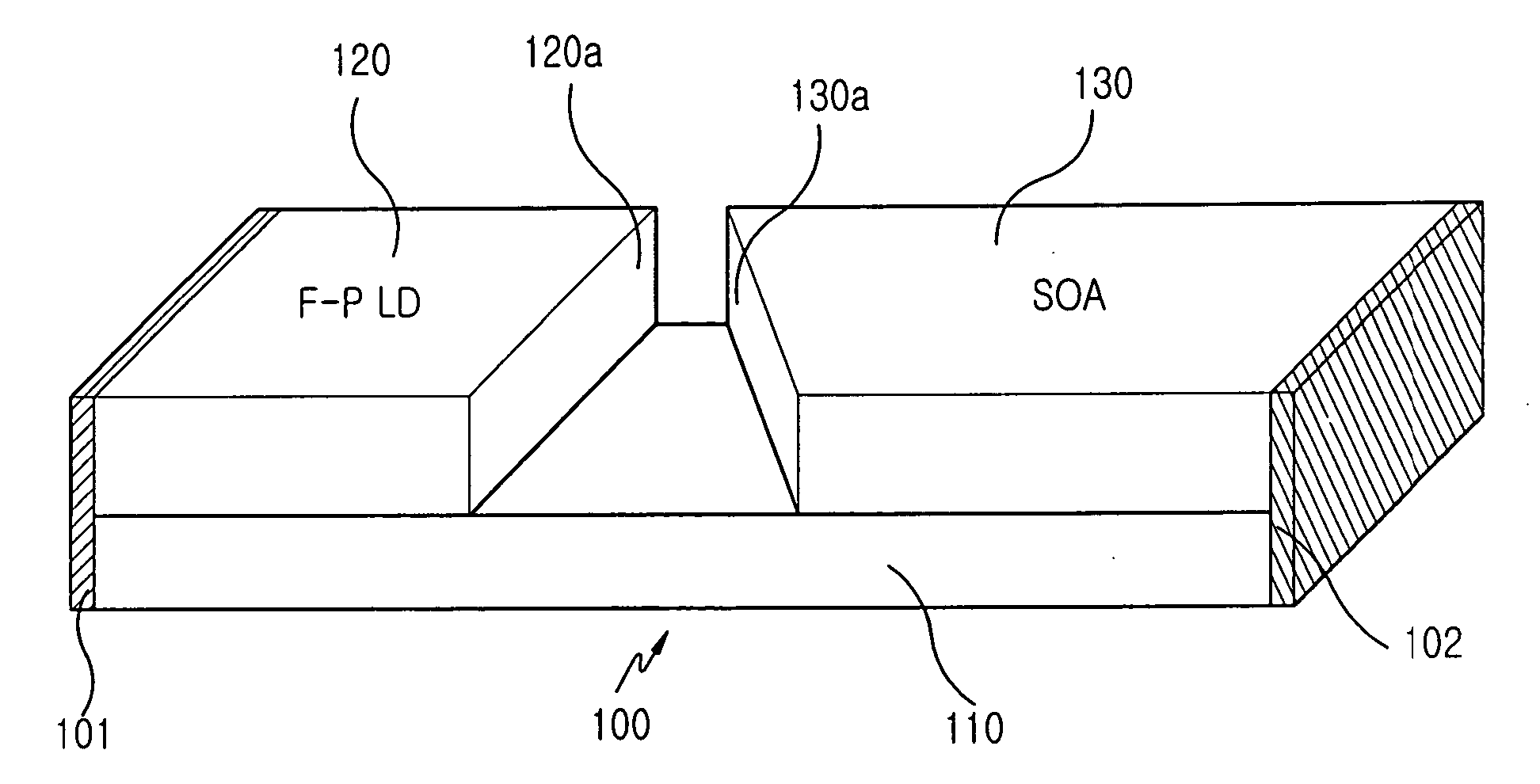
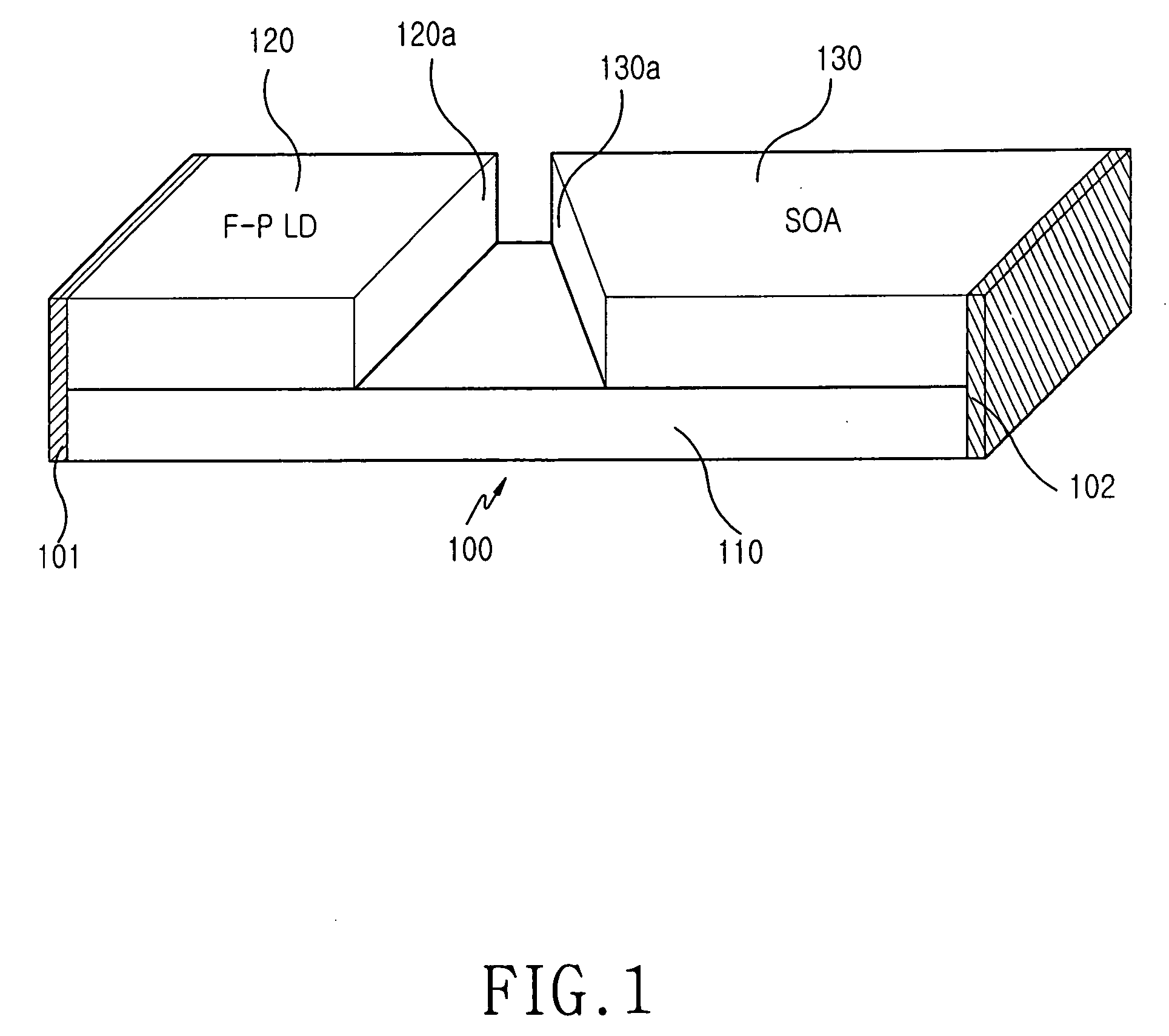
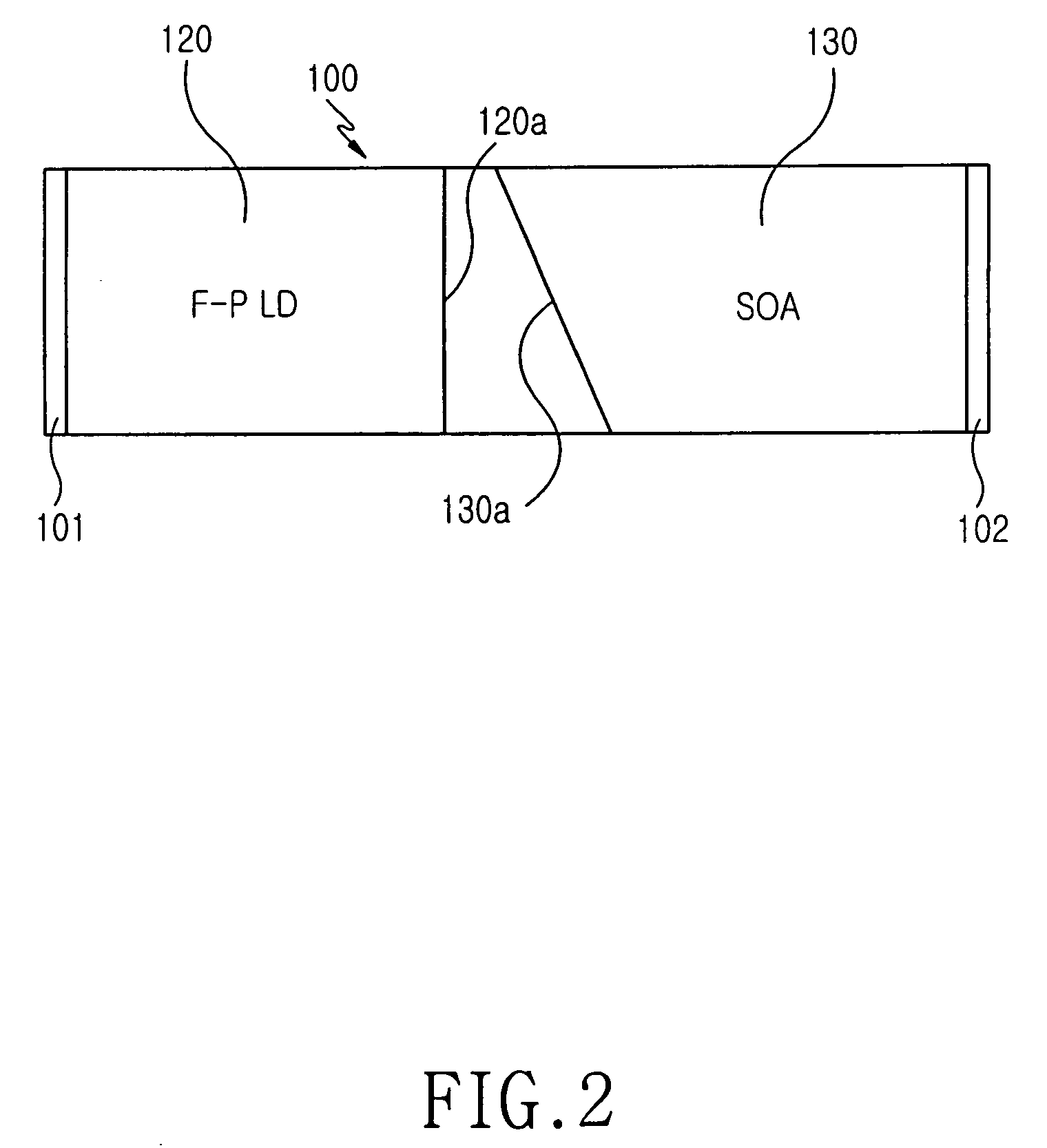
[0028]FIG. 3 is a graph of a gain curve showing correlation between the power of multi-wavelength lights input to the SOA shown in FIG. 1, and power of the multi-wavelength lights amplified by the SOA. Further, FIG. 4 shows the power of the multi-wavelength lights inputted to the SOA shown in FIG. 1, and FIG. 5 shows the power of the multi-wavelength lights amplified by the SOA shown in FIG. 1. Hereinafter, an operation characteristic of the multi-wavelength light source shown in FIG. 1 according to the present invention will be described with reference to FIGS. 3 to 5.
[0029] The gain curve of the SOA shown in FIG. 3 shows variation of the power of the multi-wavelength lights 310, 320 input to and amplified by the SOA versus the output values 311, 321, respectively. The graph has a linear region and a gain saturation region. In the linear region, as the power of the multi-wavelength lights input to the SOA increases, the power of the amplified multi-wavelength light output gradually...
second embodiment
[0033]FIG. 6 is a block diagram showing a wavelength division multiplexed communication system including a multi-wavelength light source according to the present invention. The wavelength division multiplexed communication system includes a central office 200 outputting multi-wavelength light, a remote node 230 connected to the central office 200 through an optical fiber, and a plurality of subscribers 240-1 to 240-n connected to the remote node 230.
[0034] The central office 200 includes a light source section 210 for generating multi-wavelength light comprising the fabry-perot laser 211 and the SOA 212, wherein the output of the light source section 211 is demultiplexed by, a demultiplexer 220, a plurality of modulators 201-1 to 201-n for modulating the respective multiplexed signals individually, a plurality of photodetectors 203-1 to 203-n for detecting upstream channels sent by subscribers via the remote node 230 and demultiplexed by a first Mux / Demux 221 and a plurality of wave...
PUM
| Property | Measurement | Unit |
|---|---|---|
| multi-wavelength | aaaaa | aaaaa |
| wavelengths | aaaaa | aaaaa |
| reflection | aaaaa | aaaaa |
Abstract
Description
Claims
Application Information
 Login to View More