
Image sensing apparatus and power managing method
- Summary
- Abstract
- Description
- Claims
- Application Information
AI Technical Summary
Benefits of technology
Problems solved by technology
Method used
Image

Examples
first embodiment
[0021] [First Embodiment]
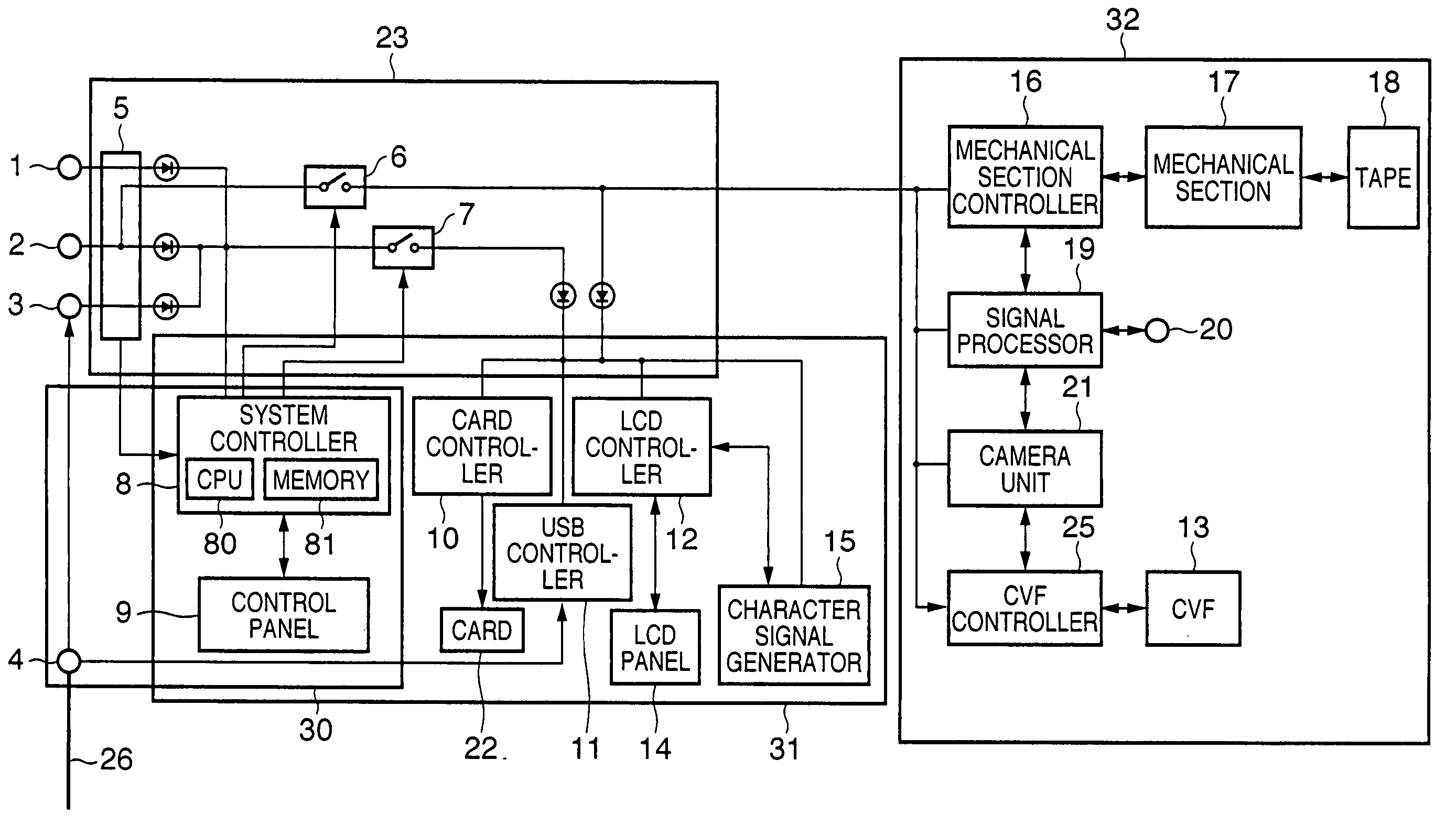
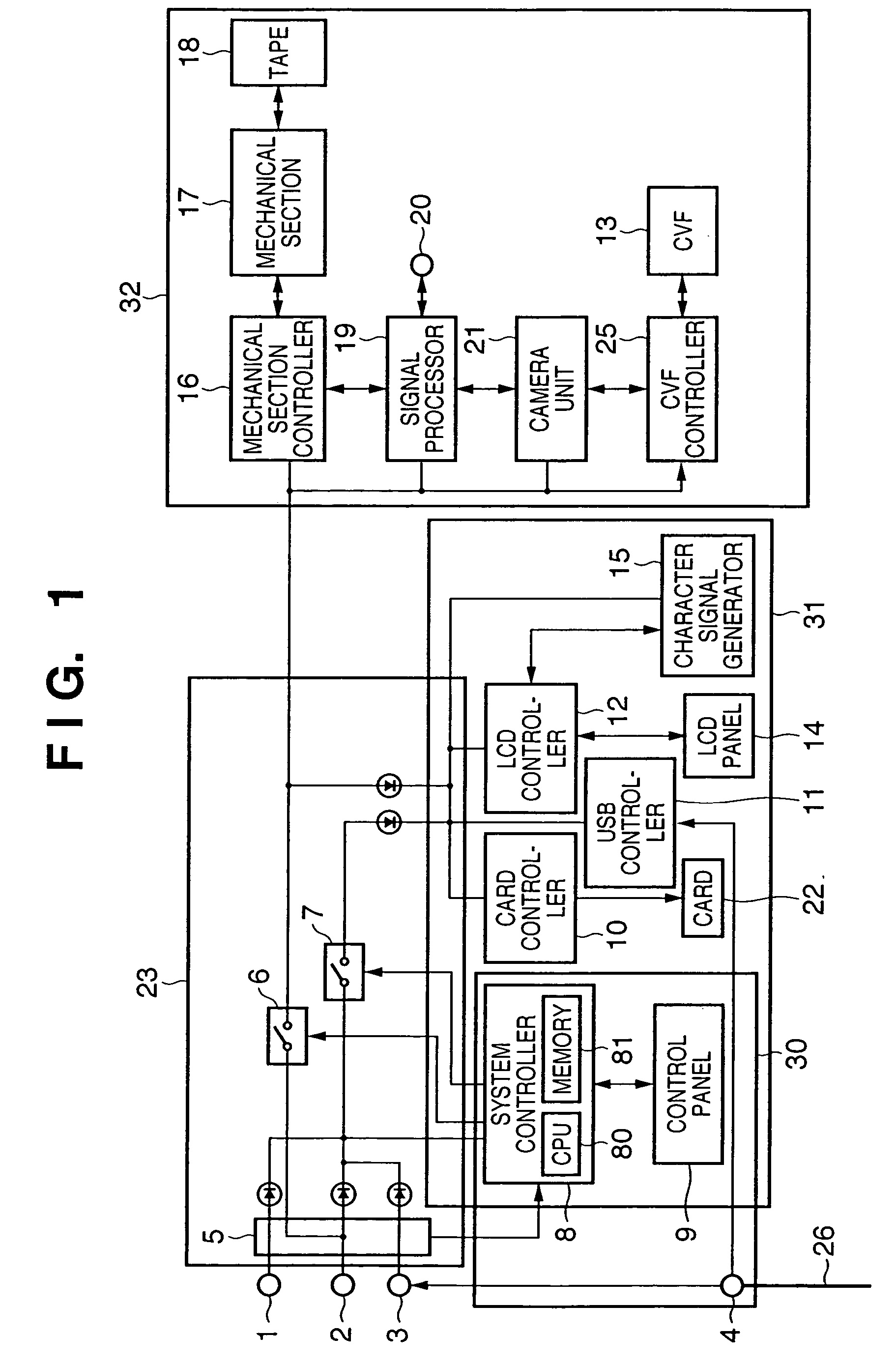
[0022]FIG. 1 is a block diagram illustrating the structure of a digital video camera 200 according to a first embodiment of the present invention.
[0023] As shown in FIG. 1, the digital video camera 200 has an input terminal 1 to which power is supplied from a back-up power source. The power applied to the terminal 1 is supplied to a system controller 8 at all times. An input terminal 2 receives power supplied from a main power source (an AC power source or a battery), and an input terminal 3 receives power (also referred to as “bus power”) supplied from a USB interface 4. The latter is an interface compliant with the above-mentioned USB 1.1 and USB 2.0 standards or standards similar thereto and has a connector for D+ and D− lines, a VBUS line and a GND line. As stipulated by the USB standards, the D+ and D− lines are lines for data transfer, and the VBUS and GND lines are lines for supplying power.
[0024] A power-source detector 5 has a function for detecti...
second embodiment
[0048] [Second Embodiment]
[0049]FIG. 6 is a block diagram illustrating the structure of a digital video camera 200 according to a second embodiment of the present invention. Components in FIG. 7 identical with those in FIG. 1 are designated by like reference characters and need not be described again.
[0050] In FIG. 6, the power-source detector 5 has a function for detecting whether power being supplied to the terminal 2 from the main power source is sufficient or not, and a function for detecting whether power being supplied to the terminal 3 from the USB interface 4 is sufficient or not. When closed, the changeover switch 7 supplies bus power from the terminal 3 to the card controller 10 and USB controller 11. An LED 61 lights in order to indicate to the user the fact that the digital video camera 200 is running solely on bus power. A CVF & LCD controller 63 outputs the signal reproduced by the card controller 10, the reproduced signal on tape 18 from the mechanical section contro...
PUM
 Login to View More
 Abstract
Description
Claims
Application Information
 Login to View More