
Continuous production of plastic siding panels with separate shingle appearance
a production line and plastic technology, applied in the field of vinyl siding panels, can solve problems such as damage to the structure, and achieve the effect of realistic appearan
- Summary
- Abstract
- Description
- Claims
- Application Information
AI Technical Summary
Benefits of technology
Problems solved by technology
Method used
Image

Examples
Embodiment Construction
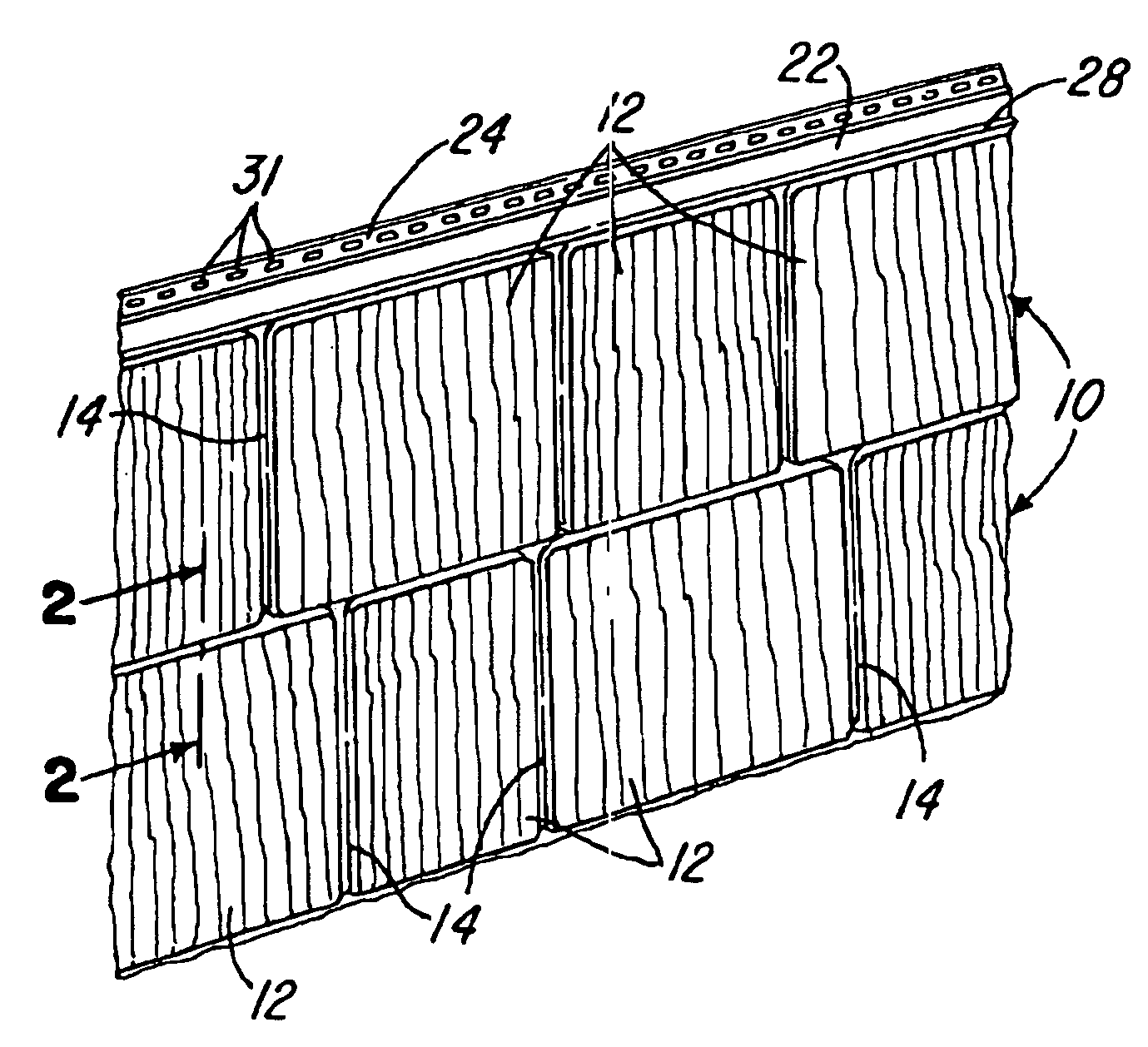
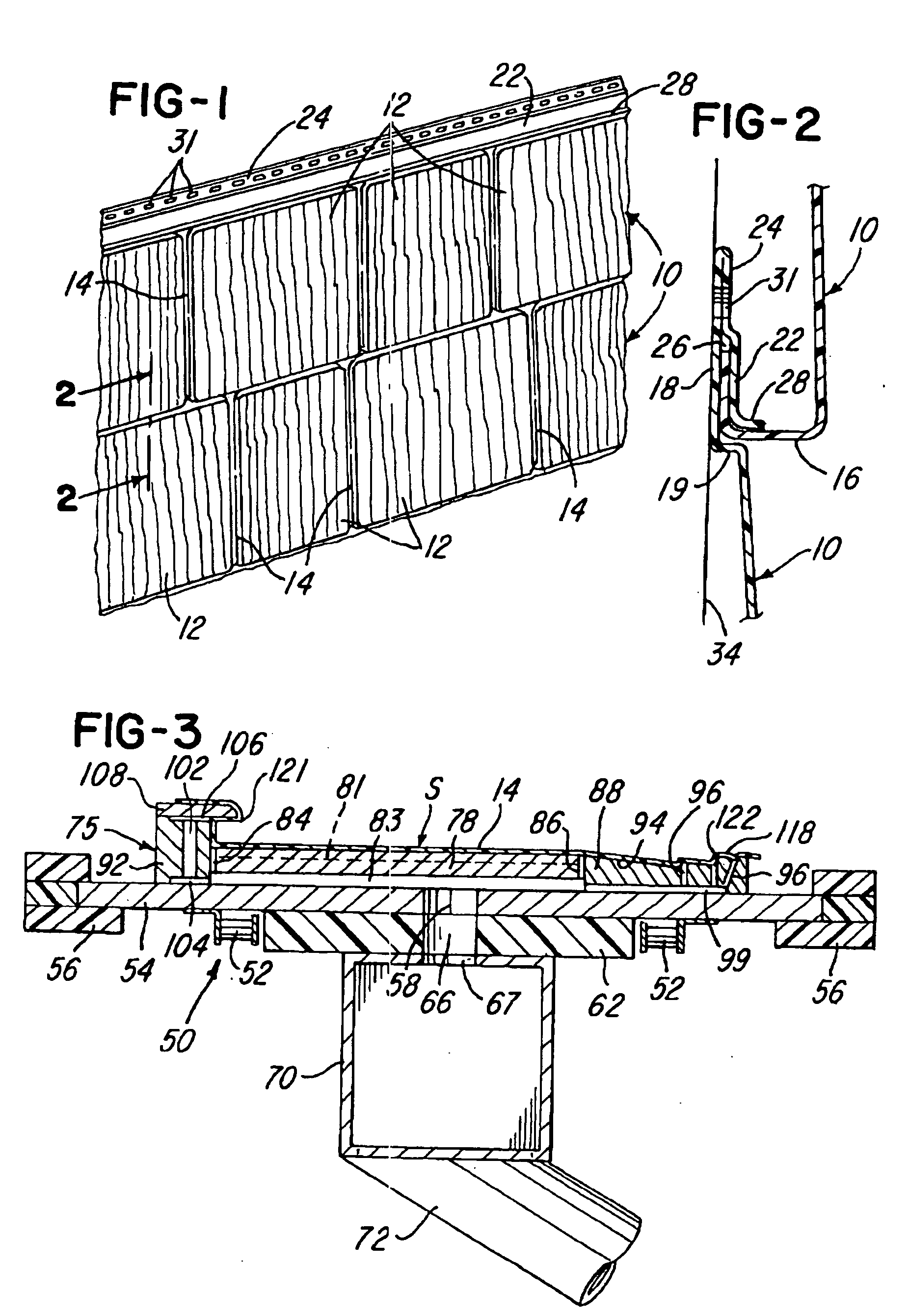
[0029]FIG. 1 illustrates portions of two elongated siding panels 10 connected together as shown in FIG. 2, and each siding panel has a length of about five feet. Each siding panel is formed from a sheet of rigid plastics material such as polyvinylchloride or “vinyl” and includes a series of ten generally rectangular shingle panels 12 each having a different and distinct wood grain appearance. The shingle panels 12 are integrally connected by flat recessed strip portions 14 defining grooves, and each panel 10 has a longitudinally extending hook-shaped lower portion 16 (FIG. 2). Each panel 10 also has a longitudinally extending upper flange portion 18 which extends from a step or shoulder portion 19 and is integrally connected to a folded-over flange portion 22.
[0030] The folded-over flange portion 22 cooperates with the flange portion 18 to form a double wall nailing flange 24 and a slot or groove 26 for receiving and retaining the hook-shaped lower edge portion 16 of the above over...
PUM
| Property | Measurement | Unit |
|---|---|---|
| angle | aaaaa | aaaaa |
| length | aaaaa | aaaaa |
| C-shape | aaaaa | aaaaa |
Abstract
Description
Claims
Application Information
 Login to View More