
Hybrid adhesives, articles, and methods
a technology of hybrid adhesives and adhesives, applied in the field of curable adhesives, can solve the problems of adversely affecting the stability, clarity, bond strength or other performance properties of adhesives in the same optical element, and other problems, to achieve the effect of convenient use, additional stability and clarity
- Summary
- Abstract
- Description
- Claims
- Application Information
AI Technical Summary
Benefits of technology
Problems solved by technology
Method used
Image

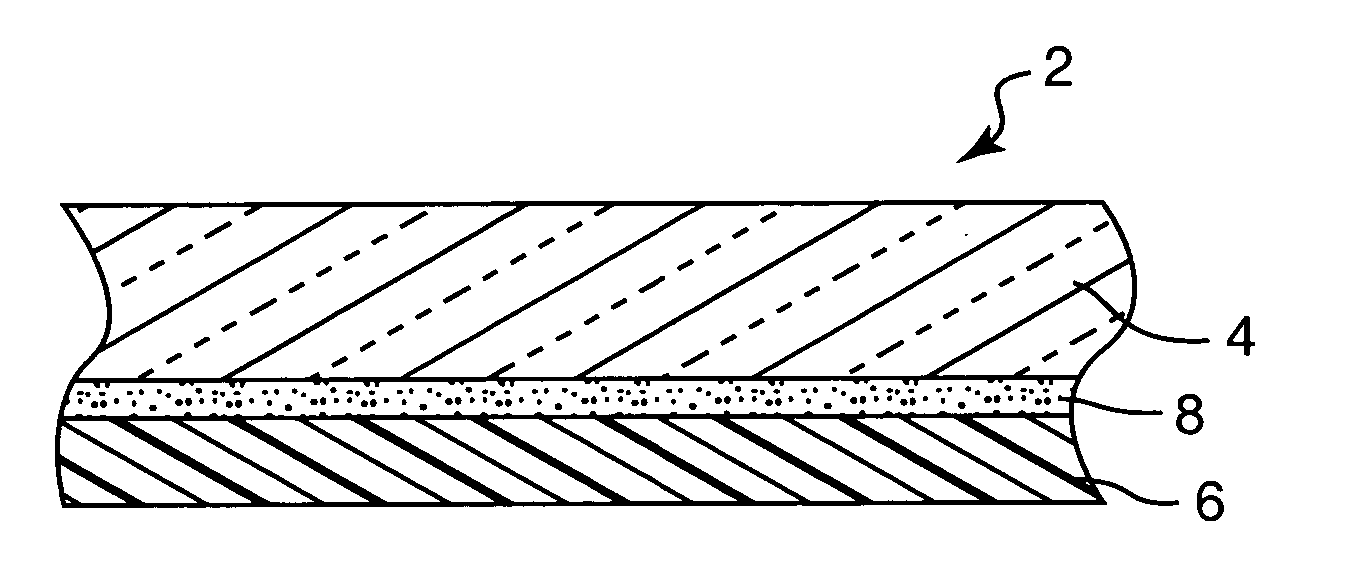
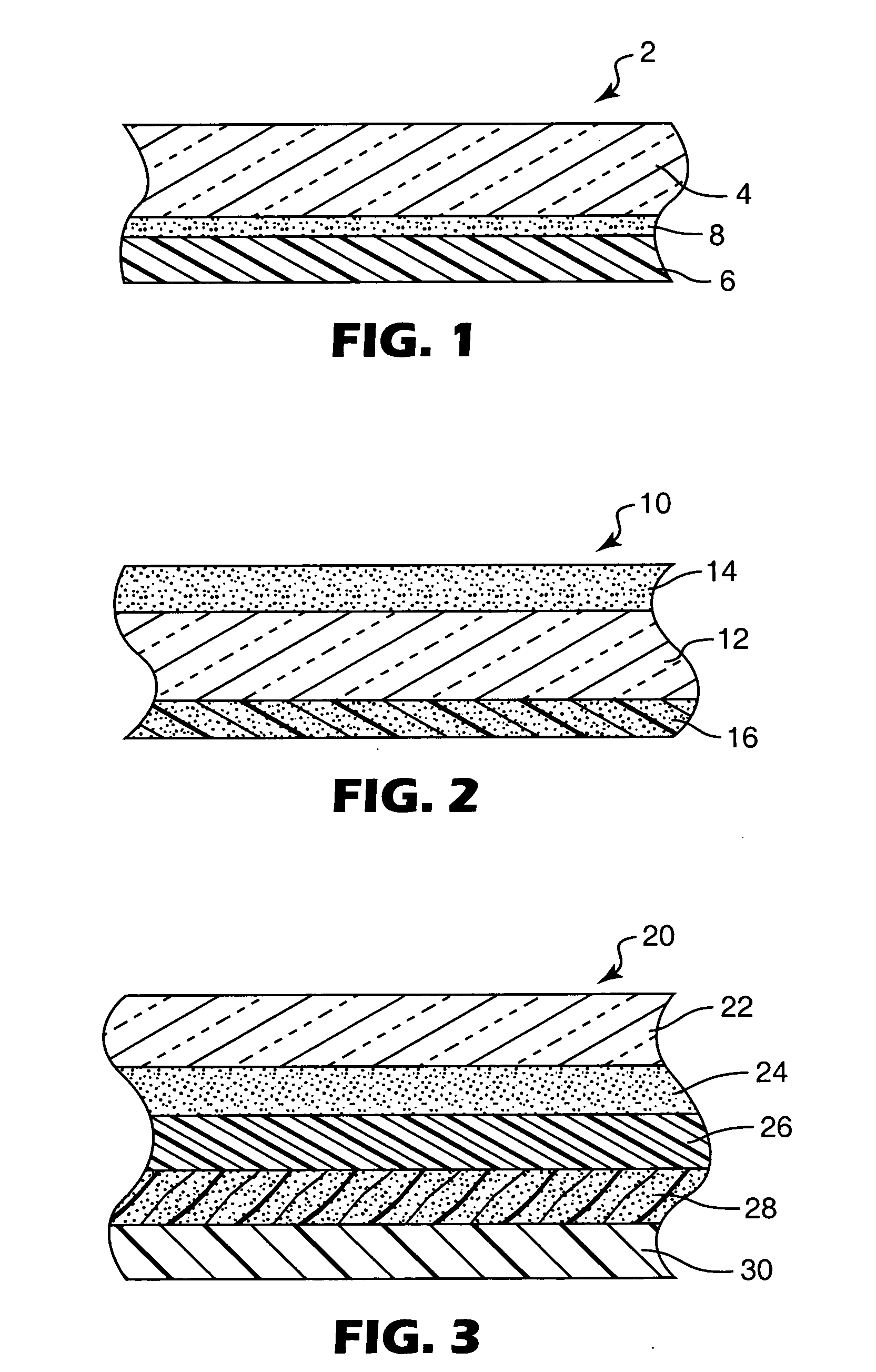
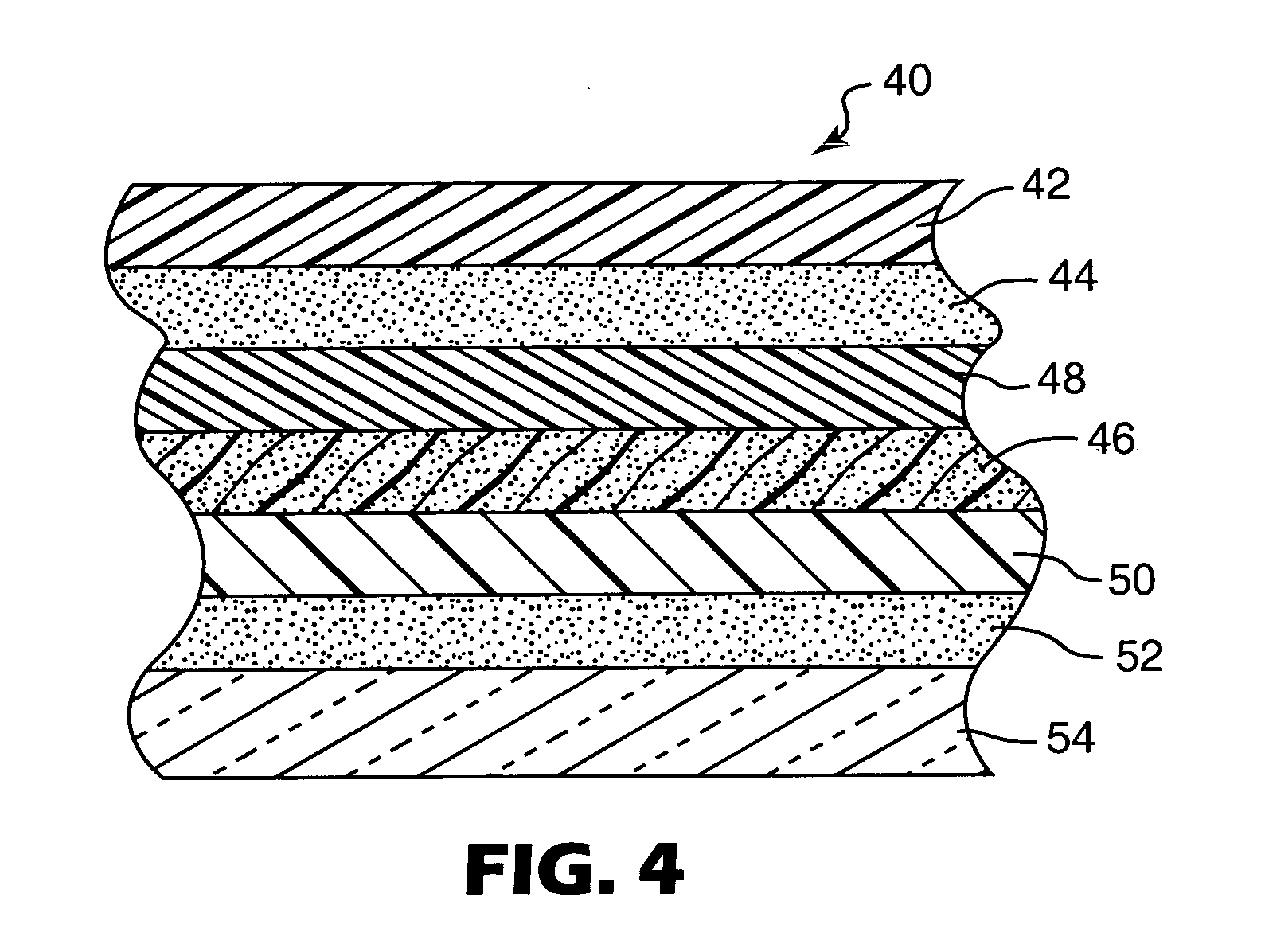
Examples
examples
[0085] These examples are merely for illustrative purposes only and are not meant to be limiting on the scope of the appended claims. All parts, percentages, ratios, etc. in the examples and the rest of the specification are by weight unless indicated otherwise.
Table of AbbreviationsAAAcrylic acidMAMethyl AcrylateBAn-Butyl AcrylateAR FilmAntireflective film as described in USpatent number 6,277,485 column 13 line60-column 14 line 39, with a sheetresistance of 65 ohm / square.PolycarbonatePolycarbonate film of 70 μm thicknessRetardation Filmfrom Teijin IndustriesGlass Microscope75 millimeter × 50 millimeter × 1Slidemillimeter Corning No. 2947 MicroSlidescommercially available from CorningGlass Works; Corning, NYIOAIsooctyl acrylateIRGACURE 651Photoinitiator 2,2 dimethoxy-2-phenylacetophenone, available from Ciba;Hawthorne, NJPETpolyester film of polyethyleneterephthalateMVTRMoisture Vapor Transmission RateBostik AdhesiveA polyester based adhesive coated out ofmethyl ethyl ketone solv...
examples 12-14
Adhesive Preparation
[0107] In a brown glass reaction vessel was placed Irgacure 651 and Ethyl Acetate in the amounts shown in Table 13. Once all of the solids were dissolved, Polyacrylate A was added and the resulting mixture was mixed well. To this mixture was added either EBECRYL 1561 or EPON 828 or ERL 4221; TTE; CD1012 and Benzophenone (BZP) in the amounts shown in Table 13.
TABLE 13EthylIrgacureEbecrylEponPolyacrylate AAcetate6511561828TTECD1012BZPEx.(grams)(grams)(grams)(grams)(grams)ERL 4221 (grams)(grams)(grams)(grams)1230.020.00.023.750000.1501348.025.0004.6900.130.190.191448.025.00004.690.130.190.19
Laminate Preparation
[0108] After mixing, the solution for example 12 was coated onto the non-metallized side of an AR Film, dried at 70° C. for 10 minutes to yield a 37.5 μm thick dry PSA tape. Samples of this PSA tape were laminated onto a Glass Microscope Slide. After 24 hour dwell, these laminates were irradiated (through the AR Film) with a Fusion UV Curing System at th...
examples 22-24
[0117] The adhesive samples described in Examples 4, 5, and 7 were used to prepare protective coatings on KE Film. The adhesive solution was coated onto the T-30 Release Liner, dried at 70° C. for 10 minutes to yield a 50.8 μm thick dry PSA film. Two samples of this PSA film were laminated onto each surface of a KE Film to form a laminate of release liner / adhesive / KE Film / adhesive / release liner. The laminates were irradiated (through the release liners) with a Fusion UV Curing System “D” bulb, 50 feet / minute, 2 passes for each side, for a total UVA (320-390 nm) dose of about 1 J / cm2 for each side. The release liner was removed from the cured adhesive after 24 hours. The laminate of cured adhesive / KE Film / cured adhesive was then aged for 500 hours using the test methods outlined above, the results are shown in Table 20.
TABLE 20Aging TestAdhesiveConditionsFormulationAging Test Conditions(80° C. / 90%ExampleUsed(90° C. for 500 hours)RH for 500 hours)224PassPass235PassPass247PassPass
PUM
| Property | Measurement | Unit |
|---|---|---|
| haze | aaaaa | aaaaa |
| haze | aaaaa | aaaaa |
| haze | aaaaa | aaaaa |
Abstract
Description
Claims
Application Information
 Login to View More