Check patentability & draft patents in minutes with Patsnap Eureka AI!

Method for Determining the Modulus of Elasticity of Paper

Inactive Publication Date: 2006-02-23
VALMET TECHNOLOGIES INC
View PDF16 Cites 6 Cited by
  • Summary
  • Abstract
  • Description
  • Claims
  • Application Information

AI Technical Summary

Benefits of technology

[0006] By means of the method according to the invention it is possible to eliminate or reduce the above-mentioned problems. The method according to the invention is characterized in that the measurements of force and deflection that are necessary in the determination of the radial modulus of elasticity are performed on a paper reel outside the reeling or winding position. The term reeling or winding position refers to the position in which the reel is located when material in the form of a continuous web is reeled or wound thereon.
[0007] The advantages of the method according to the invention are that the measurement of force and deflection can be performed on the reel, wherein the shape of the surface to be measured is correct. By means of the measurement, information is obtained which indicates how the reeling or winding should be conducted, for example which web tension should be utilized at a given time, in other words, the measurement results can be applied in theoretical winding models. Because the measurements are made on the finished reel, it is possible to rapidly react to errors in the reeling or winding. Inaccurately reeled or wound material can be reeled again or rejected. The method according to the invention can be applied after the reeling or winding position of reel-ups or winders of various types, such as center winders or carrier drum winders when the reel has been transferred to a special measurement position. The method can also be applied in a corresponding manner in continuously operated reel-ups.

Problems solved by technology

It is a problem of the laboratory measurement that it is conducted with a delay, in other words reactions to problems in the production occur slowly.
Furthermore, it is necessary to use a paper stack, wherein it is somewhat difficult to prepare a sample for the measurement.
In this measurement it is, however, necessary to use a paper stack, because it is very difficult to measure single sheets and it may cause inaccurate results.

Method used

the structure of the environmentally friendly knitted fabric provided by the present invention; figure 2 Flow chart of the yarn wrapping machine for environmentally friendly knitted fabrics and storage devices; image 3 Is the parameter map of the yarn covering machine
View more

Image

Smart Image Click on the blue labels to locate them in the text.
Viewing Examples
Smart Image
  • Method for Determining the Modulus of Elasticity of Paper
  • Method for Determining the Modulus of Elasticity of Paper
  • Method for Determining the Modulus of Elasticity of Paper

Examples

Experimental program
Comparison scheme
Effect test

Embodiment Construction

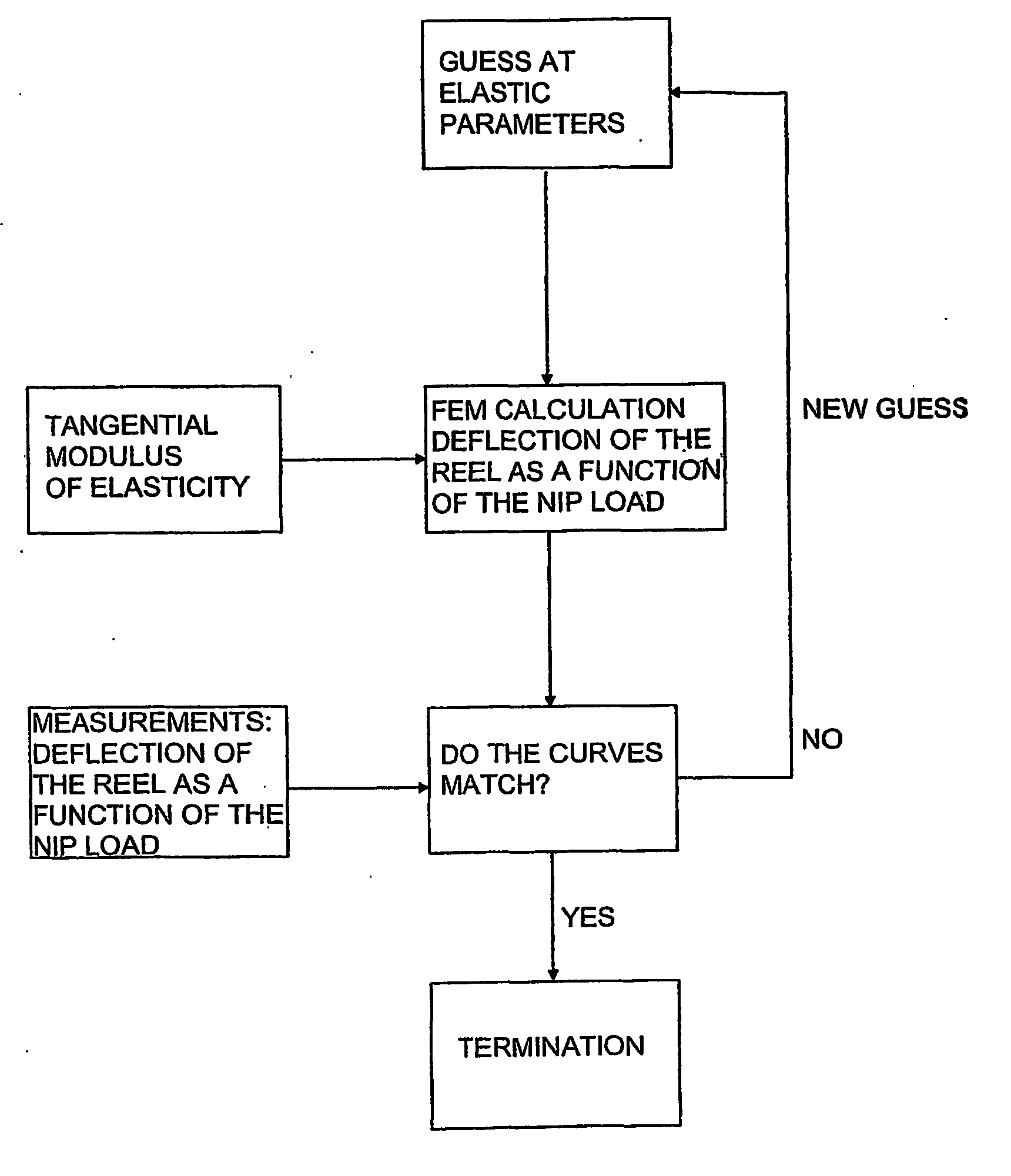
[0019]FIG. 1 shows the method according to the invention for measuring the radial modulus of elasticity of paper in a block diagram. To calculate the radial modulus of elasticity, an initial guess of the elastic parameters and a tangential modulus of elasticity measured from the paper are necessary.

[0020] The radial modulus of elasticity can be represented with the formula Er=Er(σr), i.e. Er depends on the radial stress σr. This dependency can be described with a 1st to 3rd order polynom. Elastic parameters which are required as initial guesses can be for example the coefficients of this polynom.

[0021] The tangential modulus of elasticity can be measured by means of laboratory measurement, or it can be measured in the production machine. When the elastic parameters given as an initial guess are placed in the theoretical reeling model, and a curve of the compression of the reel as a function of the nip load is obtained as a result of the FEM calculation, the obtained curve is compa...

the structure of the environmentally friendly knitted fabric provided by the present invention; figure 2 Flow chart of the yarn wrapping machine for environmentally friendly knitted fabrics and storage devices; image 3 Is the parameter map of the yarn covering machine
Login to View More

PUM

No PUM Login to View More

Abstract

In a method for determining the radial modulus of elasticity of paper or a corresponding web-like material that can be reeled or wound on a reel, the connection between the force and deflection of a material arranged in layers is measured. The measurements of force and deflection necessary for calculating the radial modulus of elasticity are performed on a reel of paper or corresponding material outside the reeling or winding position by loading the reel with a press member.

Description

CROSS REFERENCES TO RELATED APPLICATIONS [0001] This application is a U.S. national stage application of international App. No. PCT / FI2003 / 000784, filed Oct. 22, 2003, the disclosure of which is incorporated by reference herein. This application claims priority on Finnish App. No. 20021902, filed Oct. 24, 2002. STATEMENT AS TO RIGHTS TO INVENTIONS MADE UNDER FEDERALLY SPONSORED RESEARCH AND DEVELOPMENT [0002] Not applicable. BACKGROUND OF THE INVENTION [0003] The present invention relates to a method for determining the radial modulus of elasticity of paper or a corresponding web-like material that can be reeled or wound on a reel. In said method the connection between the force and deflection of a material arranged in superimposed layers is measured. [0004] A known method for measuring the radial modulus of elasticity of paper is a measurement conducted in a laboratory, which is disclosed for example in the publication by D. Roisum: The Mechanics of Winding, Tappi Press 1994, p. 62...

Claims

the structure of the environmentally friendly knitted fabric provided by the present invention; figure 2 Flow chart of the yarn wrapping machine for environmentally friendly knitted fabrics and storage devices; image 3 Is the parameter map of the yarn covering machine
Login to View More

Application Information

Patent Timeline
no application Login to View More
IPC IPC(8): G01N33/24G01L5/00G01N3/00G01N3/02G01N3/08G01N33/34
CPCB65H2515/30B65H2515/81G01N3/08G01N33/34G01N2203/0019G01N2203/0282B65H2220/03B65H2220/01B65H2220/02
Inventor JORKAMA, MARKO
Owner VALMET TECHNOLOGIES INC
Features
  • R&D
  • Intellectual Property
  • Life Sciences
  • Materials
  • Tech Scout
Why Patsnap Eureka
  • Unparalleled Data Quality
  • Higher Quality Content
  • 60% Fewer Hallucinations
Social media
Patsnap Eureka Blog
Learn More