Communication system using OFDM for one direction and DSSS for another direction

a communication system and direction technology, applied in the field of communication, can solve the problems of large peak-to-average power ratio of ofdm signals, significant hurdle for implementing ofdm-based systems, and compromise the efficiency of the overall system

a communication system and direction technology, applied in the field of communication, can solve the problems of large peak-to-average power ratio of ofdm signals, significant hurdle for implementing ofdm-based systems, and compromise the efficiency of the overall system

US20060067278A1Inactive Publication Date: 2006-03-30SDR HLDG L L C +2

Image

Smart Image Click on the blue labels to locate them in the text.
Viewing Examples
Smart Image
  • Communication system using OFDM for one direction and DSSS for another direction
  • Communication system using OFDM for one direction and DSSS for another direction
  • Communication system using OFDM for one direction and DSSS for another direction

Examples

Experimental program
Comparison scheme
Effect test

Embodiment Construction

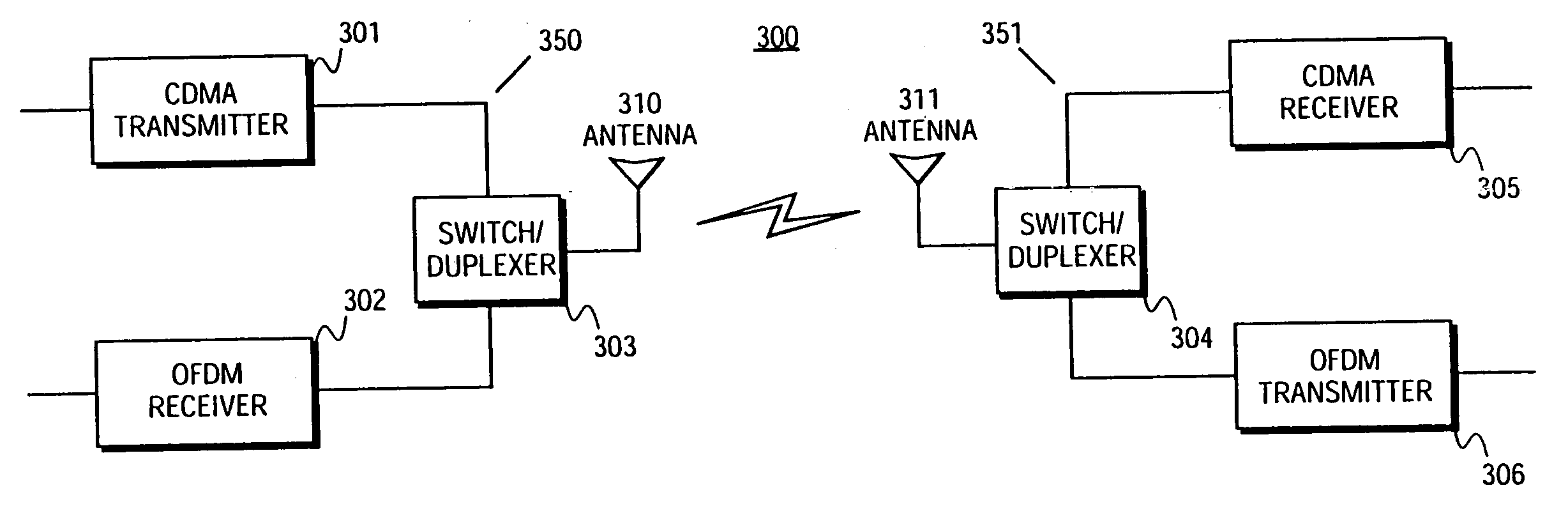
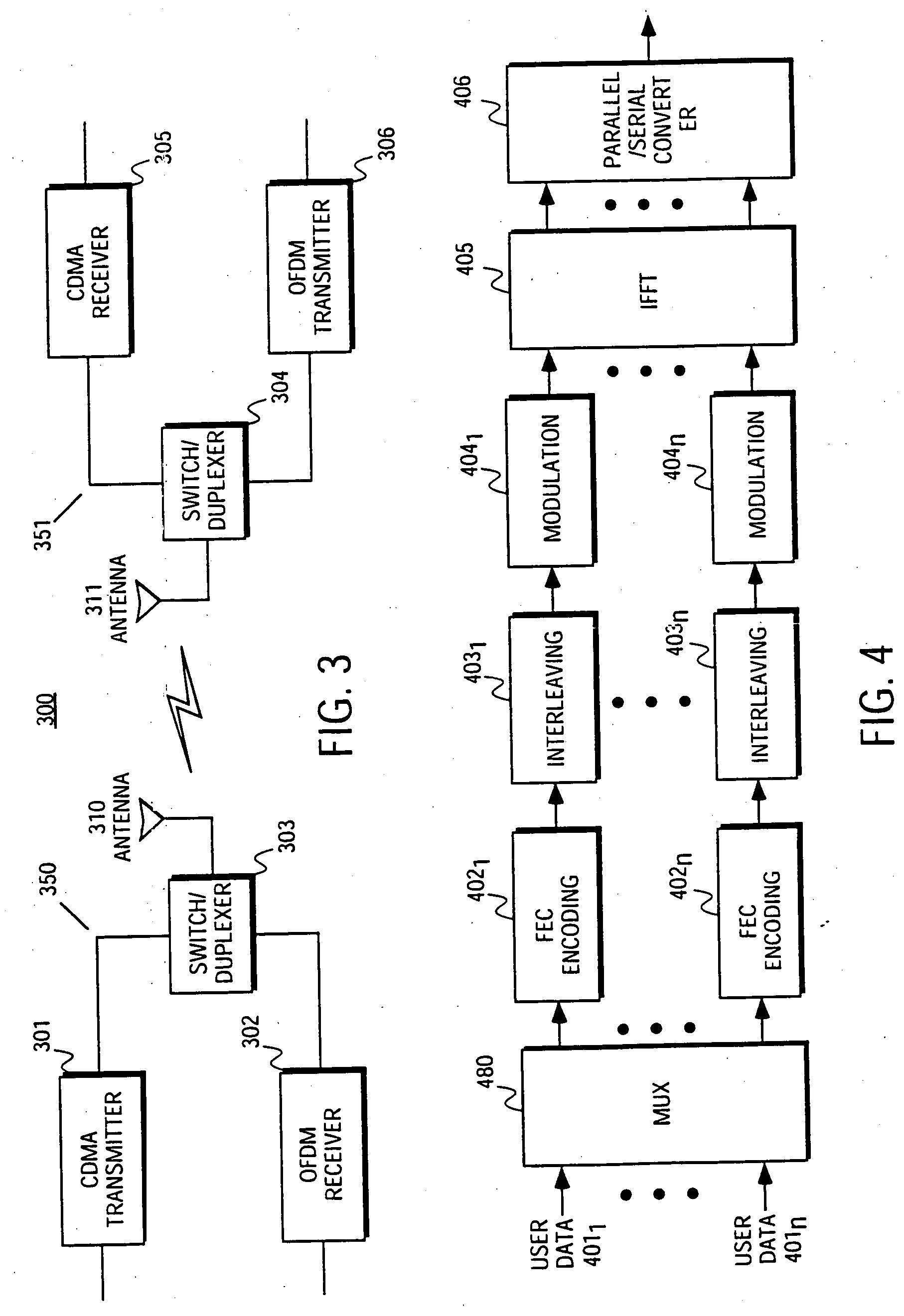
[0030] A method and apparatus to integrate OFDM and CDMA technologies is described. In one embodiment, a method for communicating with a subscriber comprises transmitting orthogonal frequency domain multiplexing (OFDM) signals to the subscriber, and receiving direct-sequence spread spectrum (DSSS) signals from the subscriber.

[0031] The techniques described herein increase, and potentially maximize, the downlink throughput while increasing, and potentially optimizing, the power efficiency of uplink, and at the same time, maintain the multiple-access flexibility of the overall system. In one embodiment, OFDM is used for downlink to increase, and potentially maximize, the spectral efficiency and the bit rate. This is an important feature for today's Internet access due to its asymmetric nature. DSSS / CDMA is used for uplink to avoid the large peak-to-average ratio problem of OFDM and increases, and potentially maximize, the multiple-access flexibility. Alternatively, CDMA techniques ot...

the structure of the environmentally friendly knitted fabric provided by the present invention; figure 2 Flow chart of the yarn wrapping machine for environmentally friendly knitted fabrics and storage devices; image 3 Is the parameter map of the yarn covering machine
Login to View More

PUM

No PUM Login to View More

Abstract

A method and apparatus for wireless communication are described. In one embodiment, a method for communicating with a subscriber comprises transmitting orthogonal frequency domain multiplexing (OFDM) signals to the subscriber, and receiving direct-sequence spread spectrum (DSSS) signals from the subscriber.

Description

FIELD OF THE INVENTION [0001] This invention relates to communications and, more particularly, to multi-subscriber systems utilizing the basic modulation formats of orthogonal frequency division multiplexing (OFDM) and spread spectrum transmission. BACKGROUND OF THE INVENTION [0002] With high-speed wireless services increasingly in demand, there is a need for more throughput per bandwidth to accommodate more subscribers with higher data rates while retaining a guaranteed quality of service (QoS), all over a packet network. While the definition for β€œwireless broadband” may vary, it is commonly accepted that the next-generation wireless broadband networks must be able to provide a wide variety of services, from high-quality voice to high-definition videos, through IP-centric, high-speed (>10 Mbps downlink and >512 Kbps uplink) wireless channels. See Shingo Ohmori, et. al, β€œThe Future Generations of Mobile Communications Based on Broadband Access Technologies,” IEEE Communication...

Claims

the structure of the environmentally friendly knitted fabric provided by the present invention; figure 2 Flow chart of the yarn wrapping machine for environmentally friendly knitted fabrics and storage devices; image 3 Is the parameter map of the yarn covering machine
Login to View More

Application Information

Patent Timeline
30 Mar 2006
Publication
US20060067278A1
IPC
H04B7/216; H04B1/707; H04L5/02; H04J11/00; H04L5/14; H04L27/26; H04W16/10; H04W52/08; H04W52/10; H04W72/54
CPC
H04B1/707; H04L5/023; H04L5/14; H04L5/143; H04W72/08; H04W16/10; H04W52/08; H04W52/10
Inventors
LI, XIAODONG; LIU, HUI