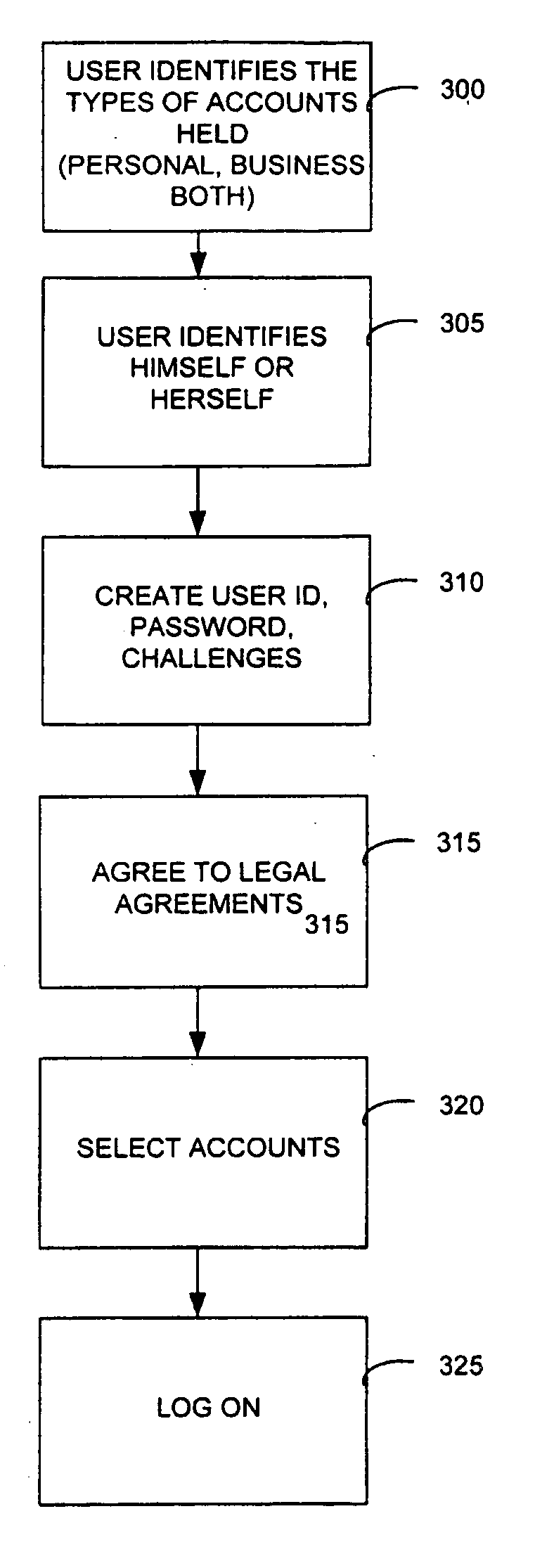
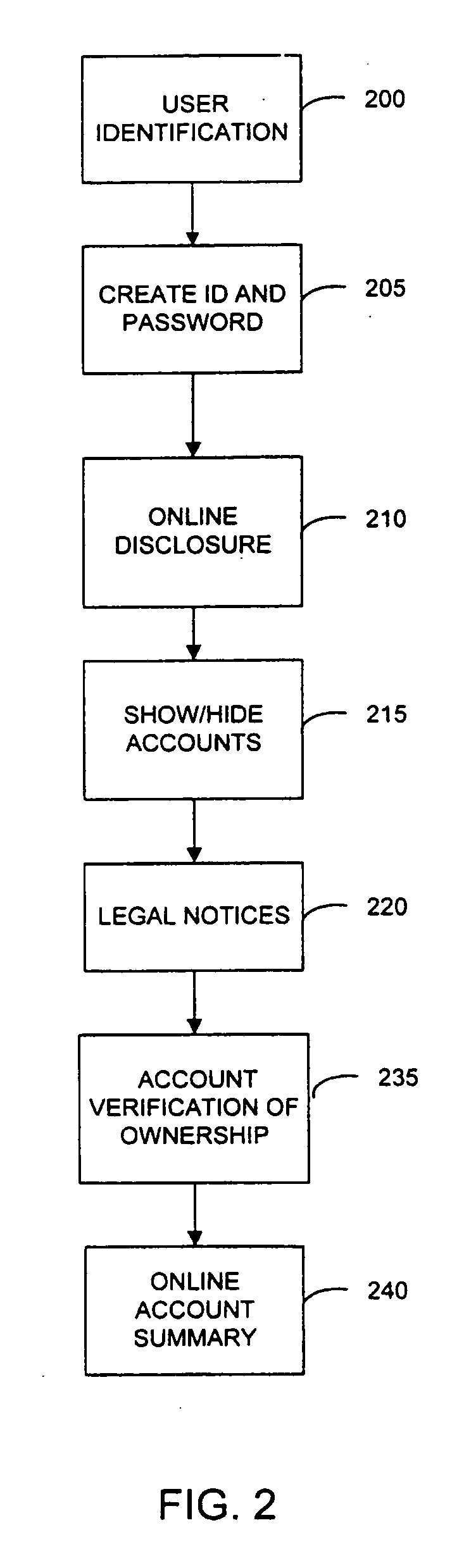
[0009] During the initial sign up for the online access to its accounts, a customer creates their User ID and password online during the same session. There is no need for the institution to mail the User ID or password to the customer. This same sign up process allows the customer to provide verification of ownership to obtain rights to information and services available online for their accounts. Once the customer has logged on (password) and verified their ownership of at least one account, the system displays all of the customer's accounts that are available for access via the Internet website. In addition to signing up existing customers, the present invention permits the creation of non-authenticated IDs for potential customers to use (or for customers to use for non-account access). For example, a non-customer can be provided access to online account opening services, pre-populating application data with their account information saving account application data, viewing status of new account application, and saving calculator and financial planning data.
[0012] In subsequent logons to the system, the present invention allows customers to re-identify themselves to see a forgotten ID, and to re-verify themselves so they can recreate a password if a password is forgotten. The present: invention allows the customer to create answers to challenge questions that only the user should know the answer to. For example, a challenge question could be, “what model was your first car?”. The answers to the challenge questions are stored in the system for future use if the user forgets his password. If the situation occurs that the user does forget his password, he is presented with the challenge questions to which he previously provided the answers. If the user successfully answers the challenge questions, he is allowed access to the system (and is allowed to change his password).
[0013] In addition to the challenge questions, the user is also able to create “cue” questions. The cue questions provide the user with a hint as to the user's selected password. For example, if the user selects the name of his dog as his password, the customer can create a cue question such as “What is your dog's name.” If the user forgets his password, he is first presented with the cue question to see if the user can recollect the password. If the cue question does not jog the user's memory, he is then presented with the challenge questions that allow the user to re-identify himself to the system.
[0014] The present invention is not limited to providing access to personal accounts and is equally applicable to business accounts. Business customers can use the system for online enrollment, fulfillment and ownership verification. This includes customers who want to see both personal and business accounts under one ID and password. The business owner may be a sole proprietor (using a social security number), a business owner or partner (using a tax identification number (TIN)), or a multiple business owner (multiple TINs). Furthermore, the system allows a tiered authority structure where an owner of an account can set up and authorize access to the same or lesser levels of authority to non-owners of the accounts (e.g., spouses or employees). This allows set up and monitoring of sub-IDS for consumers as well as businesses.
[0015] Another significant feature of the present invention is its ability to allow the customer to self-service their sign up, logon, and forgotten ID or password processes without having to contact customer service or wait for information to be given or sent to them.
[0016] The present invention provides ease of use by the customer since the customer does not need to duplicate work such as inputting his or her social security number, account number, and other personal or account information a number of different times to either sign up for access or to logon to see their accounts. The ability for the customer to use “self-service” sign up and logon failure procedures eliminates or minimizes customer and back office support for fulfillment (e.g., issuing IDs, passwords, and reissued passwords). The single sign on ID and password that allows access to all of the customer's accounts provides speed of fulfillment, ease of use and reduced customer support for issued or forgotten IDs and passwords. The ability for customers to see all of their accounts with one logon eases the customer experience and enhance customer retention, as well as enhancing cross-sell and up-sell efforts.



 Login to View More
  Login to View More