
Viral vectors with improved properties
a technology of viral clones and properties, applied in the field of viral clones, can solve the problems of limited success, lack of ideal gene delivery vehicles, scarce clinical applications of successful gene therapy, etc., and achieve the effect of increasing the infectivity of viral clones
- Summary
- Abstract
- Description
- Claims
- Application Information
AI Technical Summary
Benefits of technology
Problems solved by technology
Method used
Image

Examples
example 1
Linker Insertion Mutagenesis to Modify AAV Capsid
[0103] To retarget AAV to specific cell types, it is necessary to modify the AAV capsid. One strategy to do so is to insert ligands that bind to cell-specific surface receptors. This Example shows the production of a plasmid library encoding AAV mutants that carries an insert at every possible position of the AAV capsid (at least on the DNA level), theoretically allowing the assembly of all possible peptide insertion mutants (2205) of AAV for this specific peptide. Here, the insert was a 5-residue peptide having one of the following sequences:
PCLNS(SEQ ID NO:15)GCLNT(SEQ ID NO:16)LFKHN(SEQ ID NO:17)
[0104] The same methodology used in the instant experiment can be repeated with a peptide insert which is a receptor ligand. A selection procedure on a cell type expressing the receptor would then allow for the isolation of mutants with particularly high infectivity. For example, multiple rounds of selection at low multiplicities of infe...
example 2
Restriction to Capsid Insertions
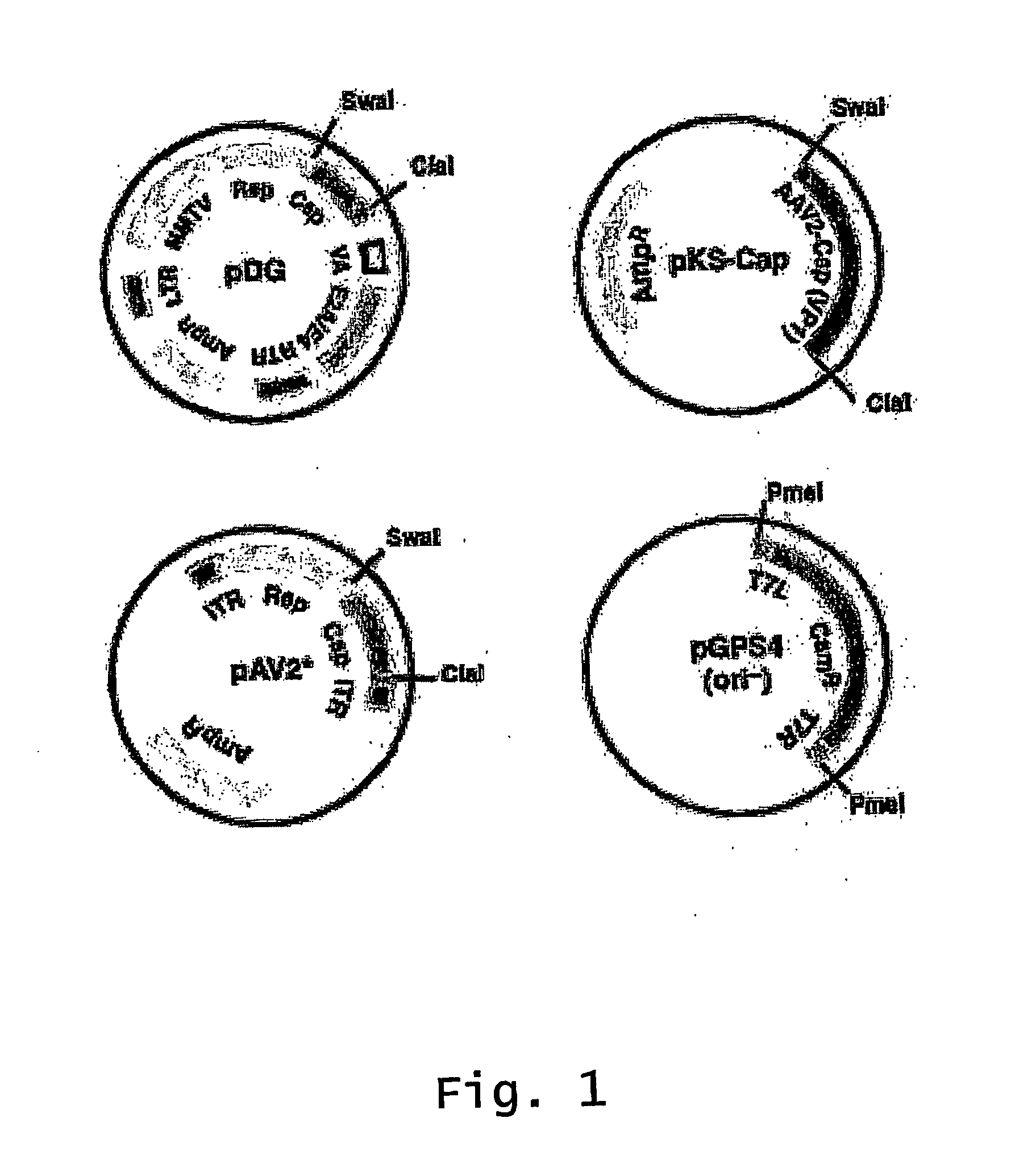
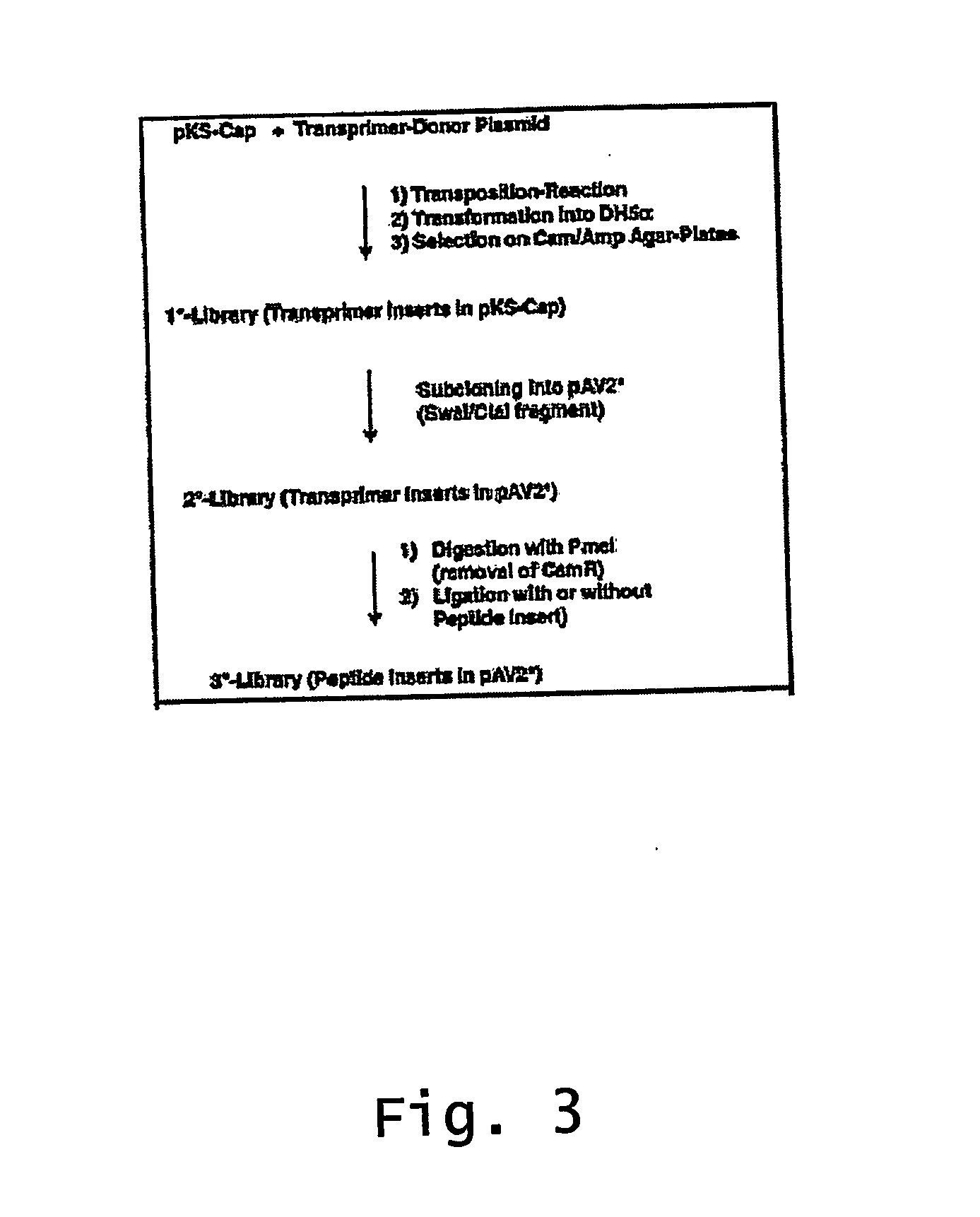
[0112] As described in Example 1, the Cap region of AAV was subcloned into pKS to produce the initial plasmid library by excising VP1-coding region from pDG with SwaI / ClaI (pKS-Cap, FIG. 1). Similarly, an infectious clone with these restriction sites was generated by inserting a ClaI site into pAV2 (pAV2*, FIG. 9). To produce the secondary plasmid library containing the Transprimer insertions in pAV2*, this SwaI / ClaI fragment was excised from the plasmids of the primary library (FIG. 4) and inserted into pAV2* digested with the same enzymes. With this procedure, this secondary plasmid library will contain insertions not only in the VP1 coding region but also between the SwaI site and the ATG start codon of VP1 as well as between the TAA stop codon of VP1 and the ClaI site. Previous experiments have shown that even small changes, such as single point mutations, in the region between the SwaI site and the VP1 start codon, will result in non-infectious ...
example 3
Linker Insertion Mutagenesis with Peptide Ligands
[0114] This Example outlines the preparation and screening of AAV plasmid libraries with ligand inserts at all possible sites. Primarily, HA-epitopes as well as an Integrin-binding ligand called L14 (Girod et al., Nat Med, 1999; 5:1052-6) are prepared. Mutant AAV that present this ligand have been generated previously and have been demonstrated to be able to transduce the Integrin expressing mouse melanoma cell line B16F10. The transducing titers reported, however, are comparatively low (Girod et al., Nat Med, 1999; 5:1052-6). The instant experiments will determine whether better insertion sites are available.
[0115] Next, optimal insertions into the AAV capsid are determined for a variety of peptides and protein ligands of various sizes. Table 1 (above), lists peptide and protein ligands of interest. The ligands and epitopes listed in Table 1 include both sequences for which AAV mutants have been reported in the literature as well a...
PUM
| Property | Measurement | Unit |
|---|---|---|
| frequency | aaaaa | aaaaa |
| viral structure | aaaaa | aaaaa |
| homogenous | aaaaa | aaaaa |
Abstract
Description
Claims
Application Information
 Login to View More