
Method and system for fast context based adaptive binary arithmetic coding
a technology of adaptive binary arithmetic and context, applied in the field of entropy encoding of video data, can solve the problems of high computational cost, high computational cost, and high computational cost of arithmetic coding, and achieve the effect of reducing function call overhead, significantly faster implementation of cabac on dsps and other processing devices, and increasing instruction level parallelism
- Summary
- Abstract
- Description
- Claims
- Application Information
AI Technical Summary
Benefits of technology
Problems solved by technology
Method used
Image

Examples
Embodiment Construction
[0026] The detailed description set forth below in connection with the appended drawings is intended as a description of various embodiments of the present invention and is not intended to represent the only embodiments in which the present invention may be practiced. The description includes specific details for the purpose of providing an understanding of the present invention.
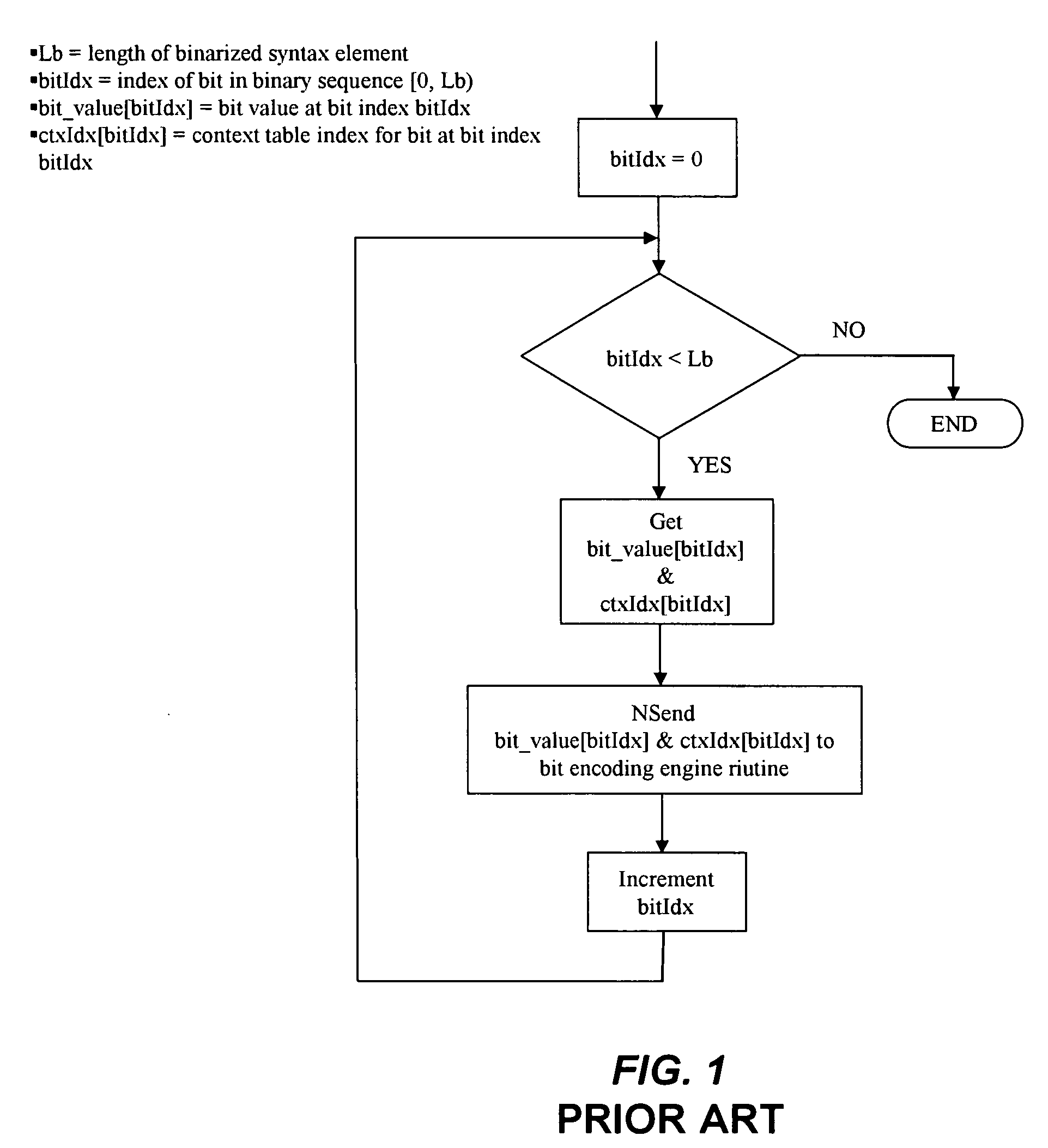
[0027] One or more embodiments of the present invention will now be described. FIG. I depicts in simplified form the flow of the CABAC encoding process of a syntax element in H.264 standard software. In this case, the binarization, context index selection, and arithmetic encoding stages are intertwined on a bit-by-bit basis. This close coupling greatly increases procedure calls overhead.
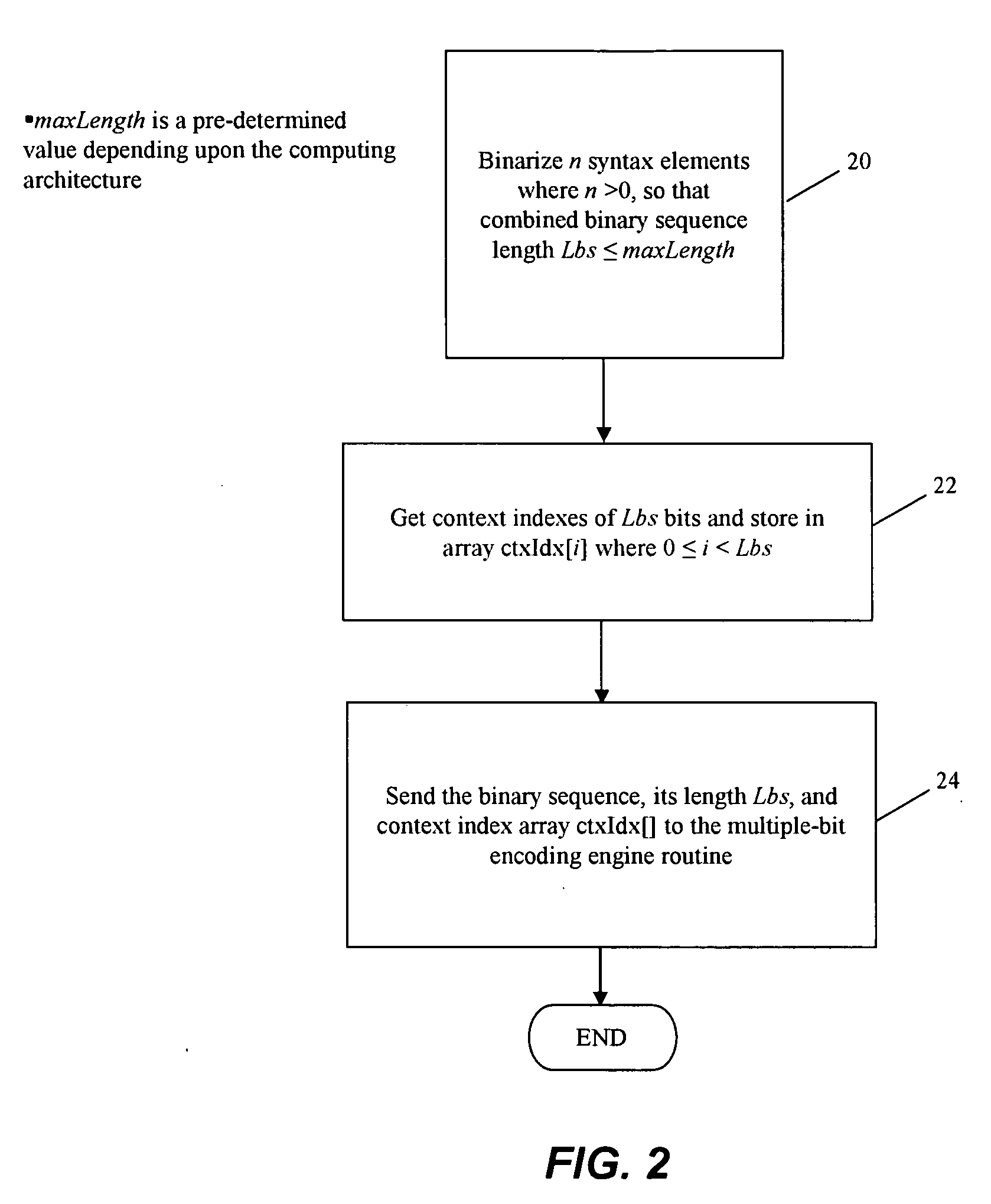
[0028]FIG. 2 is a flow diagram of the CABAC encoding process according to one embodiment of the present invention. Here, the binarization and context index selection stages (20, 22) are increasingly decoupled from the encod...
PUM
 Login to View More
 Abstract
Description
Claims
Application Information
 Login to View More