
Modulators of pharmacological agents
a technology of pharmacological agents and modules, applied in the direction of dna/rna fragmentation, peptide/protein ingredients, depsipeptides, etc., can solve the problems of increased healthcare costs, side effects of many drugs, undesirable or uncontrollable outcomes,
- Summary
- Abstract
- Description
- Claims
- Application Information
AI Technical Summary
Benefits of technology
Problems solved by technology
Method used
Image

Examples
example 1
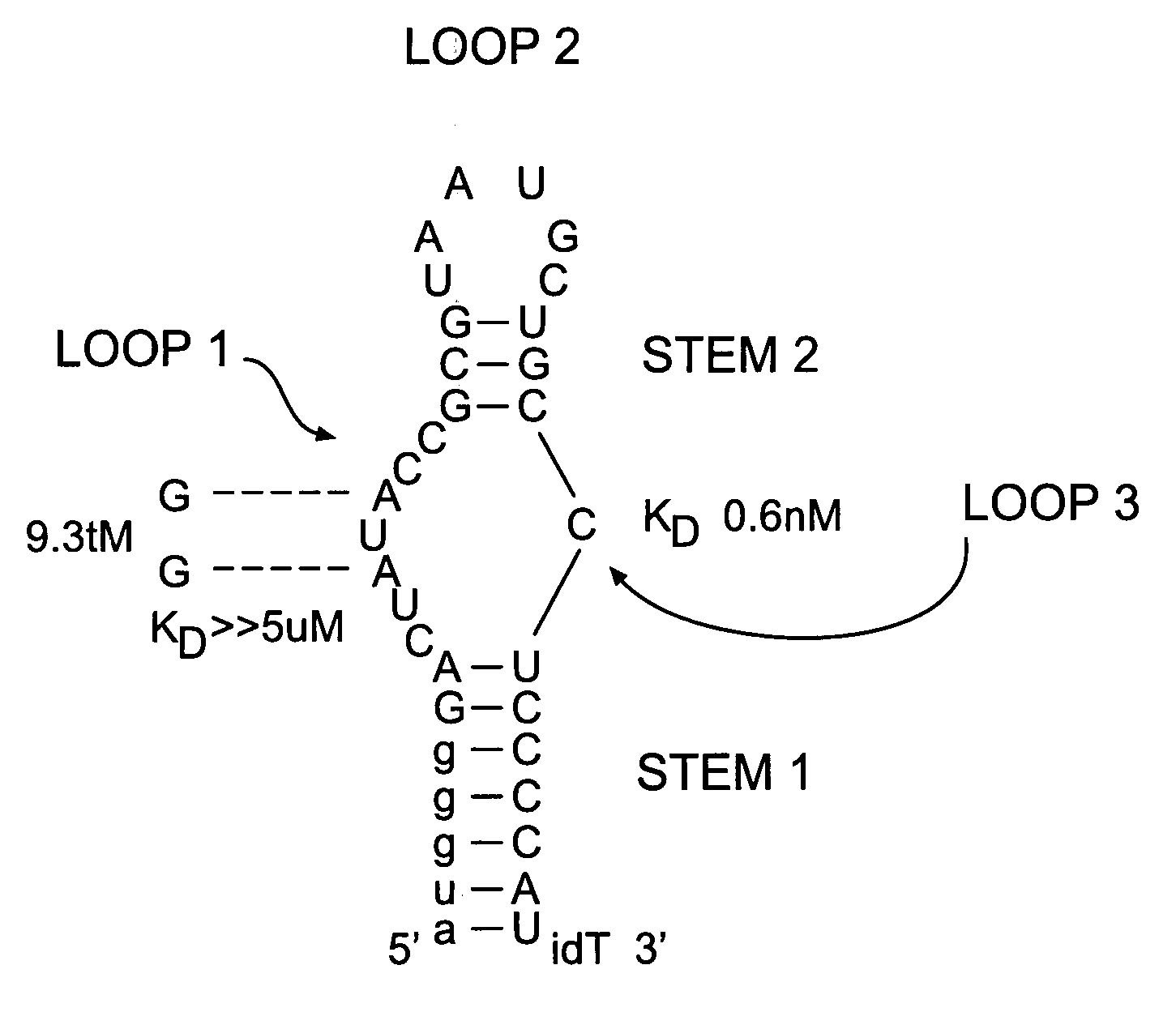
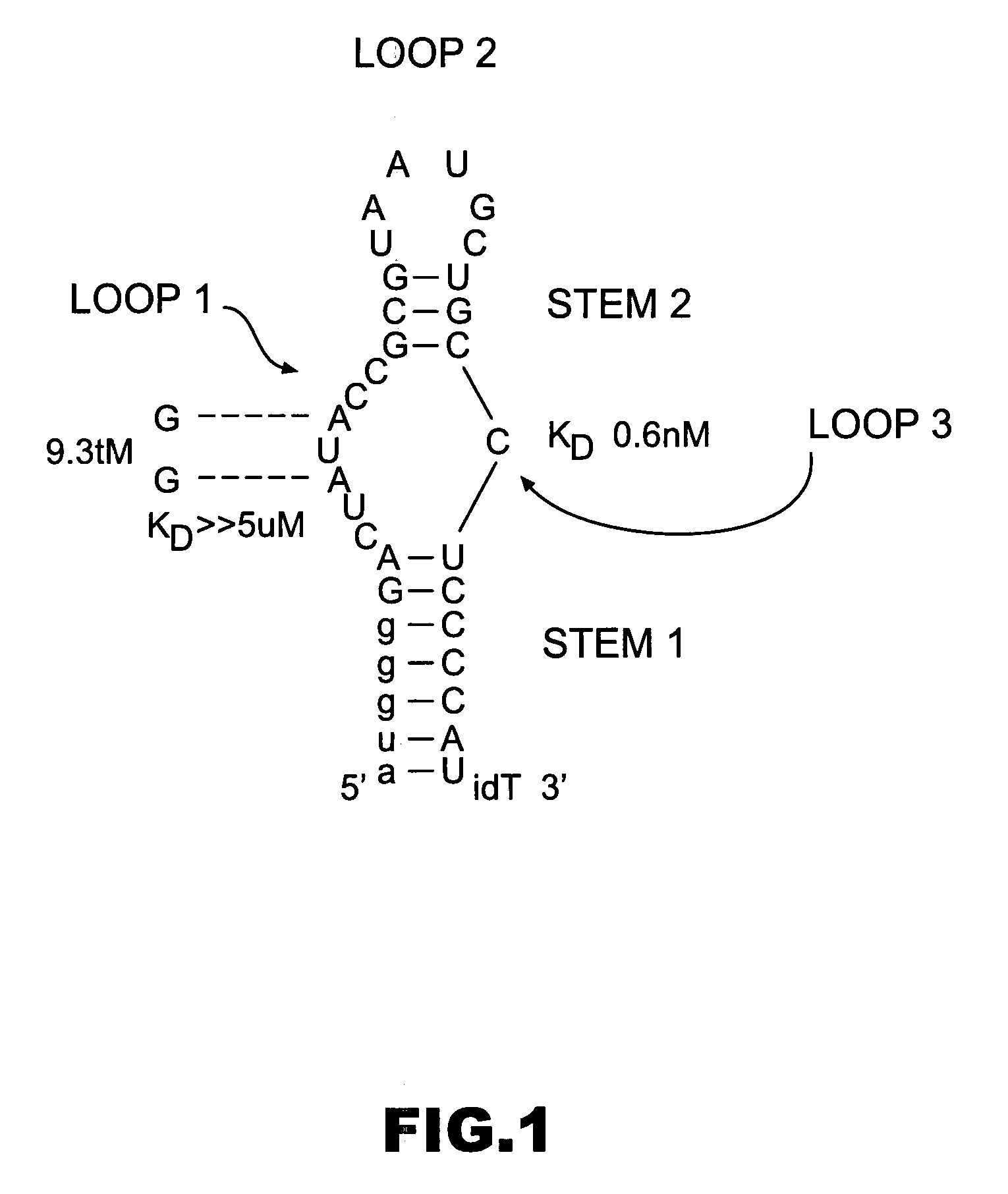
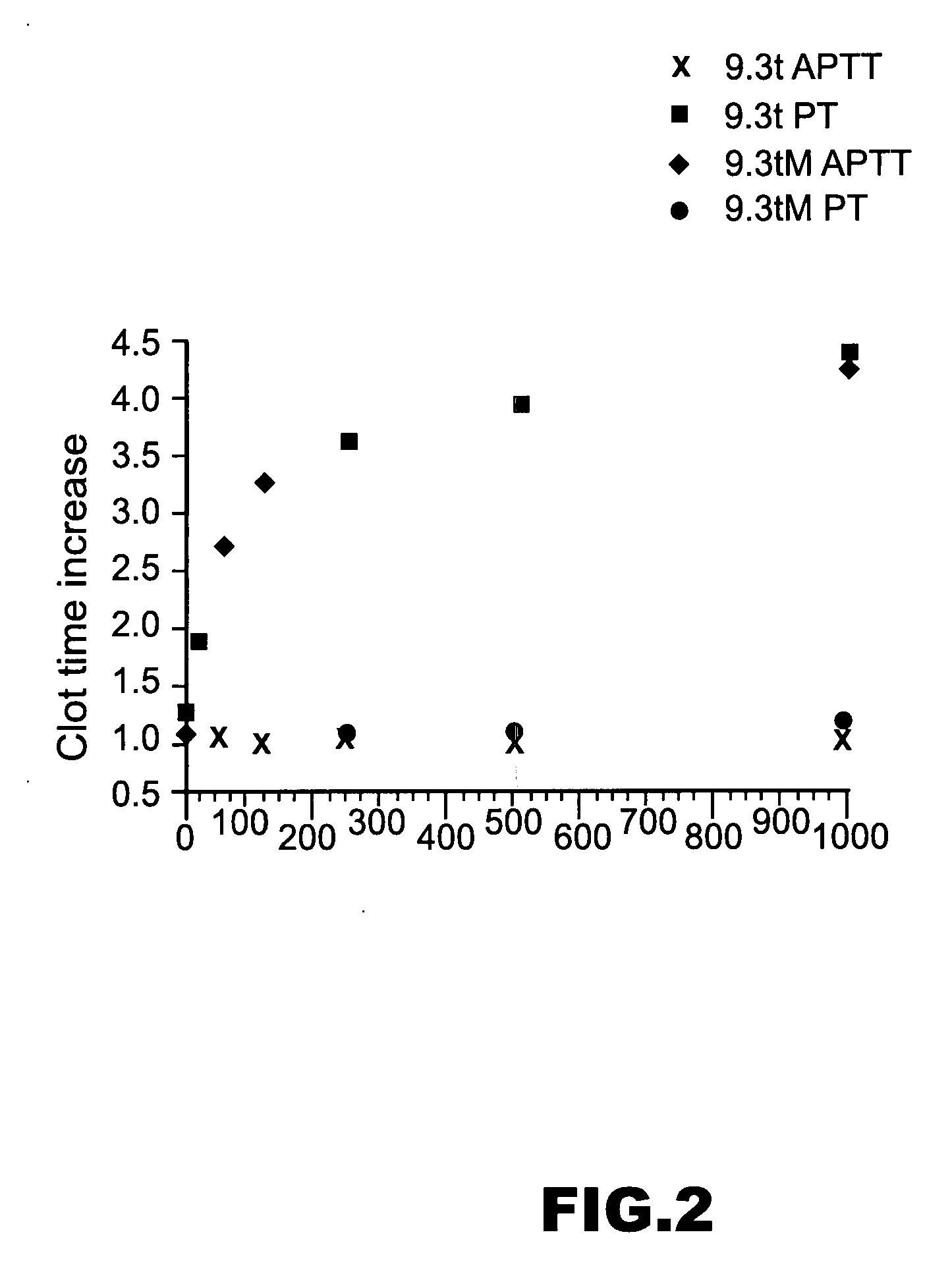
[0219] Nuclease-resistant 2′-fluoro pyrimidine-modified aptamers to human coagulation Factor IXa were generated as described in WO 0226932 A2. Eight iterative cycles of selection were performed, yielding a family of 16 aptamers with high affinity for FIXa; KD's ranging from ˜0.6-15 nM in physiologic salt and pH at 37° C. Comparative sequence analysis made it possible to predict and synthesize the minimized version of the highest affinity aptamer, termed RNA 9.3t (“t” for truncate), shown in FIG. 1. This 34 nucleotide aptamer has a molecular weight of 11.5 kDa and binds FIXa with essentially the same affinity as the full-length sequence (KD0.6 nM). As a control, a mutant version of RNA 9.3t termed 9.3tM was synthesized in which the absolutely conserved A's in the internal loop were mutated to G's (FIG. 1). This aptamer binds FIXa with a KD>5 μM as determined by competition binding assays. In all activity assays, RNA 9.3tM is employed as a control to measure any ...
example 2
Oligonucleotide that Reverses Interaction of the FIXa Aptamer with Coagulation FIXa
[0224] The secondary structure model of 9.3t is shown in FIG. 1 and was developed from comparative sequence analysis of the related FIXa aptamer sequences shown in FIG. 7. These data strongly support formation of the stem-looped structure depicted in FIG. 1. In addition, mutational analysis of aptamer 9.3t demonstrated that disruption of either stem 1 or stem 2 resulted in a greater than 1000 fold loss of affinity for FIXa. Therefore, a 17 residue all 2′Omethyl oligonucleotide was designed (sequence 5′ auggggaggcagcauua 3′) (Anti-D1) complementary to the 3′half of aptamer 9.3t beginning at the 5′ end of loop 2 (L2 in FIG. 7) and extending to the 3′ end of the aptamer. This design allows for nucleation of an intermolecular duplex between the oligonucleotide and loop 2 of the aptamer. Also, formation of the intermolecular duplex is thermodynamically favored due to both the length and base composition o...
example 3
Specificity of Oligonucleotide Antidotes
[0227] In order to assess the specificity of an oligonucleotide antidote, aptamer 9.20t was prepared (see FIG. 10A). Stem 1 of 9.20t is identical to stem 1 of aptamer 9.3t, as is the 3′ half of stem 2. The main differences between 9.20t and 9.3t are found in loop 2 and loop 3 (compare FIG. 1 with FIG. 10A).
[0228] Aptamer 9.20t binds FIXa with a KD comparable to that of 9.3t. APTT assays were used to measure the clot time of human plasma as a function of the concentration of aptamer 9.20t. Its in vitro anticoagulant potency in human plasma was comparable to that of 9.3t (FIG. 10B). Aptamer 9.20t was added to human plasma at a concentration of 50 nM and allowed to bind to plasma FIX for 5 minutes. Varying concentrations of antidote oligonucleotide Anti D1 were then added, and the APTT was measured at 10 minutes after antidote addition to plasma. The relative change in clot time caused by 9.20t addition to plasma was unaffected by the addition ...
PUM
| Property | Measurement | Unit |
|---|---|---|
| equilibrium dissociation constants | aaaaa | aaaaa |
| angle | aaaaa | aaaaa |
| temperature | aaaaa | aaaaa |
Abstract
Description
Claims
Application Information
 Login to View More