
Method of attaching drug compounds to non-reactive polymer surfaces
a technology of non-reactive polymer and compound, which is applied in the direction of drug composition, prosthesis, biocide, etc., can solve the problems of virtually no polymer material available that does not require surface modification, detrimental to biomaterials, and inability to develop materials that can be used as implants or other devices that come into contact with the human body
- Summary
- Abstract
- Description
- Claims
- Application Information
AI Technical Summary
Benefits of technology
Problems solved by technology
Method used
Image

Examples
example 1
Generating Acid Groups on the Surface of ePTFE Polymer
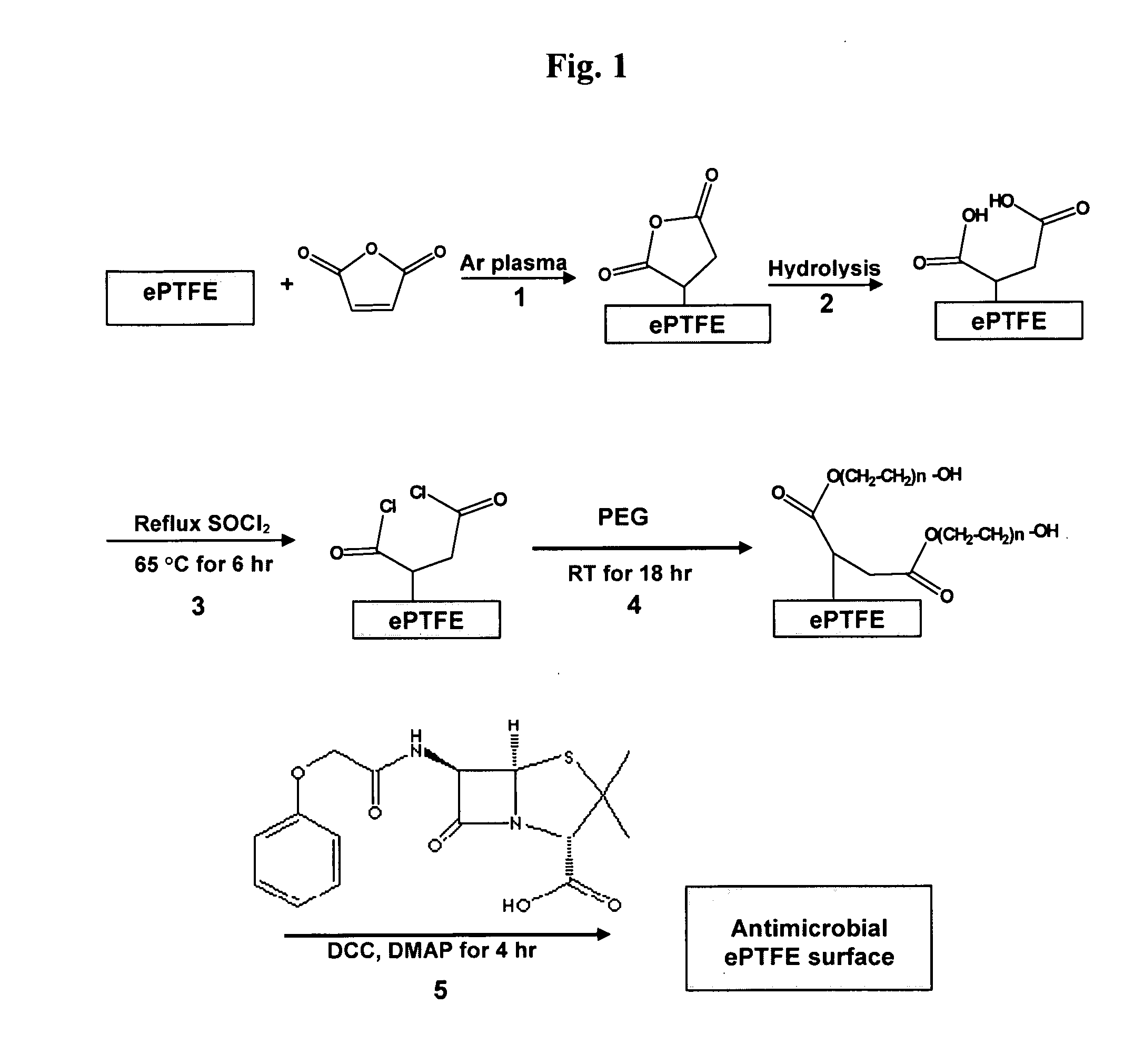
[0092]FIG. 1 illustrates a strategy for performing surface reactions that are amenable for producing antimicrobial ePTFE surfaces. An effective method of generating acid groups on polymeric surfaces is the employment of surface microwave plasma reactions in the presence of maleic anhydride, followed by surface hydrolysis thereof (Gaboury and Urban, 1993). These reactions are illustrated in FIG. 1 (steps 1 and 2). The generation of carboxylic acid (COOH) groups on the ePTFE surface is useful because of their functionality with regards to carrying out further surface modifications.
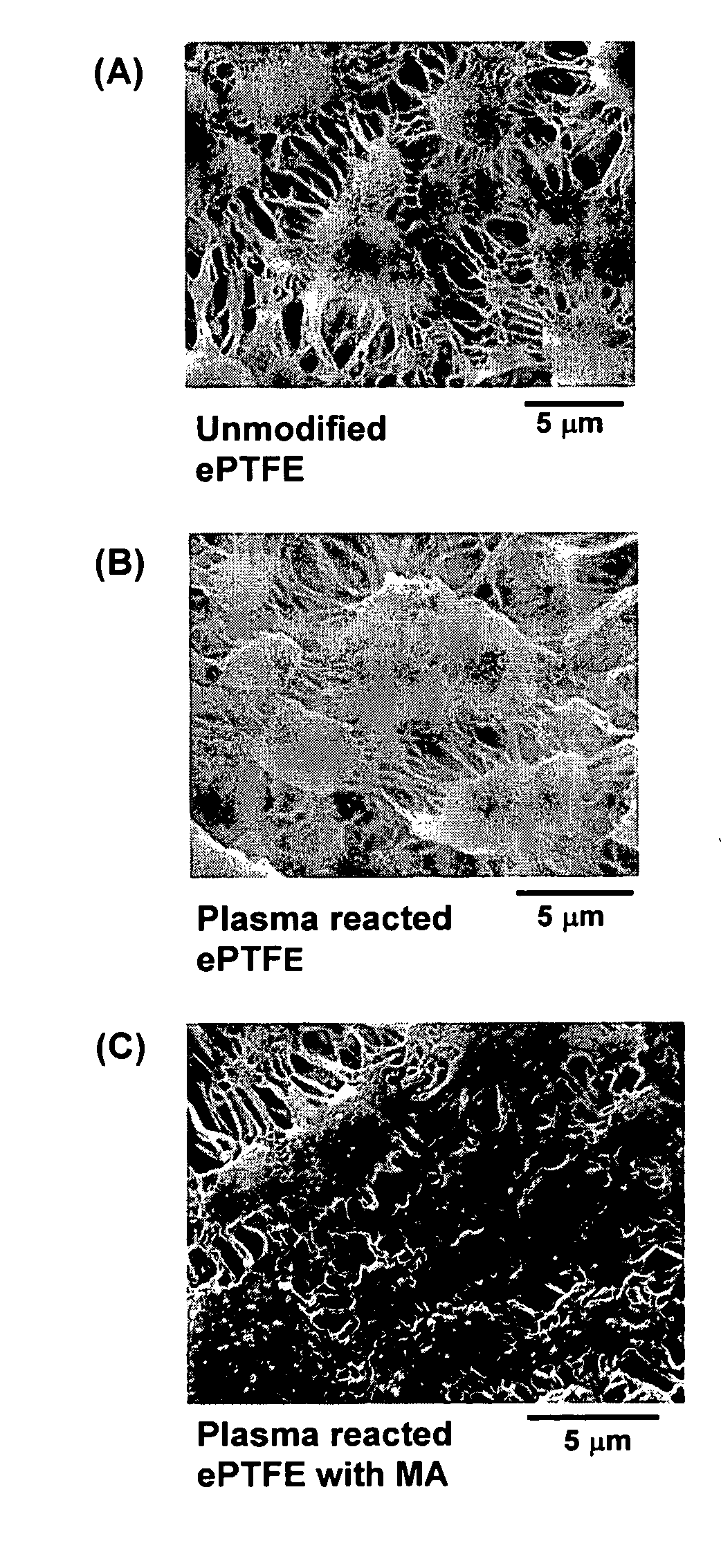
[0093]The following protocol was carried out to generate acid groups on the surface of ePTFE. ePTFE specimens were purchased from Philips Sci Inc. (Rock Hill, S.C.), cut to 7×7 mm squares, followed by washing with acetone in an ultrasonic washer, and dried at room temperature under vacuum conditions before use. Plasma reactions were conducted using open ...
example 2
Producing an Antimicrobial Surface on ePTFE Polymer that has been Pre-Modified with Acid Groups
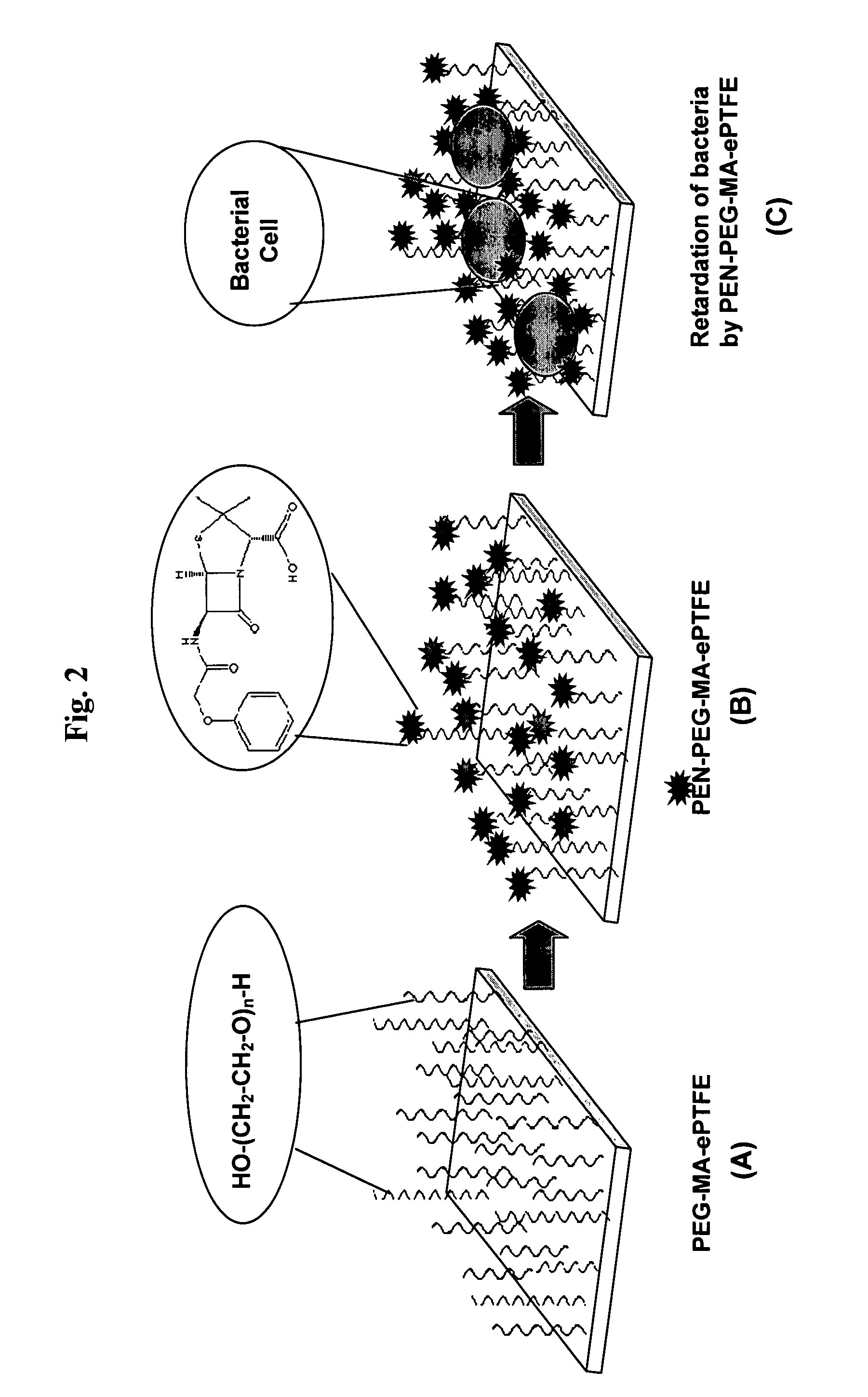
[0097]Penicillin (PEN) was chosen as the antibiotic for modifying ePTFE polymer to create an antimicrobial surface, whereupon bacterial colonization and biofilm formation is prevented. To this end, it may be preferable to provide suitable surface functionality and morphology to the ePTFE polymer in order to 1) affix penicillin thereupon and to 2) optimize bactericidal effects of PEN once affixed. Although acid groups are capable of reactions with PEN, the anti-bacterial activity of PEN when attached closely to the polymer surface may be compromised. Therefore, to enhance the anti-bacterial activity of surface-attached PEN, we introduced flexible spacer groups between the COOH-functionalized surface and PEN molecules. The choice of PEG was dictated by its non-toxicity, biocompatibility, and the ability to swell in aqueous environments (Levesque et al., 2002; Elbert and Hubbell, 1996; both...
example 3
Demonstrating the Antimicrobial Activity of ePTFE Polymer Surfaces Modified with Antibiotic
[0102]In an effort to demonstrate the effectiveness of these surface reactions with respect to antimicrobial activity, a series of experiments was conducted in which modified and unmodified ePTFE specimens were placed into bacterial cultures. To carry out this analysis, Staphylococcus aureus (RN 6390) and Pseudomonas aeruginosa (ATCC, Rockville, Md.) were allowed to grow overnight in LB broth and King's medium, respectively. A series of specimens (ePTFE, MA-ePTFE, PEG-MA-ePTFE, PEN-PEG-MA-ePTFE, and PEN-ePTFE) were immersed into freshly incubated cultures of each bacteria and incubated at 37° C. for three to four hours. Anti-microbial activity was determined both by visual observation of the cultures as well as by measuring the absorbance of each culture at 600 nm using a UV-VIS spectrometer (Beckman DU-600).
[0103]Photographs (data not shown) were taken that depict turbidity differences in St...
PUM
| Property | Measurement | Unit |
|---|---|---|
| temperature | aaaaa | aaaaa |
| temperature | aaaaa | aaaaa |
| temperature | aaaaa | aaaaa |
Abstract
Description
Claims
Application Information
 Login to View More