
Distributed track identifier on a hard disk drive
a technology of hard disk drives and track identifiers, applied in the direction of data recording, magnetic recording, instruments, etc., can solve the problem that most computing systems are not operational
- Summary
- Abstract
- Description
- Claims
- Application Information
AI Technical Summary
Problems solved by technology
Method used
Image

Examples
example cases
[0023]The following examples are for illustration only; they show three of several possible methods for distributed TID and by no means are intended to limit the claims in this invention.
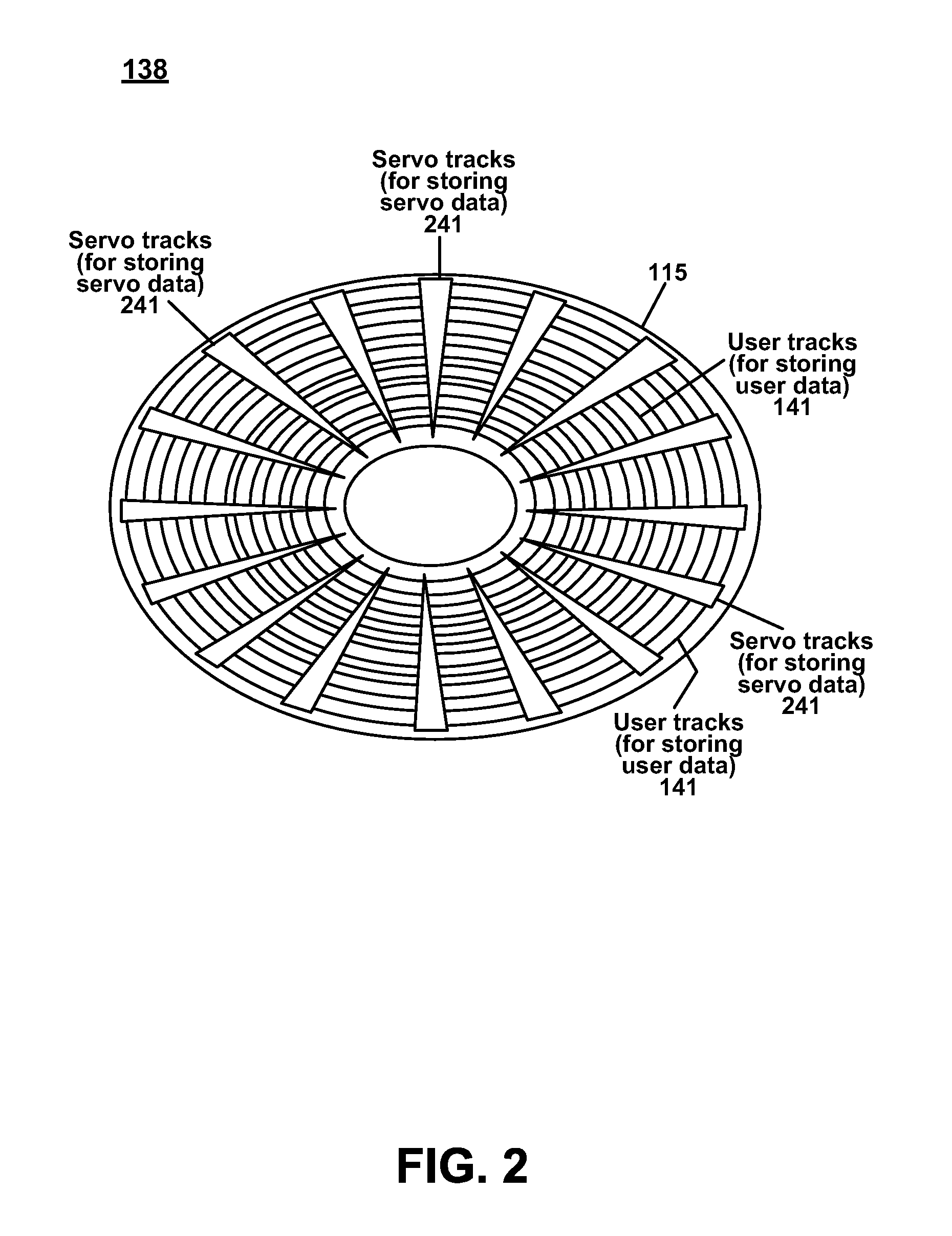
[0024]In a first example, we want to distribute the TID as much as possible, say, into TID0, TID1, TID2 . . . We assume that the sector number is known with total precision. We establish a minimal number of bits for the least significant bits (LSBs) in the TID that allows us an approximate idea of where the TID is (an estimator may help determine the exact location). In order to obtain completely the TID we need to determine the most significant bits (MSBs). So, basically we encode the LSBs using a Gray code and we distribute each of the MSBs.
[0025]Let's say, for the sake of discussion, that we need at least 6 LSBs to determine the TID. Let's assume also that we need 18 bits to determine completely the TID (i.e., we can have up to 218 TIDs). Then we add one bit to the 6 LSBs (which are Gray encoded)...
PUM
| Property | Measurement | Unit |
|---|---|---|
| length | aaaaa | aaaaa |
| magnetic | aaaaa | aaaaa |
| rotational speed | aaaaa | aaaaa |
Abstract
Description
Claims
Application Information
 Login to View More