
Speaker assembly with directional adjustability
a technology of directional adjustment and speaker assembly, which is applied in the direction of transducer details, electrical apparatus casings/cabinets/drawers, transducer details, etc., can solve the problems of limited rotation, pressure fit components that do not allow for adjustment of tension during assembly process, and speaker positions that cannot be firmly locked in pla
- Summary
- Abstract
- Description
- Claims
- Application Information
AI Technical Summary
Benefits of technology
Problems solved by technology
Method used
Image

Examples
Embodiment Construction
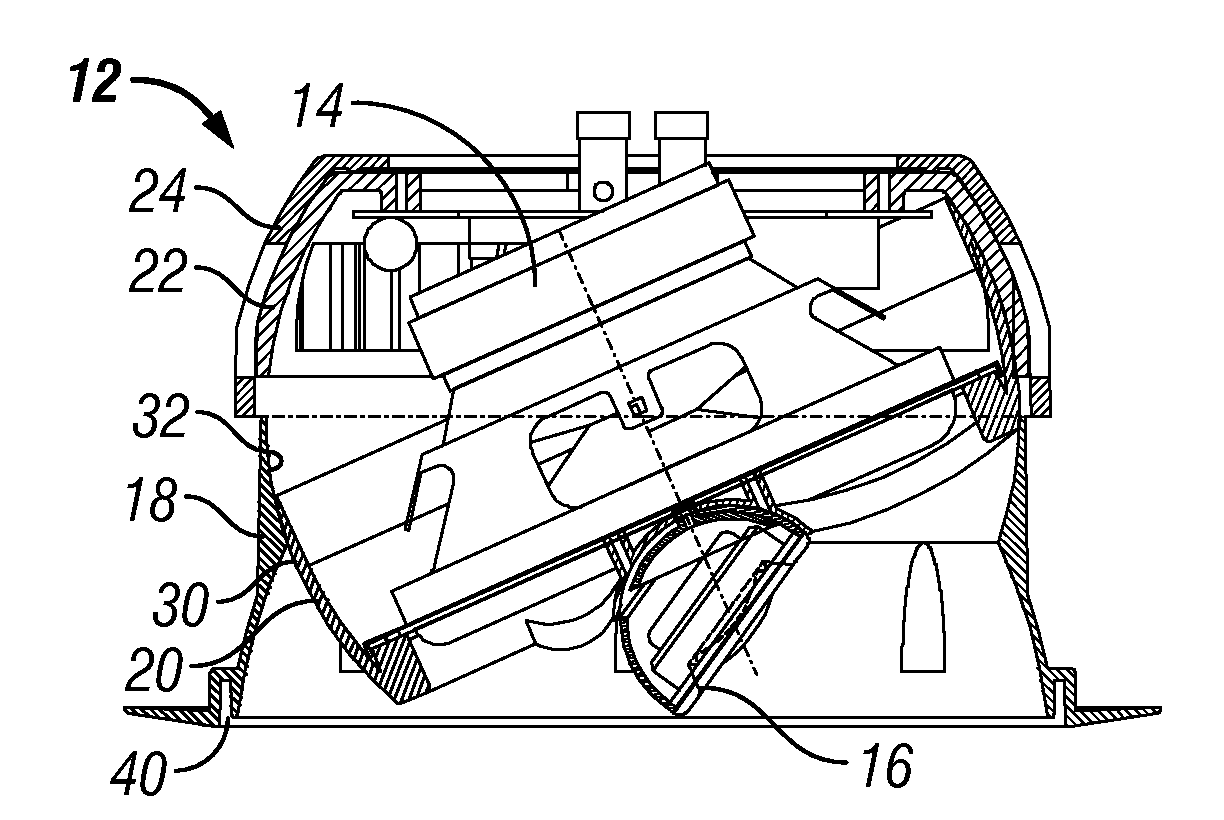
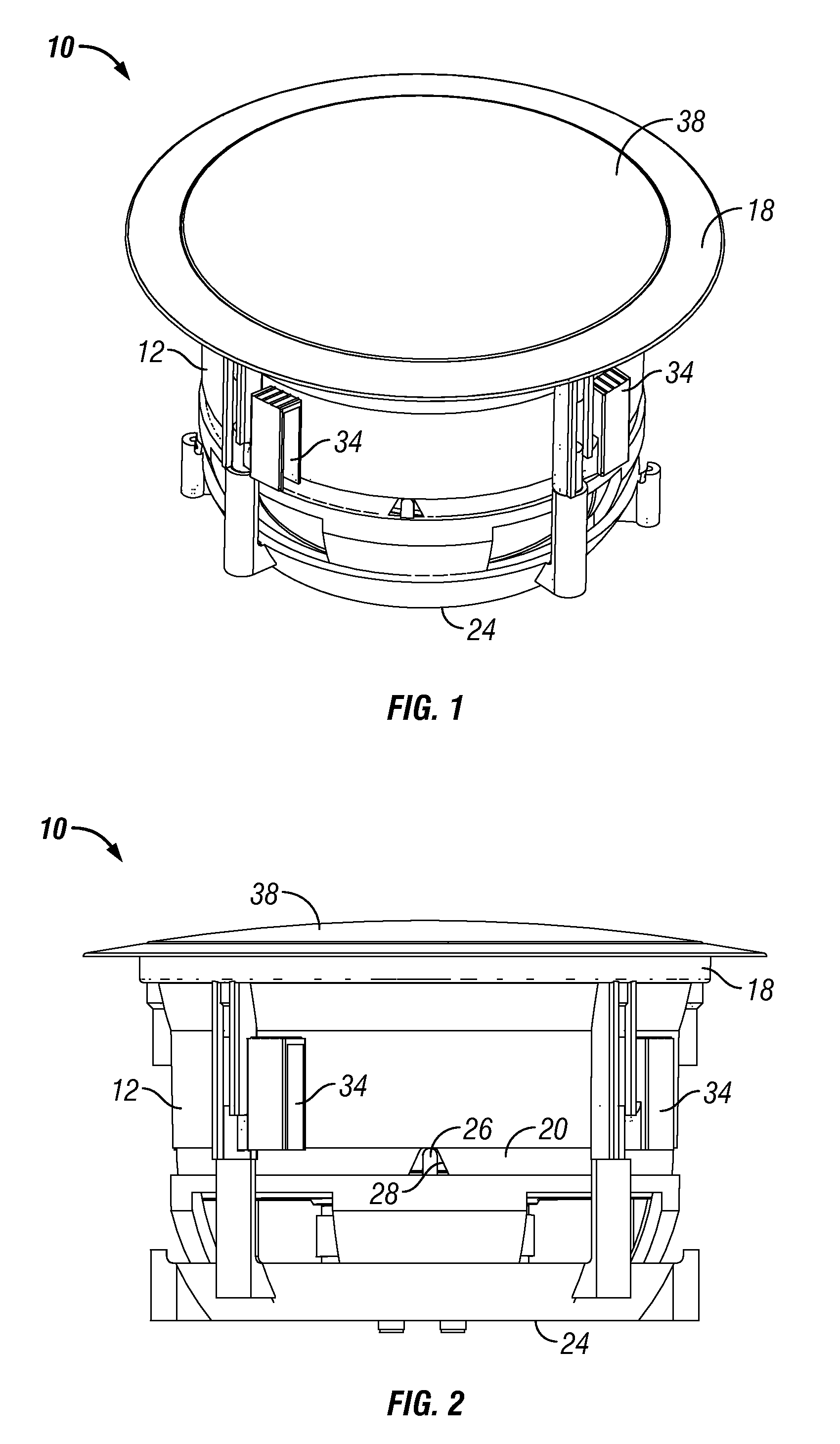
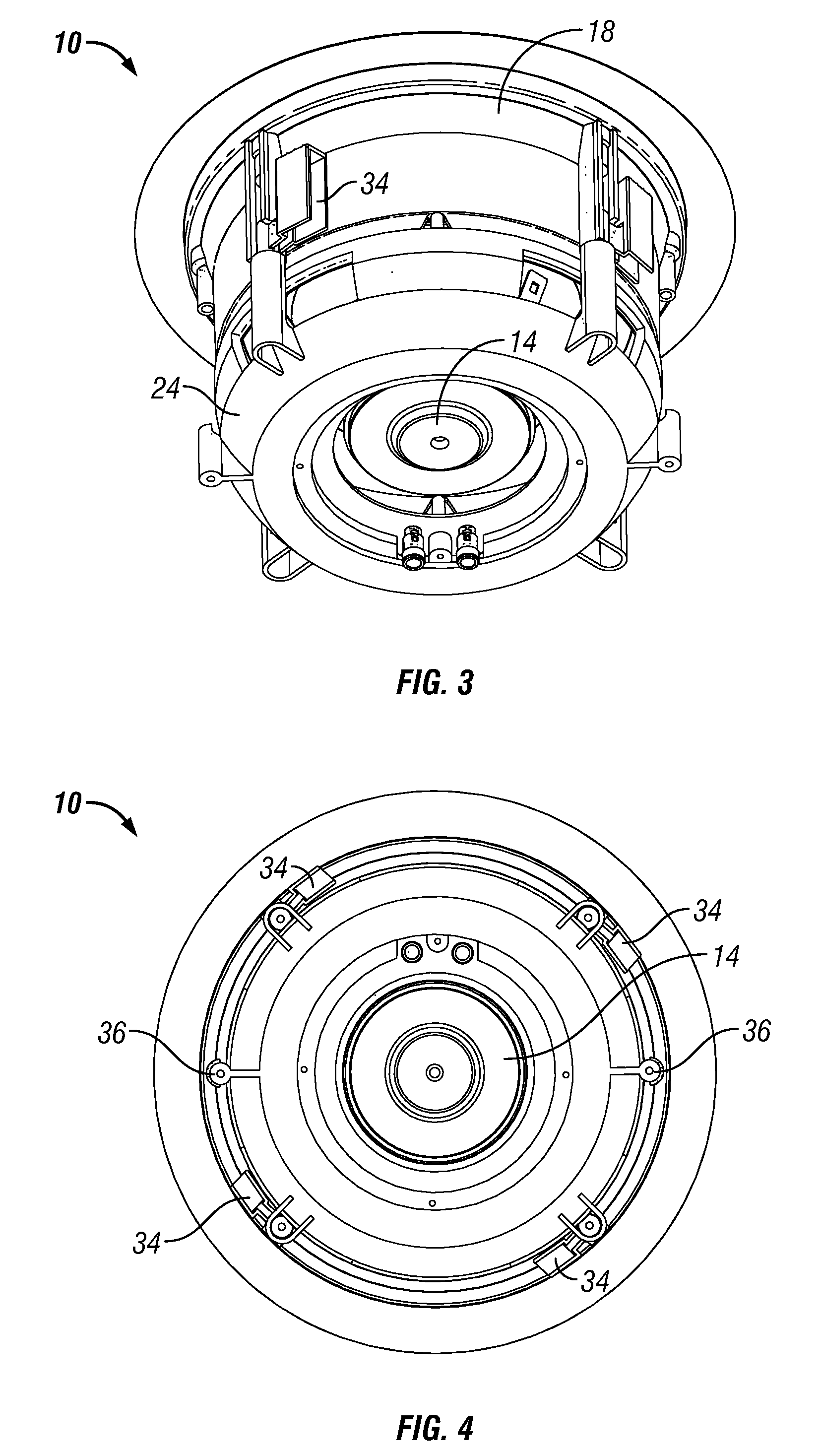
[0038]The speaker assembly of the present invention is generally designated in the drawings by the reference numeral 10. The assembly 10 includes a housing 12, a woofer or driver 14, and a tweeter 16. The housing 12 is designed so as to allow the driver 14 to be tilted and rotated about a center axis of the housing.
[0039]More particularly, the housing 12 includes four primary components, the baffle 18, the swivel 20, the swivel cup 22, and the retainer 24, as best seen in FIGS. 9, 11 and 13. The driver 14 and tweeter 16 are mounted in the swivel 20. The swivel cup 22 includes a pair of ribs 26 (FIGS. 9 and 21) extending downwardly from the opposite sides of the cup 22. The swivel 20 has a pair of recesses 28 (FIGS. 9 and 17) formed on the opposite sides to receive the ribs 26 and pivot about the ribs approximately 30° in either direction. Thus, the total pivotal movement of the swivel 20 relative to the swivel cup 22 is approximately 60°. For example, FIG. 6 shows the swivel 20 and ...
PUM
 Login to View More
 Abstract
Description
Claims
Application Information
 Login to View More