Deterministically skewing synchronized events for content streams

a technology of synchronized events and content, applied in the computer field, can solve the problems of limiting the number of unique video programs that can be broadcast (or transmitted) at any one time to homes, affecting the success rate of the content stream, so as to reduce the peak bandwidth requirement, reduce the load on the signaling control, and improve the success rate

US20100218227A1Active Publication Date: 2010-08-26AKAMAI TECH INC
53 Cites 28 Cited by

Patent Information

Authority / Receiving Office
US · United States
Patent Type
Applications(United States)
Current Assignee / Owner
Publication Date
2010-08-26

Smart Images

  • Figure 1
    Figure 1
  • Figure 2
    Figure 2
  • Figure 3
    Figure 3
Patent Text Reader

Abstract

Described are computer-based methods and apparatuses, including computer program products, for deterministically skewing synchronized events for content streams. A first content stream comprising at least one content processing location is buffered in a first buffer, wherein the first buffer is associated with a first processing delay parameter. A second content stream is buffered in a second buffer, the second content stream comprising at least one content processing location, the second buffer being associated with a second processing delay parameter that is different from the first processing delay parameter. The first content stream is processed at the at least one content processing location of the first content stream at a first content processing time based on the first processing delay parameter. The second content stream is processed at the at least one content processing location of the second content stream at a second content processing time based on the second processing delay parameter.
Need to check novelty before this filing date? Find Prior Art

Description

FIELD OF THE INVENTION

[0001] The present invention relates generally to computer-based methods and apparatuses, including computer program products, for deterministically skewing synchronized events for content streams.BACKGROUND

[0002] Video that is transmitted in the radio frequency (RF) spectrum (e.g., distributed from a cable head-end) may use Quadrature Amplitude Modulation (QAM), or for terrestrial broadcasts (e.g., Advanced Television Systems Committee (ATSC) over air in the US) 8-Vestigial Sideband Modulation (8VSB), or Coded Orthogonal Frequency Division Multiplexing (COFDM) in Europe. Both convert the digital video into a modulated RF signal that is up-converted and transmitted in the analog RF spectrum. For example, 256-QAM has approximately a 5.1 MHz symbol rate at 6 MHz, with each symbol capable of representing 8 bits of information. This means a 256-QAM channel is able to transmit approximately 40 Mbps of digital data information within the 6 MHz RF Channel (note that Eur...

Examples

Embodiment Construction

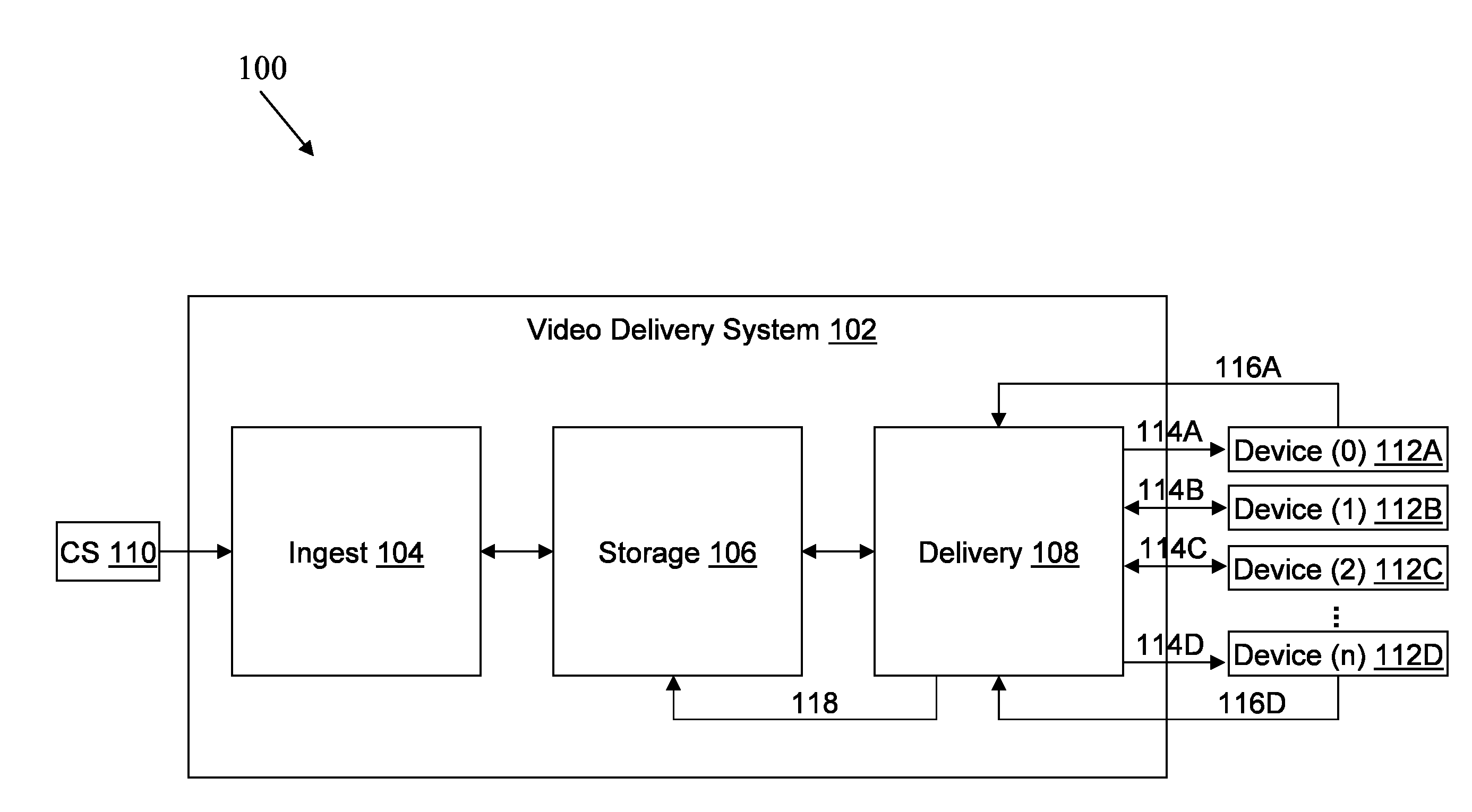
[0050]In general overview, signaling requests are distributed over a larger window of time, so that a video delivery system can respond to more subscriber requests with less observable delay. This is done by staggering the delivery of per-subscriber unicast video over a larger window of time than naturally occurring (e.g., even if from the same source). Advantageously, the number of simultaneous signaled events or content processing events (e.g., ad insertions) can also be spread over the same window of time (i.e., a larger averaging window), reducing the peak rate of requests and processing load. Although the specification describes these techniques mostly in terms of the subscriber, the techniques described herein work equally as well on individual devices, such as STBs.

[0051]FIG. 1 is an exemplary diagram 100 illustrating a video delivery system 102. The video delivery system 102 includes the ingest module 104, storage module 106, and delivery module 108. Content stream 110 is re...