Photoreceptor, Method Of Manufacturing Same, Image Formation Method, Image Forming Apparatus, And Process Cartridge

a technology of photoreceptor and manufacturing method, which is applied in the direction of electrophotography process apparatus, corona discharge, instruments, etc., can solve the problems of abnormal images, increased contact pressure between cleaning blade and photoreceptor, and prone to abraded organic photoconductor repetitively used in electrophotography process, etc., to achieve good electrical characteristics, high and stable abrasion resistance and damage resistan

Inactive Publication Date: 2010-09-09
RICOH KK
View PDF9 Cites 1 Cited by
  • Summary
  • Abstract
  • Description
  • Claims
  • Application Information

AI Technical Summary

Benefits of technology

[0019]Because of these reasons, the present inventors recognize that a need exists for a photoreceptor (photoconductor, image bearing member) that has high and stable abrasion resistance and damage resistance even inside the surface layer with good electric characteristics and produces quality images for a long period of time, a method of manufacturing the photoreceptor, and an image forming apparatus and a process cartridge using the photoreceptor.
[0021]Accordingly, an object of the present invention is to provide a safe photoreceptor (photoconductor, image bearing member) that has high and stable abrasion resistance and damage resistance even inside the surface layer with good electric characteristics and produces quality images for a long period of time, a method of manufacturing the photoreceptor, and an image forming apparatus and a process cartridge using the photoreceptor.

Problems solved by technology

Thus, an organic photoconductor repetitively used in the electrophotography process tends to be abraded under mechanical stress by a developing system or a cleaning system.
Currently, this is a significant problem because the cleaning property of the photoreceptor should be improved to deal with size-reduced toner particles demanded for production of quality images so that usage of hard rubber for the cleaning blade and an increase in the contact pressure between the cleaning blade and the photoreceptor are inevitable.
Such abrasion of a photoreceptor causes deterioration of electric characteristics, for example, the sensitivity and the chargeability, resulting in production of abnormal images having, for example, low image density and background fouling.
Local abrasion damage to a photoreceptor causes streaks on an image due to bad cleaning performance on the photoreceptor.
Therefore, such abrasion and damage determine the working life of a photoreceptor and lead to replacement thereof.
Therefore, the reduction of the abrasion amount is inevitable to manufacture an organic photoconductor having a long working life and creates the most imminent issue in this field.
Among these technologies, the curable binder resin in the surface layer has poor compatibility with a charge transport material and impurities such as a polymerization initiator and non-reacted residual group tend to raise the residual voltage, which leads to deterioration of image density.
Furthermore, the technology of dispersing an inorganic filler in the surface layer tends to cause trap of charge carrier existing on the surface of the inorganic filler, which leads to a rise of residual voltage.
Furthermore, the multi-functional cured acrylate monomer has a compatibility problem with a charge transport material having a low molecular weight simply contained in the surface layer, thereby causing precipitation of the low molecular weight charge transport material and white turbidity.
This easily degrades the mechanical strength.
This creates problems of insufficient curing reaction, and compatibility between the cured material and the binder resin.
Thus, a rough surface is easily manufactured due to the phase separation in the curing reaction, which leads to bad cleaning performance.
However, the resin having no carbon-carbon double bonding with no reactivity with the charge transport material has poor compatibility with a cured material produced in the reaction of the monomer and the charge transport material.
Thus, a rough surface is easily formed while in the phase separation and cross-linking, which results in bad cleaning performance.
In addition to the blocking of monomer curing by, the binder resin as described above, the monomers specified in the technology are two functional, meaning that the number of functional groups is insufficient to obtain a sufficient cross linking density.
Therefore, the obtained photoreceptor does not have sufficient abrasion resistance.
Furthermore, when the binder resin having a reactivity is used, it is difficult to have a good combination of the bonding amount of the charge transport material and the cross-linking density since the monomer and the binder resin have a small number of functional groups.
Therefore, the obtained photoreceptor has insufficient electric characteristics and abrasion resistance.
The radical polymerizable monomer (1) is easily available from the market but the purity thereof is generally low and contains impurities deriving from catalysts, etc.
These degrade abrasion resistance and electric characteristics.
In addition, some of the among radical polymerizable monomers (1) are not safe.
This safety problem is ascribable to the impurities contained in the radical polymerizable monomer (1), particularly residuals relating to the catalyst.

Method used

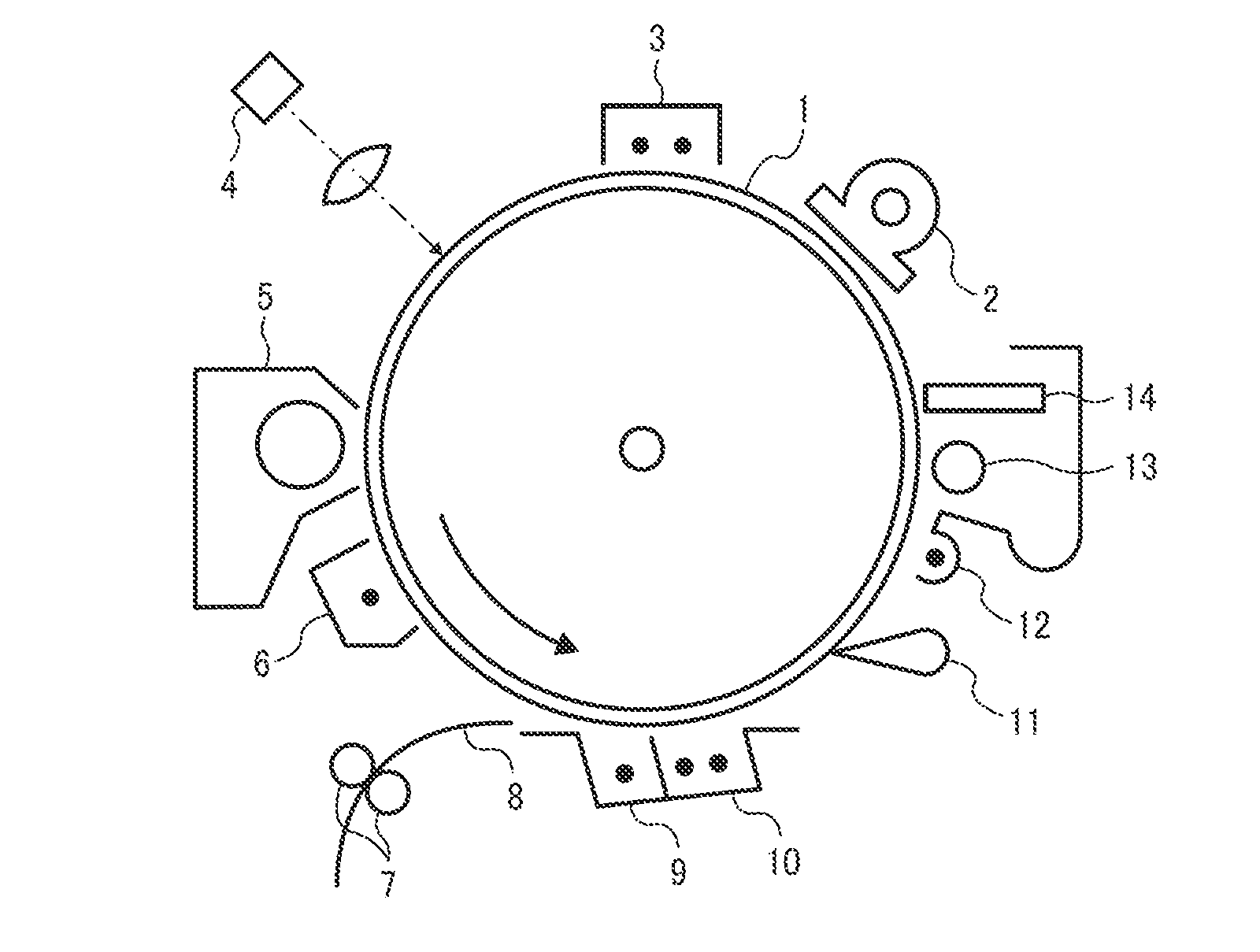
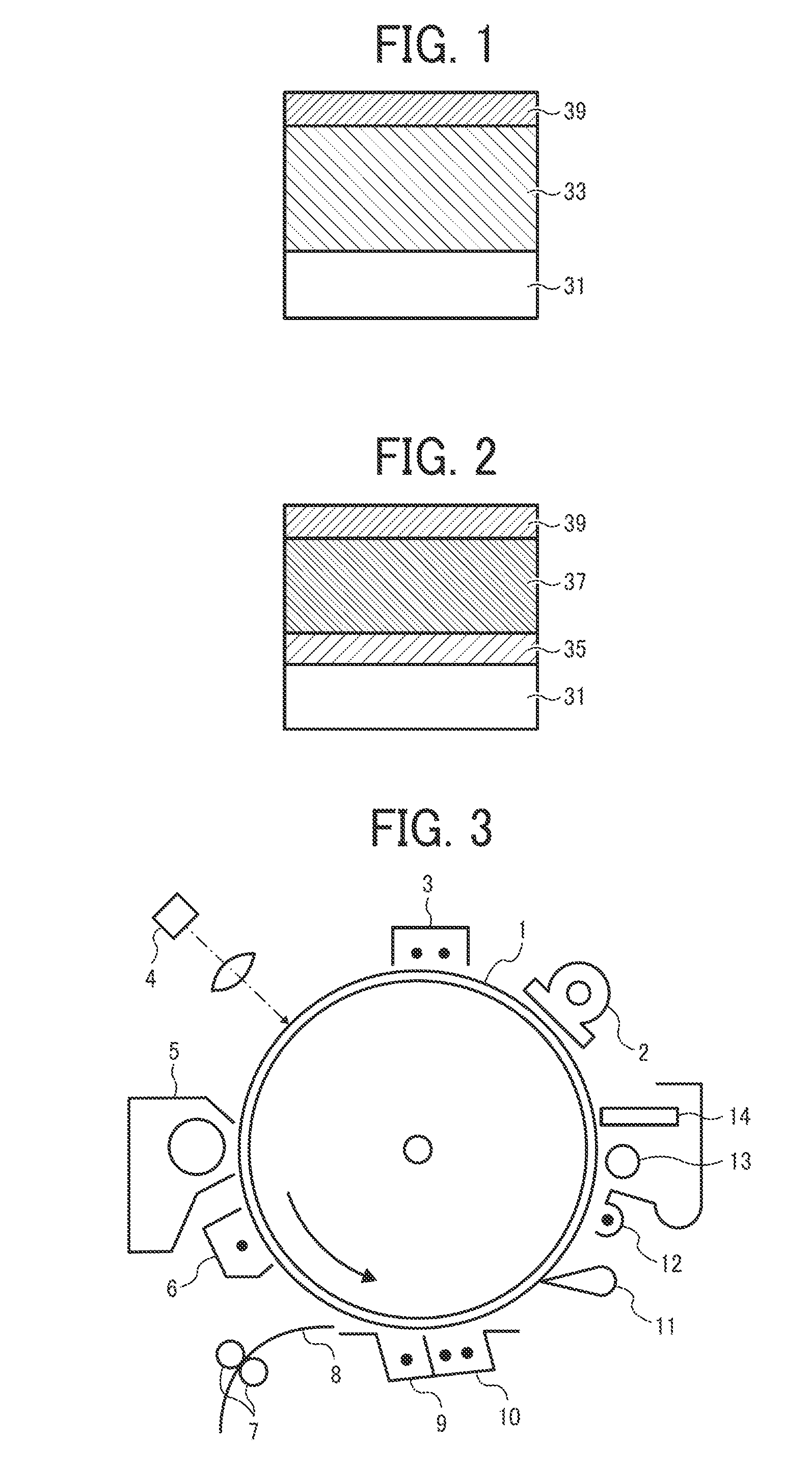
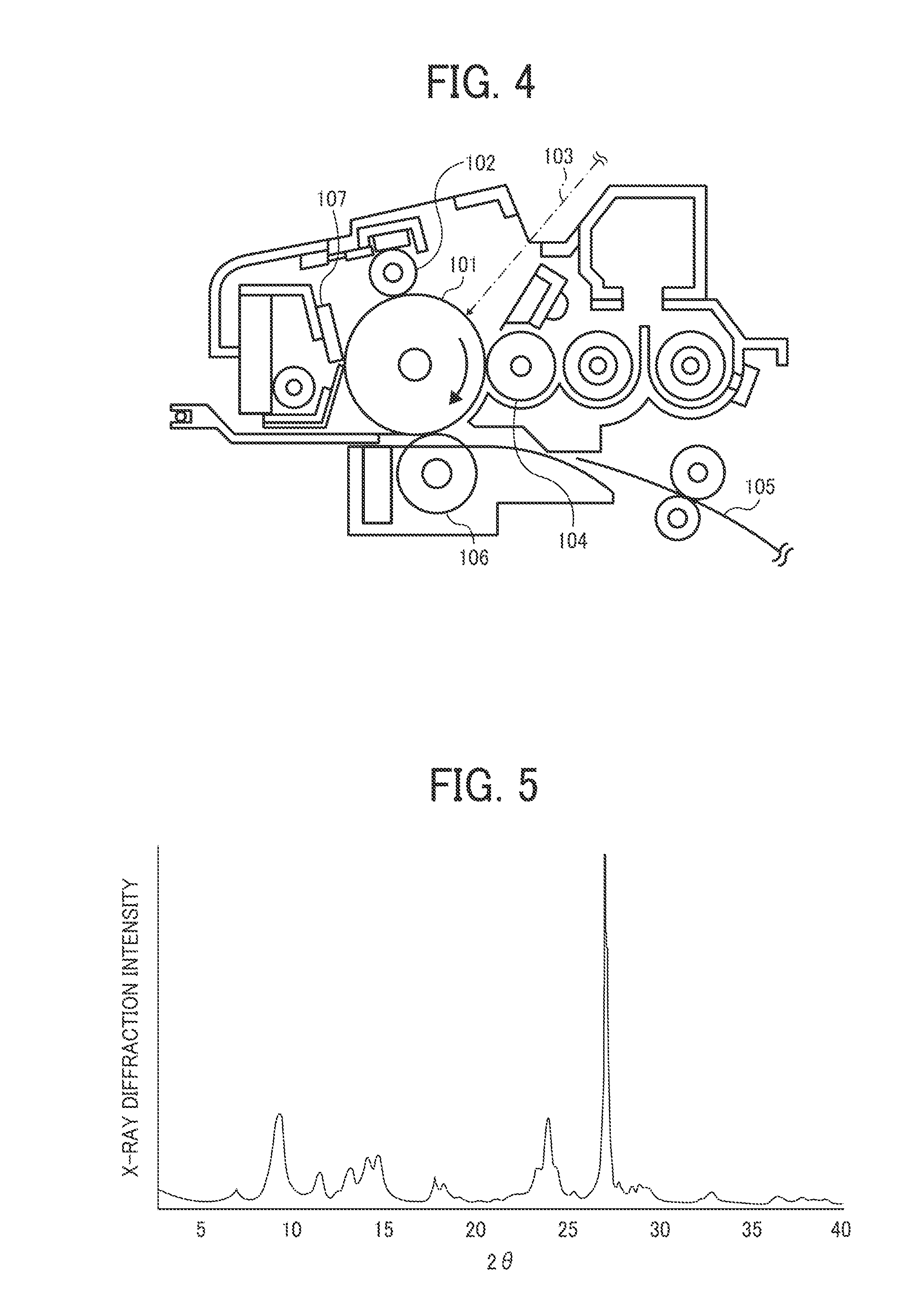
the structure of the environmentally friendly knitted fabric provided by the present invention; figure 2 Flow chart of the yarn wrapping machine for environmentally friendly knitted fabrics and storage devices; image 3 Is the parameter map of the yarn covering machine
View more

Image

Smart Image Click on the blue labels to locate them in the text.
Viewing Examples
Smart Image
  • Photoreceptor, Method Of Manufacturing Same, Image Formation Method, Image Forming Apparatus, And Process Cartridge
  • Photoreceptor, Method Of Manufacturing Same, Image Formation Method, Image Forming Apparatus, And Process Cartridge
  • Photoreceptor, Method Of Manufacturing Same, Image Formation Method, Image Forming Apparatus, And Process Cartridge

Examples

Experimental program
Comparison scheme
Effect test

example 1

[0252]Liquid application having the following recipe is applied to an aluminum substrate (outer diameter: 100 mm φ) by a dip coating method to form an undercoating layer having a layer thickness of 4.0 μm after drying.

Liquid Application for Undercoating LayerAlkyd resin (Beckozole 307-60-EL, manufactured by6.5 partsDainippon Ink and Chemicals, Inc.; Solid portion: 50%)Melamine resin (Super-beckamine G-821-60, manufactured by3.5 partsDainippon Ink and Chemicals, Inc.)Titanium oxide (CR-El, manufactured by Ishiahara Sangyo 60 partsKaisha Ltd.)Methylethylketone 90 parts

[0253]Liquid application for charge generation layer containing the titanyl phthalocyanine pigment is applied to the undercoating layer by a dip coating followed by heating and drying to form a charge generation layer having a layer thickness of 0.3 μm.

Liquid Application for Charge Generation LayerTitanyl phtahlocyanine pigment manufactured by Synthesis2.5 partsExample 1Polyvinylbutyral (BX-1, manufactured by Sekisui0.5 ...

example 2

[0260]The liquid application of surface layer is prepared in the same manner as in Example 1 except that the radical polymerizable monomer having at least 3 functional groups with no charge transport structure for use in the liquid application of surface layer is replaced with a TMPTA (V#295, manufactured by Osaka Organic Chemical Industry Ltd.). The sulfur concentration contained in the TMPTA after refinement is 30 ppmw. The sulfur concentration remaining in the surface layer is 15 ppmw. A mutation test is conducted for the TMPTA refined by the column chromatography and its colony increase multiple is 1.1.

example 3

[0261]The liquid application of surface layer is prepared in the same manner as in Example 1 except that the radical polymerizable monomer having at least 3 functional groups with no charge transport structure for use in the liquid application of surface layer is replaced with a TMPTA (kayarad, manufactured by Nipponn Kayaku Co., Ltd.) The sulfur concentration of the product prior to refinement is 310 ppmw. The sulfur concentration contained in the TMPTA after refinement is 30 ppmw. The sulfur concentration remaining in the surface layer is 20 ppmw. A mutation test is conducted for the TMPTA refined by the column chromatography and its colony increase multiple is 1.2.

the structure of the environmentally friendly knitted fabric provided by the present invention; figure 2 Flow chart of the yarn wrapping machine for environmentally friendly knitted fabrics and storage devices; image 3 Is the parameter map of the yarn covering machine
Login to View More

PUM

No PUM Login to View More

Abstract

A photoreceptor including an electroconductive substrate, a photosensitive layer located overlying the electroconductive substrate, and a surface layer located overlying the photosensitive layer, the surface layer including a cross-linked material of a radical polymerizable monomer having at least 3 functional groups with no charge transport structure and a radical polymerizable compound having a charge transport structure, the surface layer having a sulfur concentration of 50 ppmw or lower.

Description

BACKGROUND OF THE INVENTION[0001]1. Field of the Invention[0002]The present invention relates to a photoreceptor and a manufacturing method thereof, a method of image formation, image forming apparatus, and a process cartridge.[0003]2. Discussion of the Background[0004]Recently, organic photoconductors (photoreceptors) have been used in place of inorganic photoreceptors for a photocopier, a facsimile machine, a laser printer and a multi-functional device thereof in light of performances and advantages. Specific reasons for this replacement are, for example, (1) good optical characteristics, for example, width of the range of optical absorption wavelength and size of the amount of absorption of light; (2) electric characteristics, for example, high sensitivity and stable chargeability; (3) a wide selection of materials; (4) ease of manufacturing; (5) inexpensive cost; and (6) toxic-free property.[0005]In addition, the trend of the size reduction of an image forming apparatus has acce...

Claims

the structure of the environmentally friendly knitted fabric provided by the present invention; figure 2 Flow chart of the yarn wrapping machine for environmentally friendly knitted fabrics and storage devices; image 3 Is the parameter map of the yarn covering machine
Login to View More

Application Information

Patent Timeline
no application Login to View More
IPC IPC(8): G03G13/16G03G5/04G03G5/00G03G15/00G03G21/18
CPCG03G5/0546G03G5/0592G03G5/0614G03G5/071G03G15/751G03G5/14786G03G5/14791G03G5/14795G03G5/14734G03G5/072
InventorKAWASAKI, YOSHIAKINAGAI, KAZUKIYOFUJIWARA, YUKIO
OwnerRICOH KK