
Polyetherketoneketone nonwoven mats
a technology of ketone and nonwoven mats, applied in the field of polymer chemistry, can solve the problems of aggressive environment and low work efficiency of traditional polymers at elevated temperatures
- Summary
- Abstract
- Description
- Claims
- Application Information
AI Technical Summary
Benefits of technology
Problems solved by technology
Method used
Image

Examples
example 1
[0049]A lightweight multilayer insulating blanket, of a type appropriate for use in aircraft, may be fabricated as follows—An insulating insert for said blanket is prepared by forming a non-woven blanket by meltblowing a felt composed of OXPEKK-SP. The felt mat is expanded into a foamed, but still non-woven felt mat, with good control using a process like CO2 infusion and expansion (practiced by MicroGreen of WA, US) to increase volume and insulating ability through the use of dead space without adding weight. This felt insert is trimmed to fit inside a film shell (preferably of OXPEKK-C), which is heat sealed to contain the felt insulator. The outer shell may optionally be aluminized or otherwise treated to reject radiant heat to increase efficacy and improve fire resistance. The blanket so made is capable of replacing current blankets, which use glass fiber wool, in aircraft applications where weight is at an extreme premium.
example 2
Production of a PEKK Non Woven Fibers
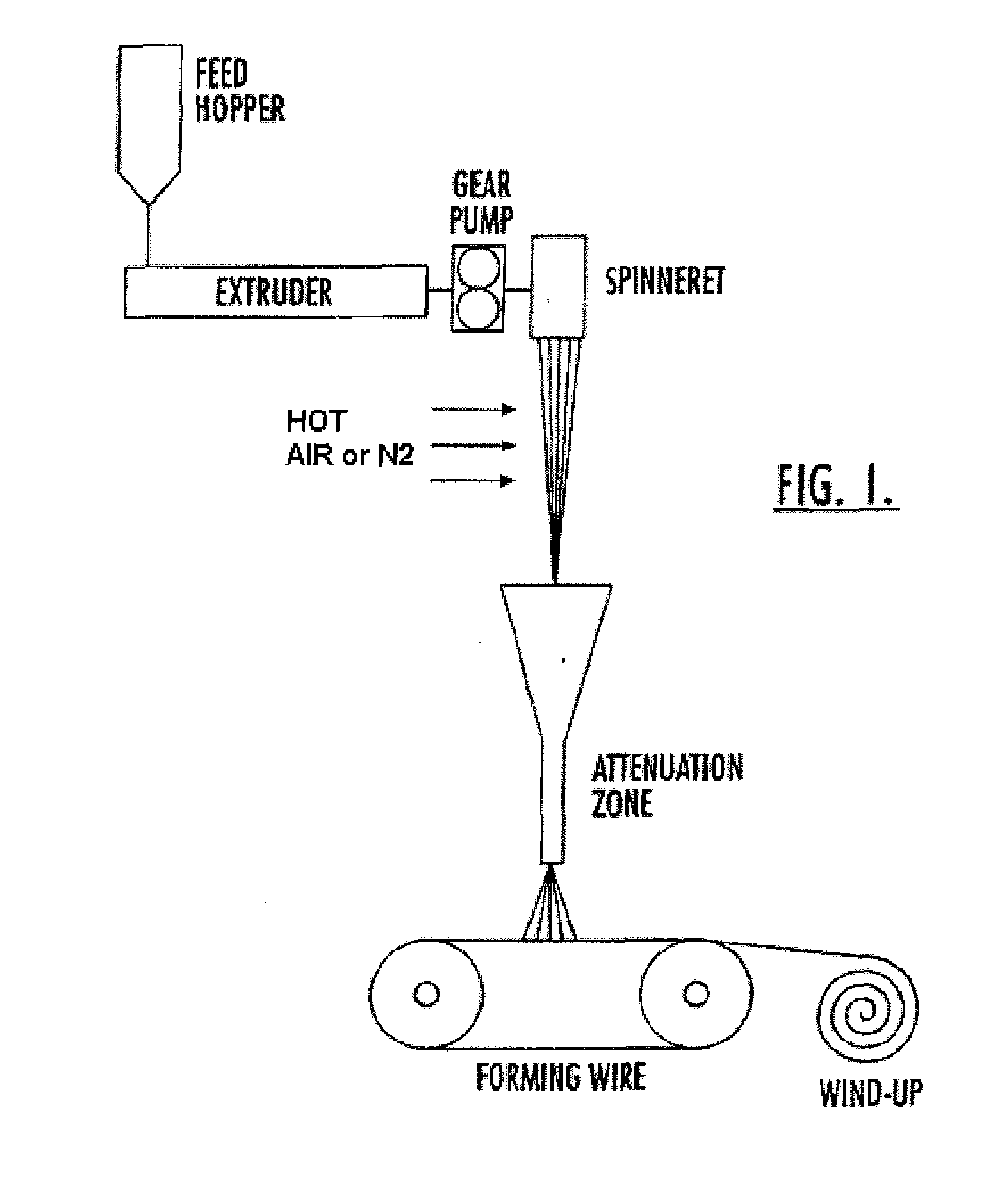
[0050]A low T / I ratio, amorphous grade, of Polyetherketoneketone, PEKK (such as OXPEKK SP from Oxford Performance materials) was dried overnight at 120° C. and then extruded and formed into fibers using a standard fiber spinning device as depicted in FIG. 1.
[0051]The extruder is operated at 20-60 RPM and heated to 315° C. for the feed zone, 320° C. for the middle zone and 330° C. for the final zone, gear pump and spinneret. The spinneret can be designed to form one or preferably multiple fibers. The fibers are directed to the forming wire using an air stream with or without an attenuation zone. For highly crystalline fibers such as PEEK and PEKK, the rate of crystallization is very fast when compared to polymers normally used to produce non-woven materials. Thus rather than cooling the fibers with cool or tepid air, when forming polarylate fibers the cooling rate is actually retarded by the use of a hot air or nitrogen stream. The temperature of ...
example 3
[0053]Using a fiber spinning device similar to that depicted in FIG. 1, but equipped with two extruders and two gear pumps that feed into the spinneret, a two layer fiber is produced in a coextrusion system. Temperature and conditions are similar to those above. The flow rates, of the different polymers are adjusted by the size of the extruders and the speed of the screws to form the desired thickness layers. Typically the higher T / I ratio polymer, which will also be stiffer, would be at the center of the fiber, and the lower T / I ratio polymer, which will soften at a lower temperature, will be placed at the periphery of the fiber. In this case the primary extruder, which is processing the high T / I ratio material for the center of the fiber, would be operated at a slightly higher temperature (30-50° C.) than the secondary extruder, which is processing the lower T / I ratio material.
Hot air is still used to maintain the fibers in a soft state as they are laid onto the forming wire in a ...
PUM
| Property | Measurement | Unit |
|---|---|---|
| crystallinity | aaaaa | aaaaa |
| DSC | aaaaa | aaaaa |
| flame resistance | aaaaa | aaaaa |
Abstract
Description
Claims
Application Information
 Login to View More