Check patentability & draft patents in minutes with Patsnap Eureka AI!

Methods and Apparatus for Halftoning Continuous-Tone Images

a continuous-tone image and image technology, applied in the field of system and method of rendering an image, can solve the problems of increasing the printing pressure on the dispersed dots, affecting the effect of the image quality, and the impracticality of representing tones having a lower intensity, etc., to achieve the effect of larger population density, and small average dot siz

Active Publication Date: 2013-08-08
ESKO SOFTWARE BV
View PDF0 Cites 4 Cited by
  • Summary
  • Abstract
  • Description
  • Claims
  • Application Information

AI Technical Summary

Benefits of technology

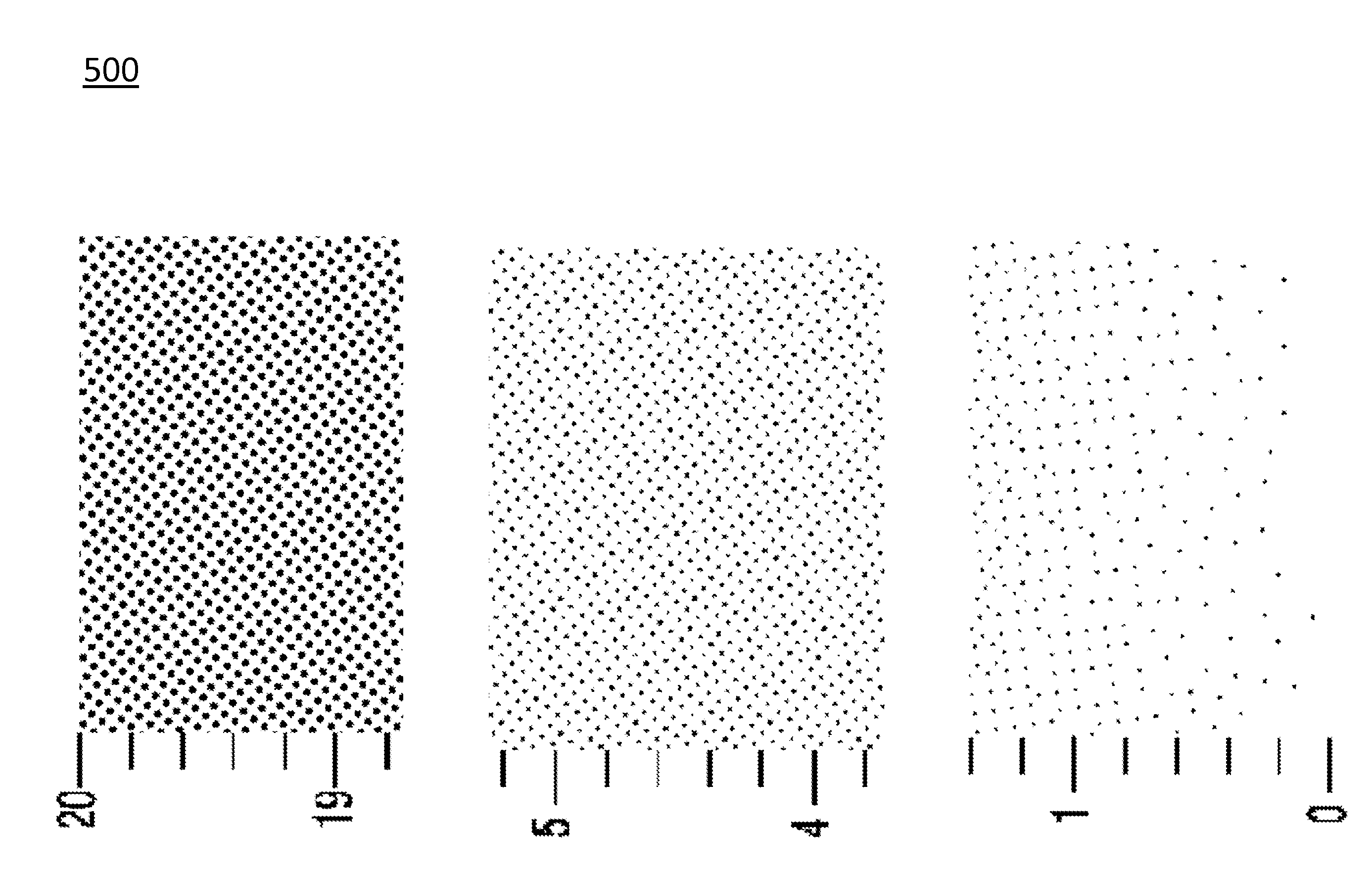
The present invention relates to methods of halftoning continuous-tone images using a flexographic printing plate. The method involves expressing the transition tone intensity using a maximum population density of halftone dots, and then expressing the intensity of the darker tones using a different maximum population density. The method also involves expressing the lighter tones at a lower density, resulting in smaller dots. The flexographic printing plate used in the invention includes regions of halftone dots expressing the transition tone intensity, darker tone intensity, and lighter tone intensity. The method and the flexographic printing plate can improve the image quality and resolution of the continuous-tone image.

Problems solved by technology

Because of this direct contact, it becomes impractical to represent tones having a lower intensity (i.e., lighter tones) using halftone dots below a certain minimum threshold size.
These known screening techniques suffer from several limitations.
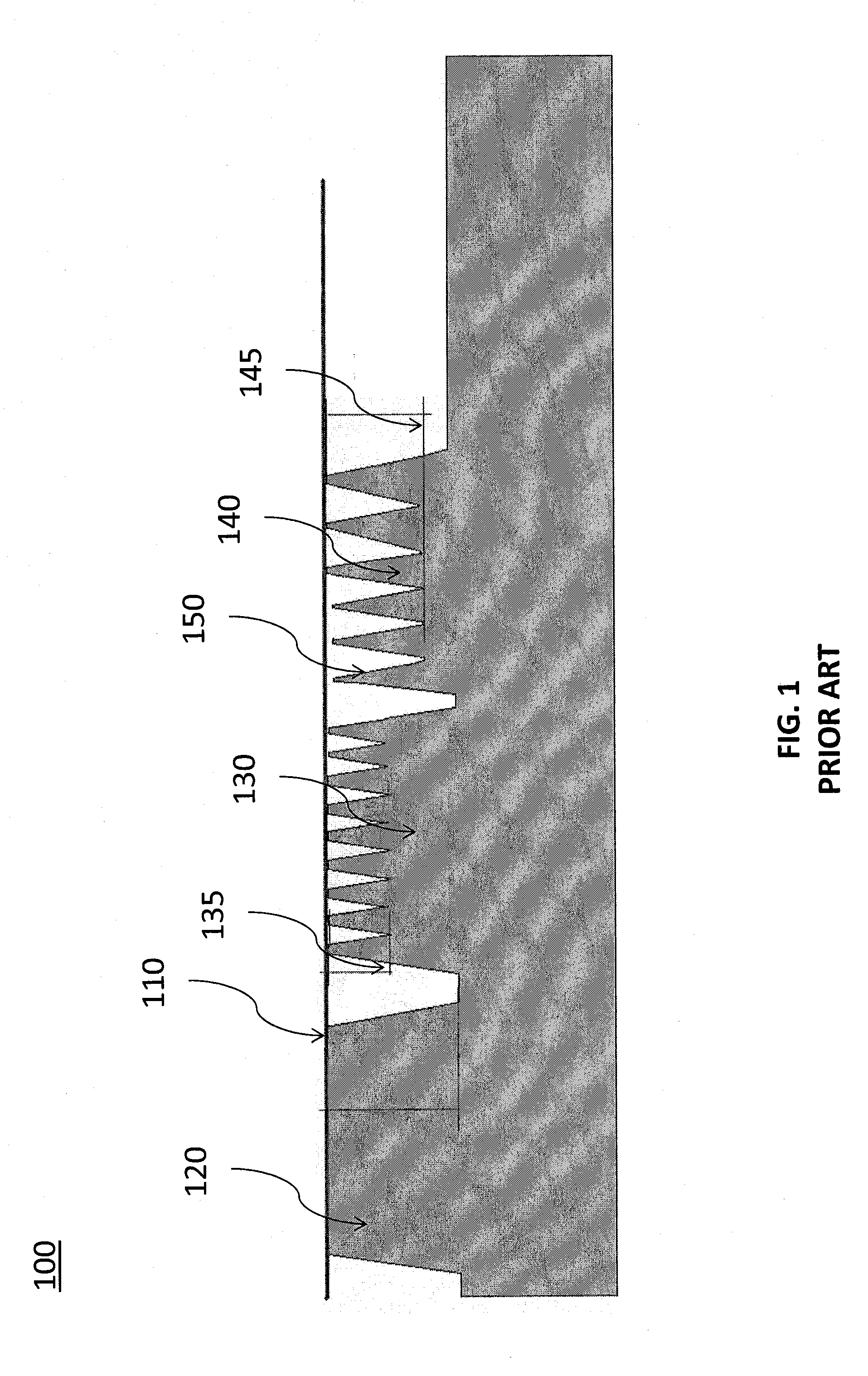
This undesirably both increases the printing pressure on the dispersed dots and increases the size of the inked plate relief.
Further, in some cases, the transferred image may become distorted as smaller dots no longer reach the substrate.
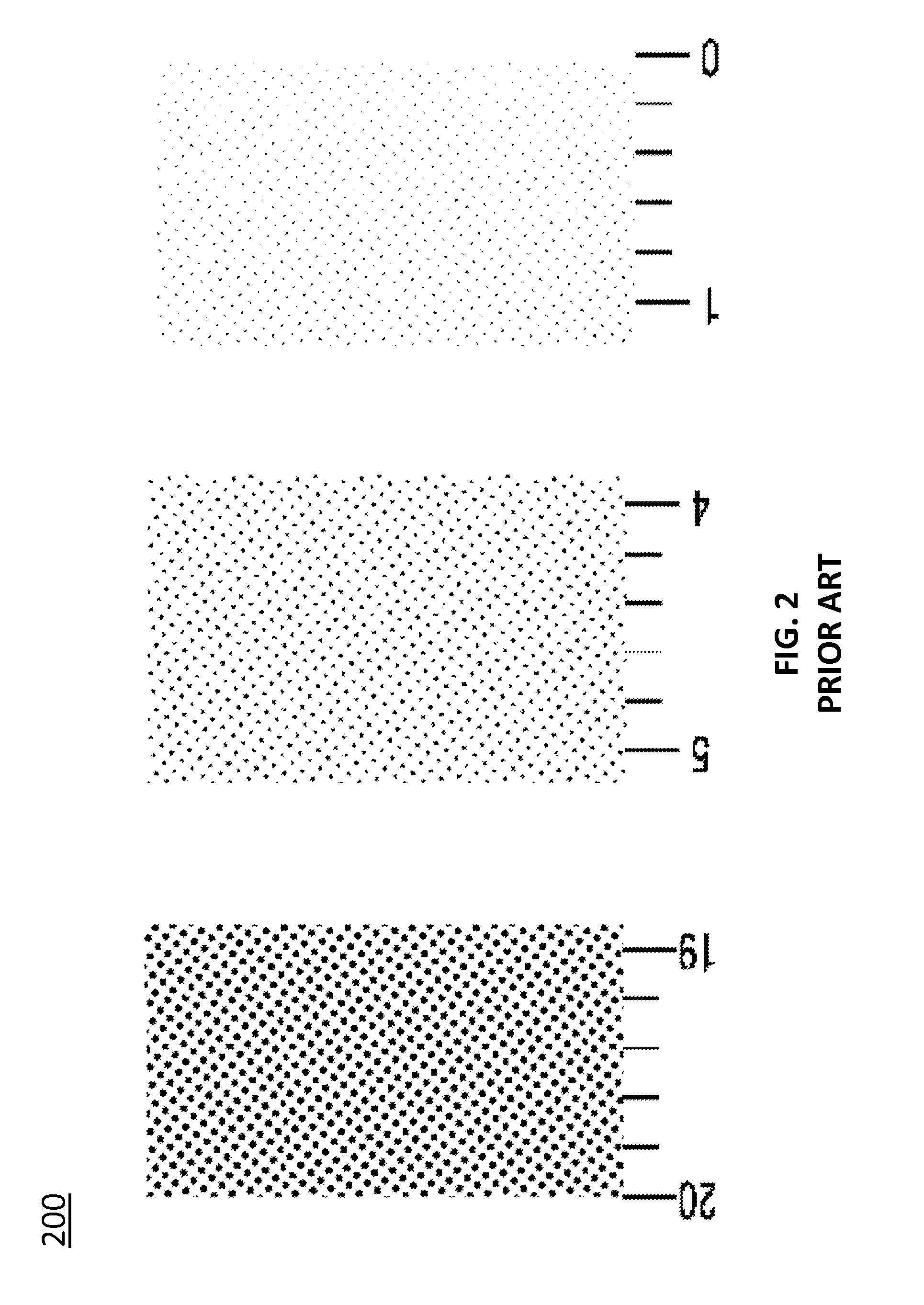
This results in “grainy” images, tonal jumps, and discontinuous digital dot gains.
Likewise, AM modulation may not adequately represent image regions having low tonal intensities.
This pressure may cause individual halftone dots to break, bend, or otherwise distort.
Additionally, some dots below the threshold minimal size may not reach the substrate, thereby failing to transfer a portion of the image.
The persisting deficiencies inherent in these known processes often produce undesirable visual distortions.
In flexographic printing, the visibility of individual dots is undesirable.
Relatedly, as the distance between dots increases, and as the size of the dot decreases, the pressure applied by the printing process may bend a given dot, resulting in distortion.
Consequently, the relationship between dot population, relief plate depth, and dot size limits expression of the full range of tonal intensities, especially with respect to the representation of lighter tones.

Method used

the structure of the environmentally friendly knitted fabric provided by the present invention; figure 2 Flow chart of the yarn wrapping machine for environmentally friendly knitted fabrics and storage devices; image 3 Is the parameter map of the yarn covering machine
View more

Image

Smart Image Click on the blue labels to locate them in the text.
Viewing Examples
Smart Image
  • Methods and Apparatus for Halftoning Continuous-Tone Images
  • Methods and Apparatus for Halftoning Continuous-Tone Images
  • Methods and Apparatus for Halftoning Continuous-Tone Images

Examples

Experimental program
Comparison scheme
Effect test

Embodiment Construction

[0038]The various aspects of the present invention relate generally to novel methods for halftoning a continuous-tone image. These methods entail the use of one or more groupings of halftone dots to convert a continuous-tone image into a halftone image. The one or more groupings of halftone dots have differing dot sizes and / or dot populations. Varying dot size and / or dot population permits the representation of different artistic tones. Moreover, variation of these characteristics according to the methods disclosed herein results in improved halftone images.

[0039]Many Raster Image Processors (RIPs) use single pixel threshold bitmaps to convert images. Single pixel threshold bitmaps only allow pixels to switch on past a specific threshold or tone. On these RIPs halftone dots can only increase in size for increasing tones. Thus, one embodiment of the invention creates an optimal transition for use with single threshold bitmaps. In this embodiment, tone intensity is increased by increa...

the structure of the environmentally friendly knitted fabric provided by the present invention; figure 2 Flow chart of the yarn wrapping machine for environmentally friendly knitted fabrics and storage devices; image 3 Is the parameter map of the yarn covering machine
Login to View More

PUM

No PUM Login to View More

Abstract

A method of halftoning a continuous-tone image includes the step of expressing a transition tone intensity by a maximum population density of halftone dots equal in size and having a transition dot size. Expressing tone intensities darker than the transition tone intensity includes increasing dot sizes beyond the transition dot size of the maximum population. Expressing tone intensities lighter than the transition tone intensity includes using a population density lesser than the maximum population density, and each relatively darker tone includes a relatively smaller dot size and a relatively larger population density than each relatively lighter tone.

Description

FIELD OF THE INVENTION[0001]The present invention relates to systems and methods of rendering an image in which an image is expressed on a substrate through populations of very fine ink dots which alter in size and / or frequency.BACKGROUND OF THE INVENTION[0002]Flexographic printing is one of the fastest growing conventional printing processes, with significant commercial application in the packaging and publishing industries.[0003]Flexography involves the transfer of an image from an inked relief plate onto a substrate. The areas on the inked relief plate which contact the substrate, and thereby transfer image characteristics, are known as the “image areas.” Conversely, the “nonimage areas” on the inked relief plate do not contact the substrate. Generally, the image can be transferred to any type of substrate including, without limitation, plastics (such as polyethylene, polyester, and polypropylene), metallic films, cellophane, fabrics, and paper.[0004]Flexographic processes encomp...

Claims

the structure of the environmentally friendly knitted fabric provided by the present invention; figure 2 Flow chart of the yarn wrapping machine for environmentally friendly knitted fabrics and storage devices; image 3 Is the parameter map of the yarn covering machine
Login to View More

Application Information

Patent Timeline
no application Login to View More
IPC IPC(8): G06K15/02
CPCH04N1/4057H04N1/405
Inventor MORISSE, PETER
Owner ESKO SOFTWARE BV
Features
  • R&D
  • Intellectual Property
  • Life Sciences
  • Materials
  • Tech Scout
Why Patsnap Eureka
  • Unparalleled Data Quality
  • Higher Quality Content
  • 60% Fewer Hallucinations
Social media
Patsnap Eureka Blog
Learn More