
Lithium electrode for lithium metal battery and method of manufacturing the lithium electrode
a lithium metal battery and lithium metal technology, applied in the direction of cell components, final product manufacturing, sustainable manufacturing/processing, etc., can solve the problems of securing an ion conduction path in the lithium electrode, and achieve the effect of increasing the shelf life of the lithium metal battery
- Summary
- Abstract
- Description
- Claims
- Application Information
AI Technical Summary
Benefits of technology
Problems solved by technology
Method used
Image

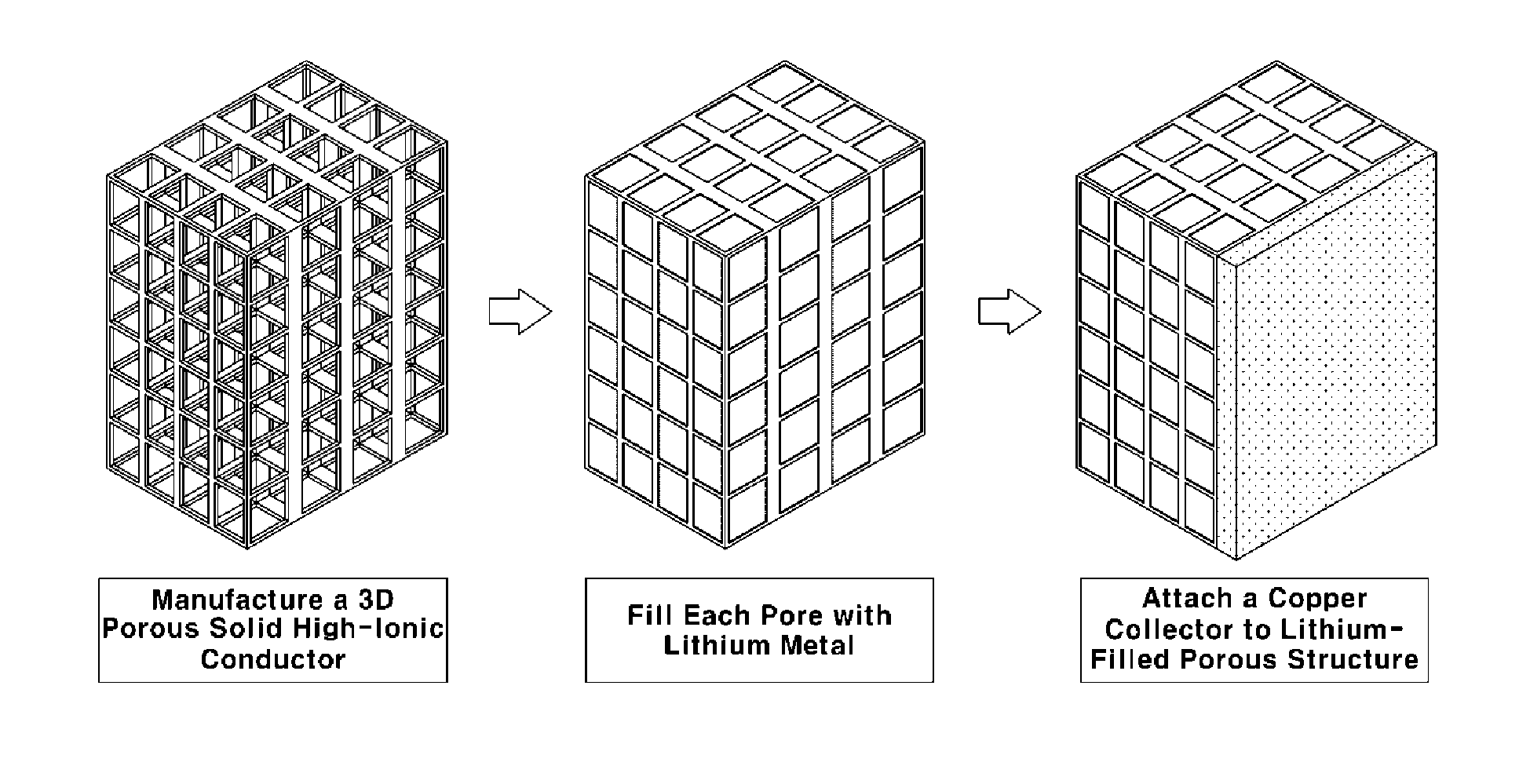
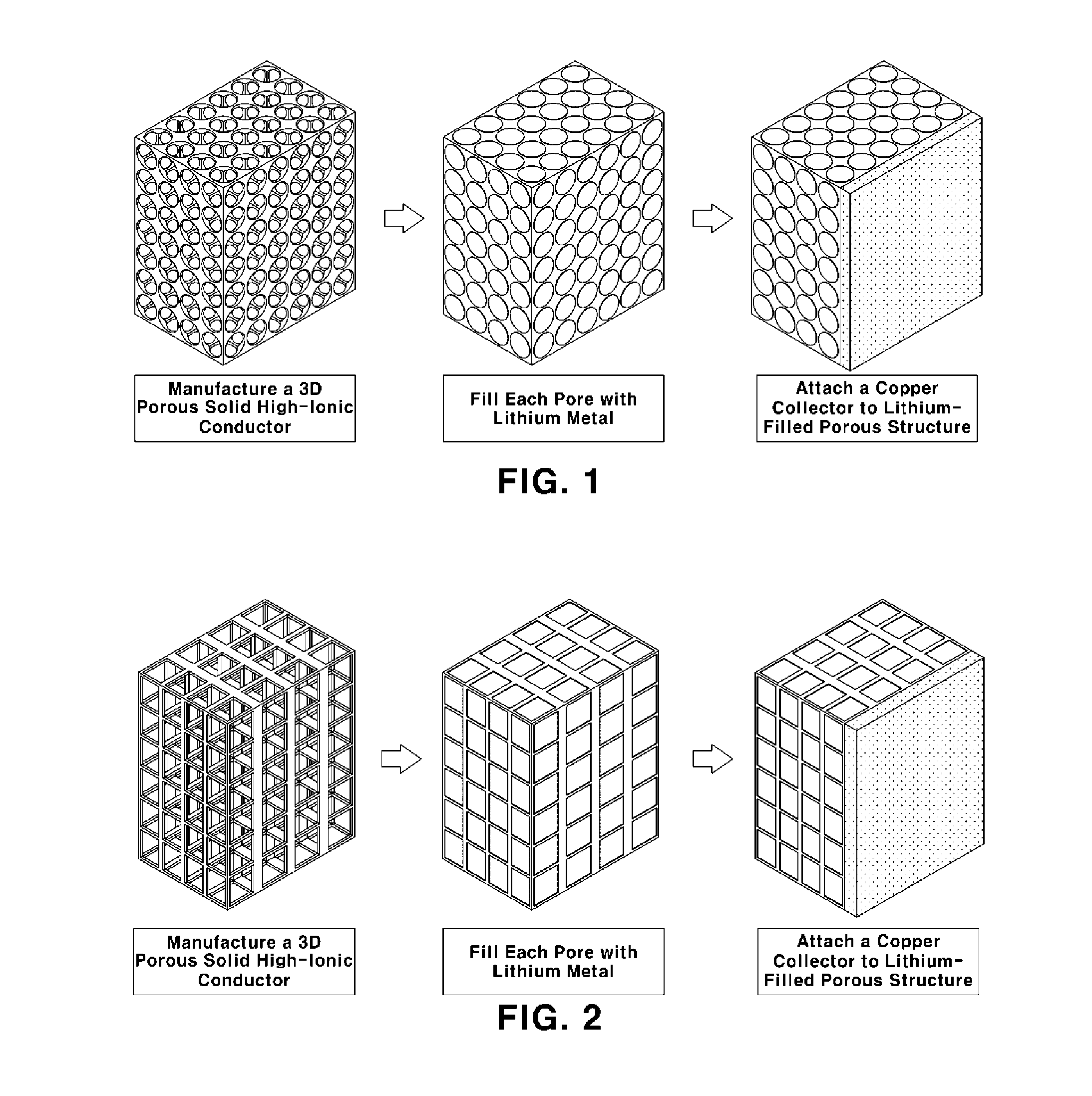
Examples
example 1
[0041]La2O3(powder)+Li2CO3(powder)+TiO3(powder) were mixed, ground and then sintered at high temperature of 1350° C. to obtain an oxide-based high-ionic conductor (La2-3Li1 / 3TiO3). The powder was prepared with an average particle size of 500 nm or less.
[0042]Dispersed polystyrene beads a few micrometers in size were provided, mixed with ethanol (i.e., a dispersion solvent) and an oxide-based high-ionic conductor, dispersed by ultrasonication and dried. Then, polystyrene was removed therefrom using methylene dichloride, followed by heat treatment at a high temperature (a temperature of 300° C.) to obtain a 3D porous structure (10×10×0.7 mm) having open pores, in which the porosity was 70% and a average pore size was about 1.7 μm.
[0043]Then Al2O3 was coated on the interface in the form of an ultrathin film by PVD (Physical Vapour Deposition) with substrate temperature at 700° C. Even though there was a thickness gradient of a 3D porous structure, the thickness of the Al2O3 coating was...
example 2
[0046]An oxide-based high-ionic conductor (La2 / 3Li1 / 3TiO3) was prepared in the same manner as in Example 1 as a 3D porous structure (10×10×0.7 mm) having open pores, in which the porosity was 65% and an average pore size was about 2.5 μm.
[0047]Then Al2O3 was coated on the interface in the form of an ultrathin film by PVD (Physical Vapour Deposition) with substrate temperature at 700° C. Even though there was a thickness gradient of a 3D porous structure, the thickness of the Al2O3 coating was less than 10 nm from TEM investigation. Because the solid high-ionic conductor (3D porous structure) reacts with lithium, the reaction is prevented by adding the Al2O3 coating step with nano-size thickness between interfaces.
[0048]Then, each pore of the 3D porous structure manufactured as described above was filled with lithium metal by placing the structure in the argon-gas atmosphere and coating the pores with a paste formed by mixing a few micrometers of lithium particles and a binder.
[0049]...
example 3
[0050]An oxide-based high-ionic conductor (La1.3Al0.3Ti1.7(PO4)3) was provided as a fine powder having an average particle size of 500 nm or less. Then, a 3D porous structure (10×10×0.7 mm) having open pores was prepared in the same manner as in Example 1, to provide a porosity of 65% and a pore size of about 3.3 μm.
[0051]Then Al2O3 was coated on the interface in the form of an ultrathin film by PVD (Physical Vapour Deposition) with substrate temperature at 700° C. Even though there are thickness gradient of a 3D porous structure. The thickness of the Al2O3 coating was less than 10 nm from TEM investigation. Because the solid high-ionic conductor (3D porous structure) reacts with lithium, the reaction is prevented by adding the Al2O3 coating step with nano-size thickness between interfaces.
[0052]Lithium metal was then filled into each pore of the 3D porous structure using the same melting method as in Example 1.
[0053]As in Example 1, a copper collector was attached onto the surface ...
PUM
| Property | Measurement | Unit |
|---|---|---|
| porosity | aaaaa | aaaaa |
| pore size | aaaaa | aaaaa |
| porosity | aaaaa | aaaaa |
Abstract
Description
Claims
Application Information
 Login to View More