However, once the commodity product has been sold at the end of the
production cycle, the original owner / producer loses all control over the sold commodity, and other market participants may benefit by driving the price of the commodity lower, or other factors, like weather, international conflicts, transportation issues / costs, organized labor strikes and other actions and events may also have a detrimental
impact on a commodity's price post-sale, which can still hurt the original owner / producer of the commodity, as future commodity production / growth may be affected, in many ways, by the market price of the commodity.
A commodity owner / producer may utilize various derivative contracts and strategies to help protect against future downswings caused by market participants or the aforementioned other factors, but these can be expensive and can leave an owner / producer exposed to financial loss if these contracts move against the owner / producer, and if, for any reason, the owner / producer cannot deliver enough of the specified commodity to meet contractual obligations.
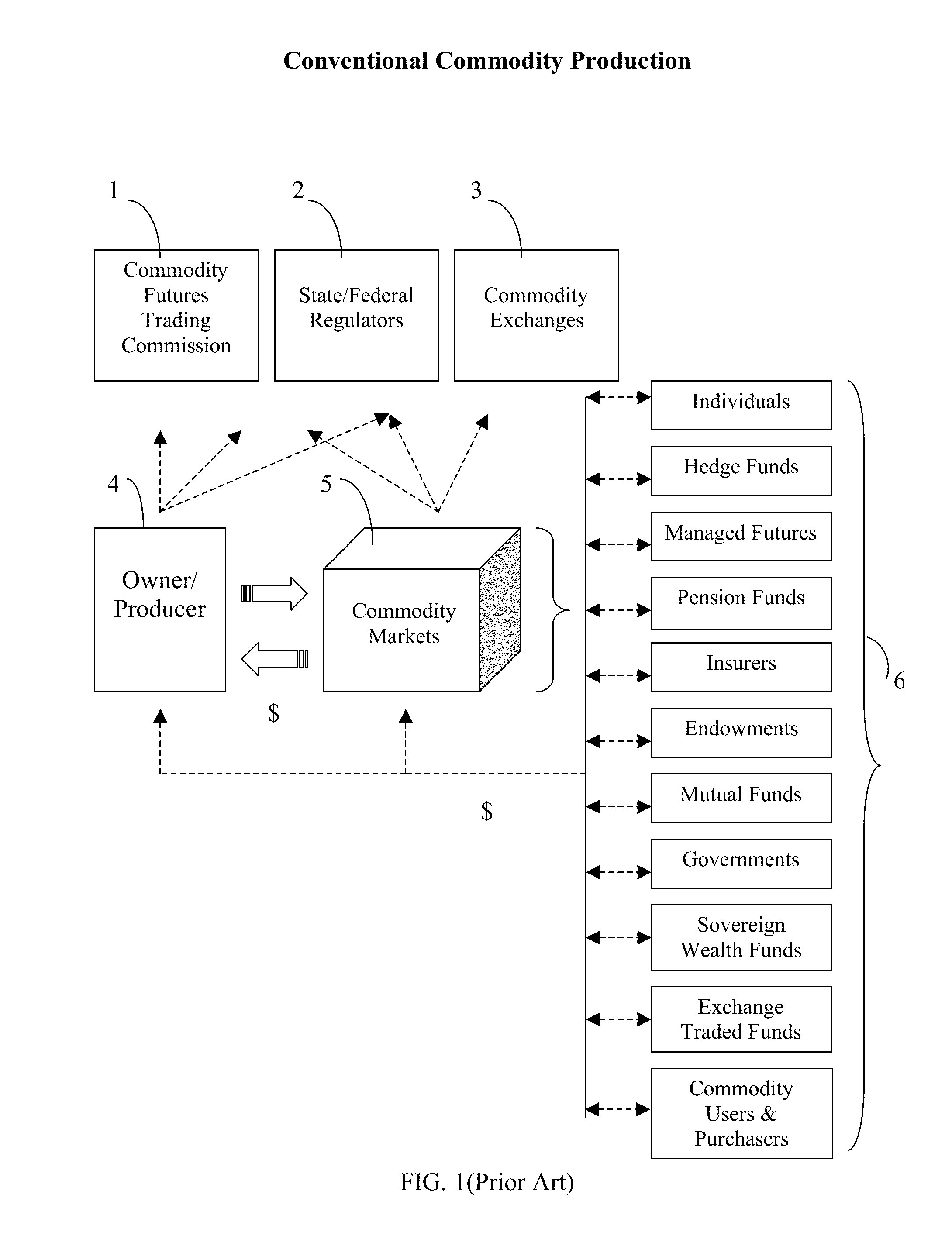
One of the problems that owners / producers of commodities encounter is that of short-selling, through which, investors and speculators borrow a commodity from other market participants, often through the use of futures contracts or other derivative financial instruments, and sell the commodity short in the market hoping to buy it back at a lower price and make a profit.
These shorts sales are often highly-leveraged, and short-selling puts downward price pressure on the commodity, which can have several harmful effects.
First, as the price of the commodity falls, it can force owners / producers to sell the commodity at disadvantageous prices in order to avoid additional losses if the commodity continues to fall in price, which then adds to the selling pressure on the commodity and drives its price lower.
Lower commodity prices hurt the owners / producers and can lead, ultimately, to less production of the commodity and higher prices as there is less production to meet market demand.
As commodity owners / producers often rely on borrowing to fund their production, lower commodity prices can, in extreme circumstances, lead to financial ruin for the commodity owners / producers.
A good example of this problem in practice is the
current price pressure on
natural gas in the United States, which has forced many owners / producers to cap existing
natural gas wells and
delay future production due to the low prices of
natural gas which, in part, have been caused by speculation and short selling of natural gas.
As many of the large natural gas producers have borrowed heavily to finance their drilling and exploration activities, these low prices imperil many of them.
Another problem is that the further the price of a commodity is depressed by short-selling, the harder, more expensive, and more dilutive it becomes for a commodity owner / producer to raise additional capital through additional debt or equity sales.
Excessive selling pressure and the resulting lower commodity price, via short sales and derivative instruments, can influence and / or cause rating agencies to
downgrade a commodity owner's / producer's financial ratings, thereby increasing the cost of raising additional capital via debt sales.
Similarly, excessive downward pressure, via short sales and derivative instruments, on a commodity owner's / producer's publicly traded stock can depress the stock to extremely low levels making additional equity sales highly dilutive to existing shareholders.
In extreme cases, the pressure on a company's stock from a low commodity price can make it virtually impossible to raise new capital via equity sales because of the dilutive effects.
Finally, for privately-held commodity owners / producers, downward pressure on their commodity's price can hamper their efforts to obtain
bank financing.
As discussed above, short-selling in commodities has become a huge problem in today's capital markets, as it can have a detrimental
impact on commodity prices and, thus, on commodity owners / producers.
Short selling can increase volatility in a commodity's price, which can force commodity owners / producers to sell their commodities at unfavorable prices to avoid a (further) loss.
However, each of these prior art references fails to address, either singularly or in combination with each other, the aforementioned problems associated with short-selling of an owner's / producer's commodity, as each addresses the trading of, or mechanisms associated with the trading of, commodities.


 Login to View More
  Login to View More