
Screening methods for identifying plasmodium proteases inhibitors
a technology of proteases and inhibitors, applied in the field of parasitology, can solve the problems of reducing the efficacy of treatment and malaria control measures, and the efforts to develop a malaria vaccine with long-term efficiency have met with limited success, so as to minimize the risk of failure or resistance and maximize the effect of efficacy
- Summary
- Abstract
- Description
- Claims
- Application Information
AI Technical Summary
Benefits of technology
Problems solved by technology
Method used
Image

Examples
example 1
An in Silico Screening Approach to Select Inhibitors of Plasmodium
[0094]Red blood cell egress and invasion by Plasmodium parasites strictly depend upon the precise maturations of parasite proteins SERA5, a cystein protease implicated in the rupture of the parasitophorous vacuole membrane and MSP1 (Merozoite Surface Protein 1). The parasite subtilisin-like serine protease SUB1 plays a key role in the process (S. Yeoh et al, Cell, 131(6), 1072-83 (2007)) as it is essential for the merozoite egress. On the other hand, SUB2, another subtilisin-like serine protease is essential for the merozoite entry into RBC. Taking advantage of the similarity of SUB1 active site with bacterial subtilisins, we have used an in silico screening approach and have identified inhibitors of Plasmodium.
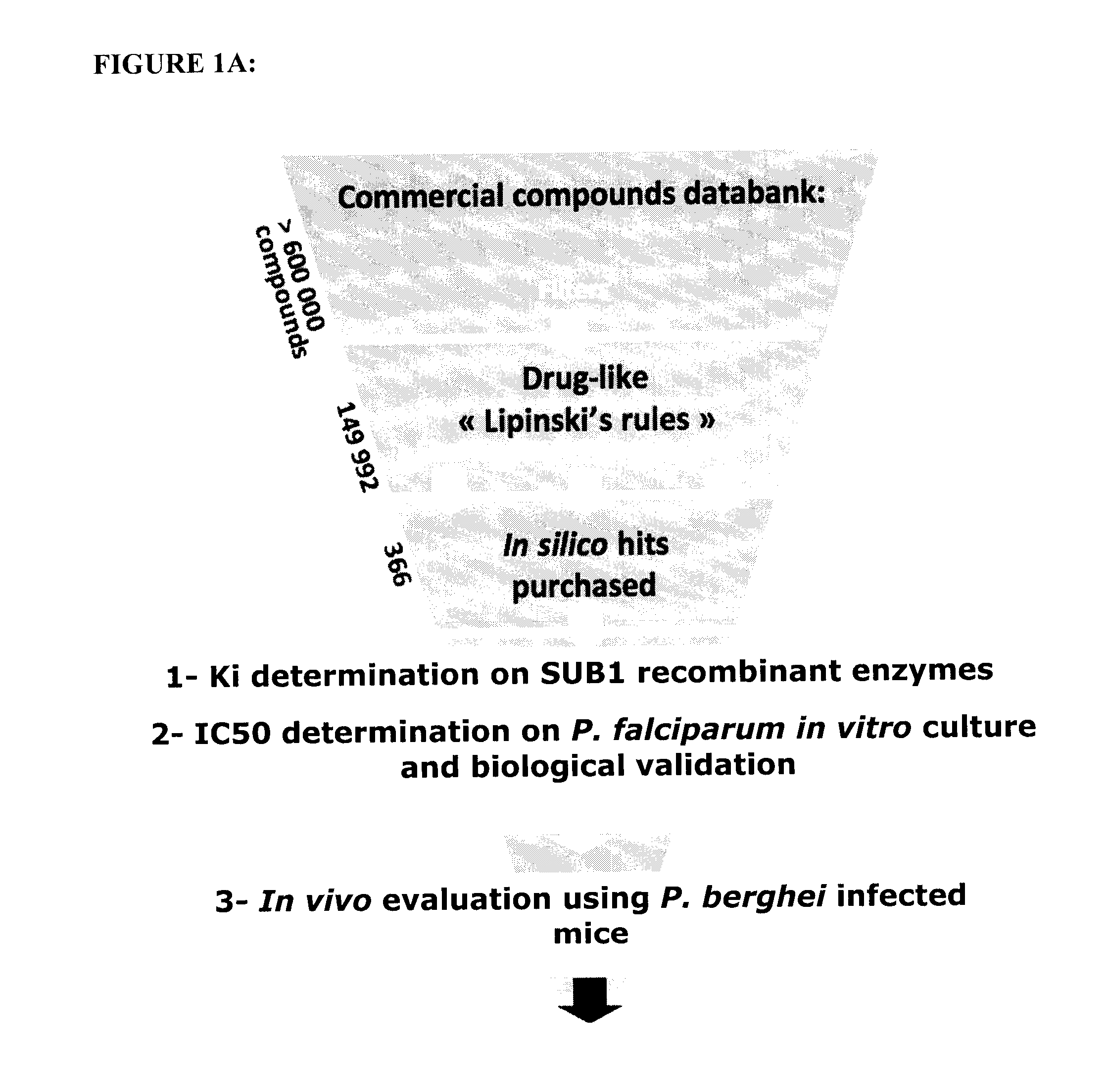
[0095]A general strategy for screening and validation of Plasmodium inhibitors according to a preferred embodiment of the invention is summarized in FIG. 1A. Briefly, commonly used filters were applied in sil...
example 2
Screening Method to Select Inhibitors of Plasmodium Modeling of PvSUB1 and PfSUB1 Active Sites
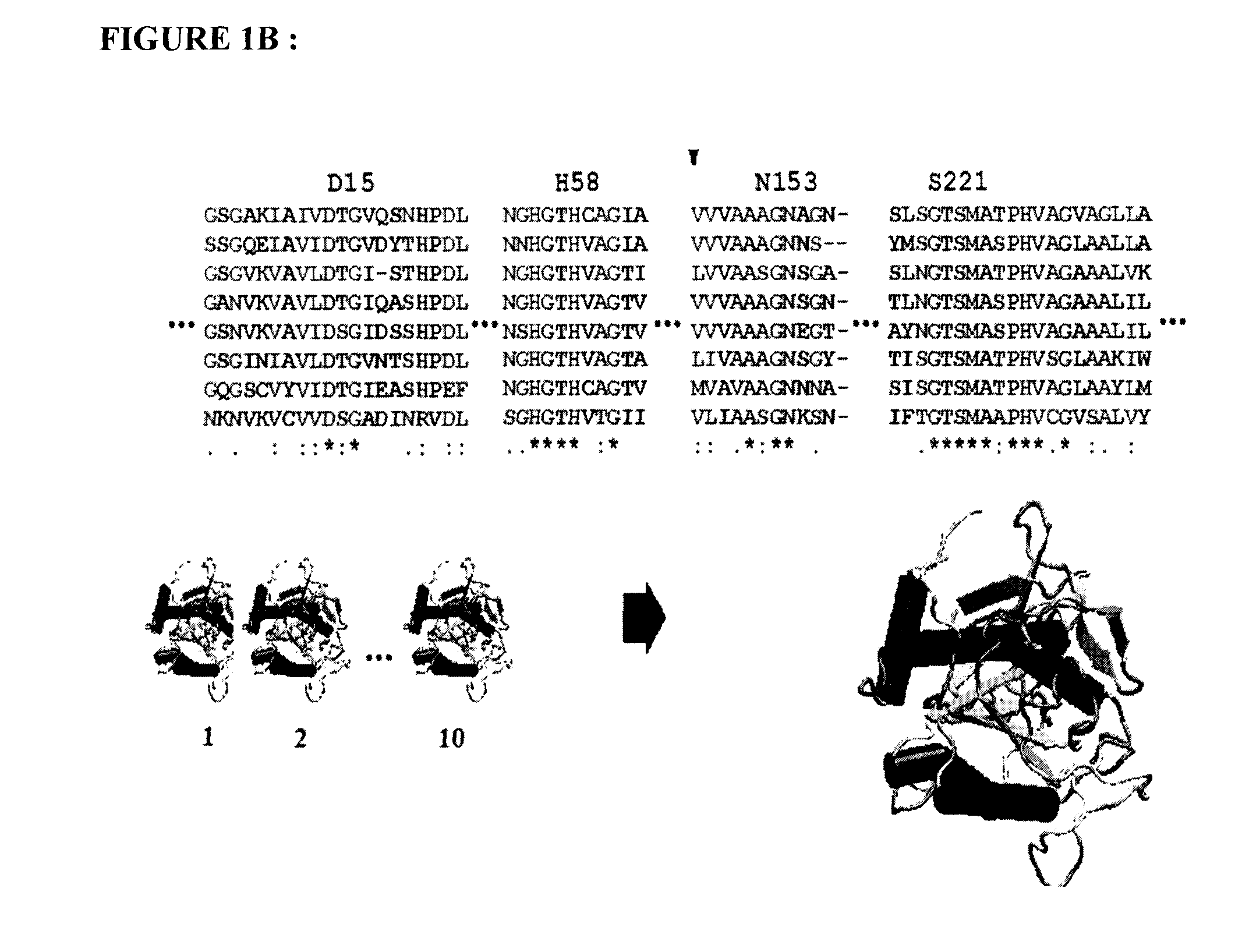
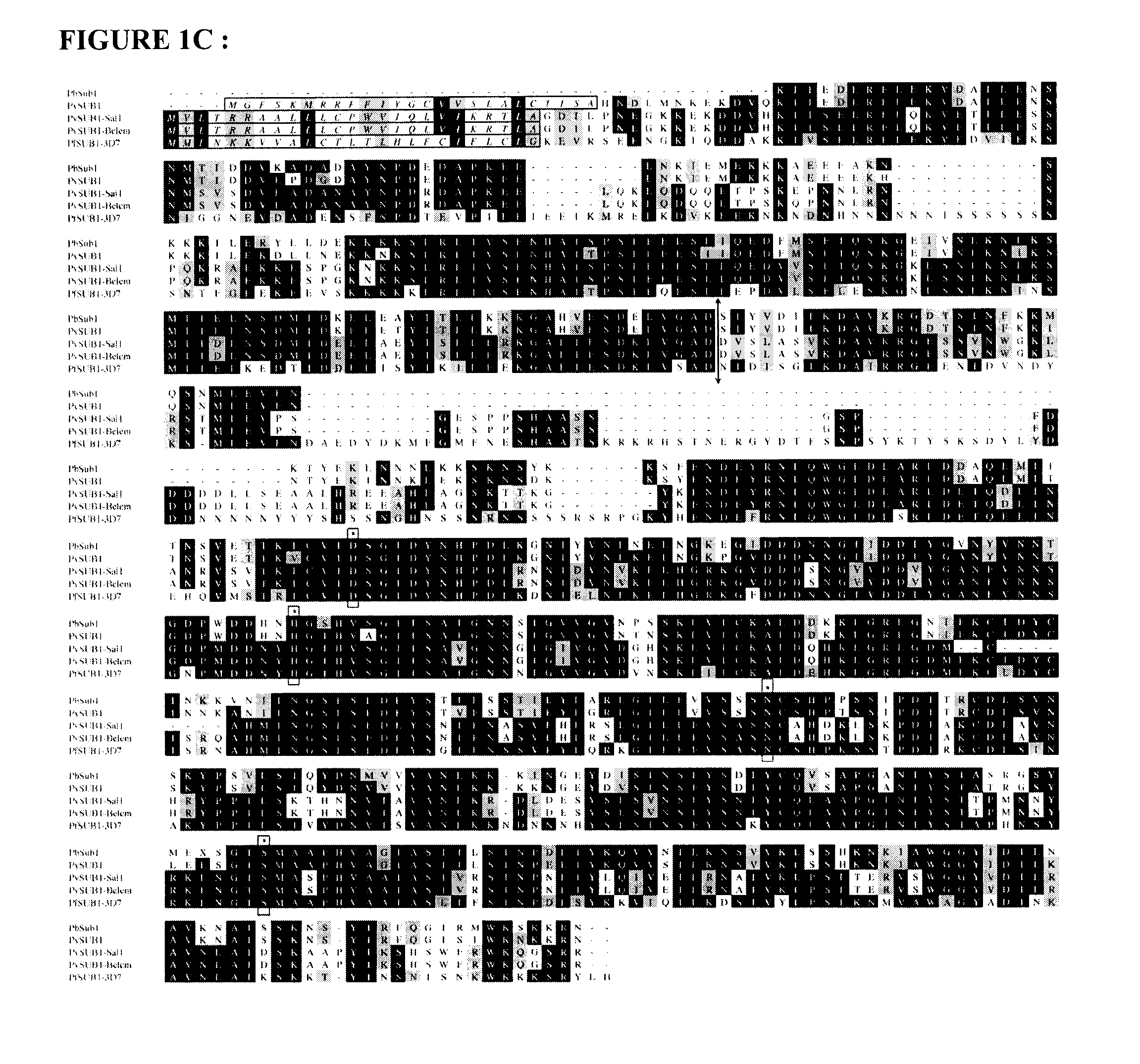
[0107]The homology modeling procedure was realized using the suite of tools, Biskit. In many ways, Biskit presents features to produce models as accurate as possible (Grunberg R, et al., A software platform for structural bioinformatics, Bioinformatics. 2007, 23(6):769-70.). The multiple alignments and the construction of models are the most critical task of modeling. Biskit use respectively 3DCoffee™ (O'Sullivan et al. 3DCoffee: combining protein sequences and structures within multiple sequence alignments. J Mol Biol. 2004, 340(2):385-95.) and Modeller™ (Sall and Blundell. Comparative protein modeling by satisfaction of spatial restraints. J Mol Biol 1993, 234(3): 779-815.). For this study, modeling of PvSUB1 enzyme is restricted to its catalytic domain from residue 1302 to P586, which present a significant homology to bacterial subtilisins. Proteins structures displaying significant sequ...
PUM
| Property | Measurement | Unit |
|---|---|---|
| Mass | aaaaa | aaaaa |
| Mass | aaaaa | aaaaa |
| Power | aaaaa | aaaaa |
Abstract
Description
Claims
Application Information
 Login to View More