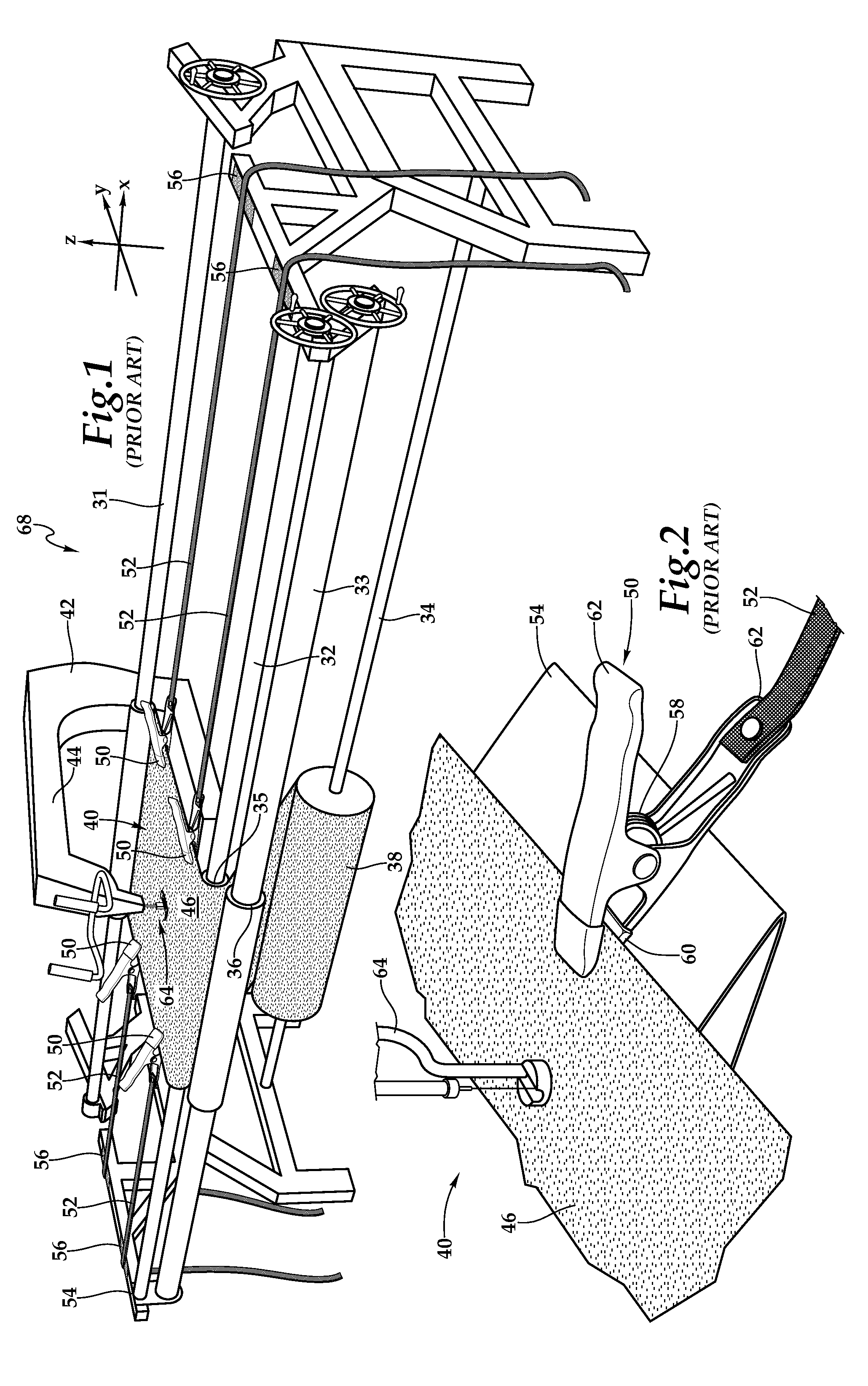
Thus, a clamp 50 that requires a woman to use two hands to squeeze it is undesirable to many users.
A hook / loop
fastener has a tendency to grab and retain dust, fabric fuzz (especially batting material), hair, rug material, carpet material,
food particles, debris, and other loose materials typically found on a floor.
For example, some users try to hold the strap 52 with one hand while manipulating the clamp 50 with the other hand (one-handed clamp operation), but some users are unable to do this due to strength and / or coordination limitations.
Some users tend to replace the straps or the entire clamp and strap combination regularly because the straps become dirty, unsightly, and / or non-functional, which can become expensive over time.
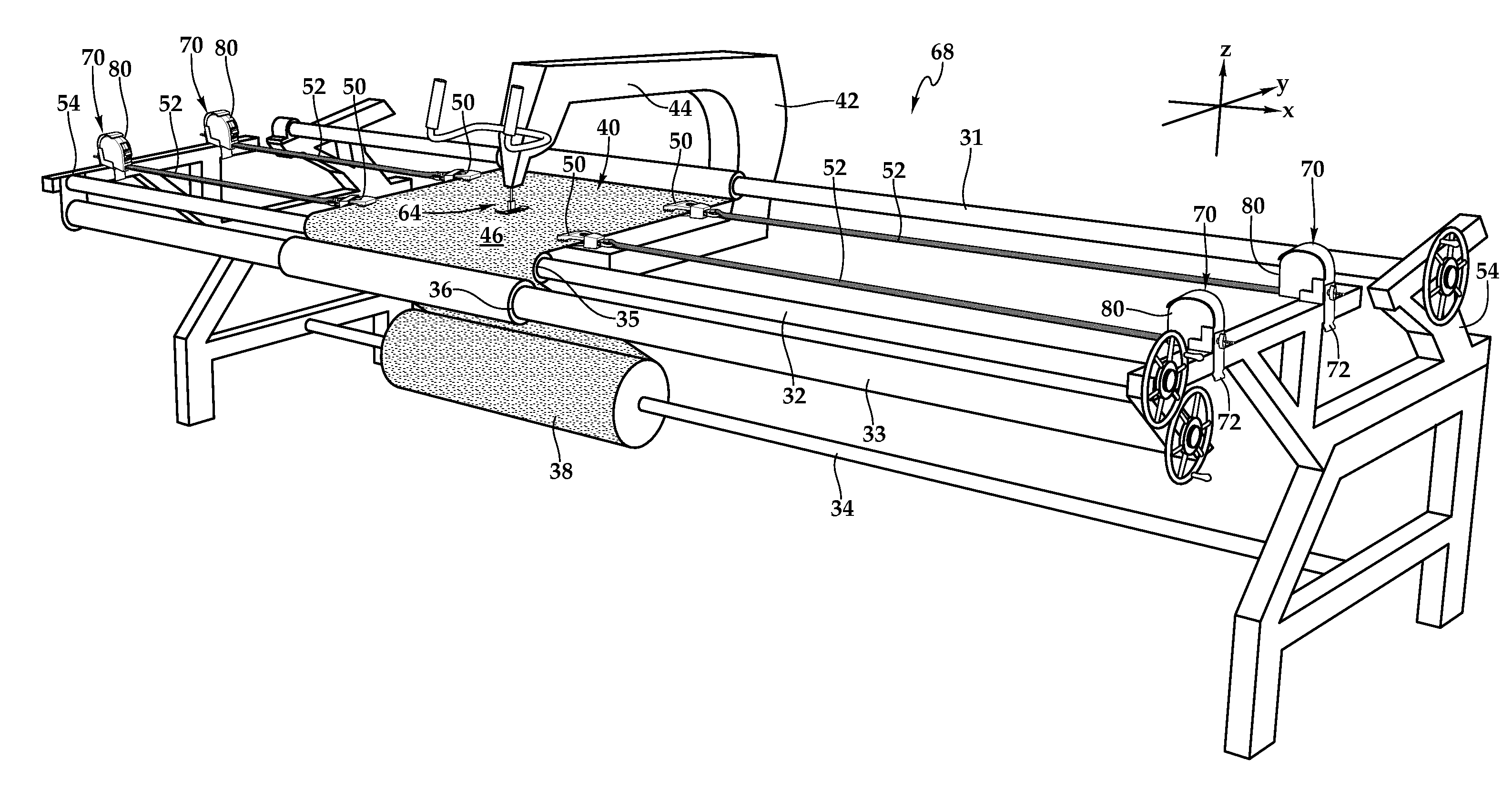
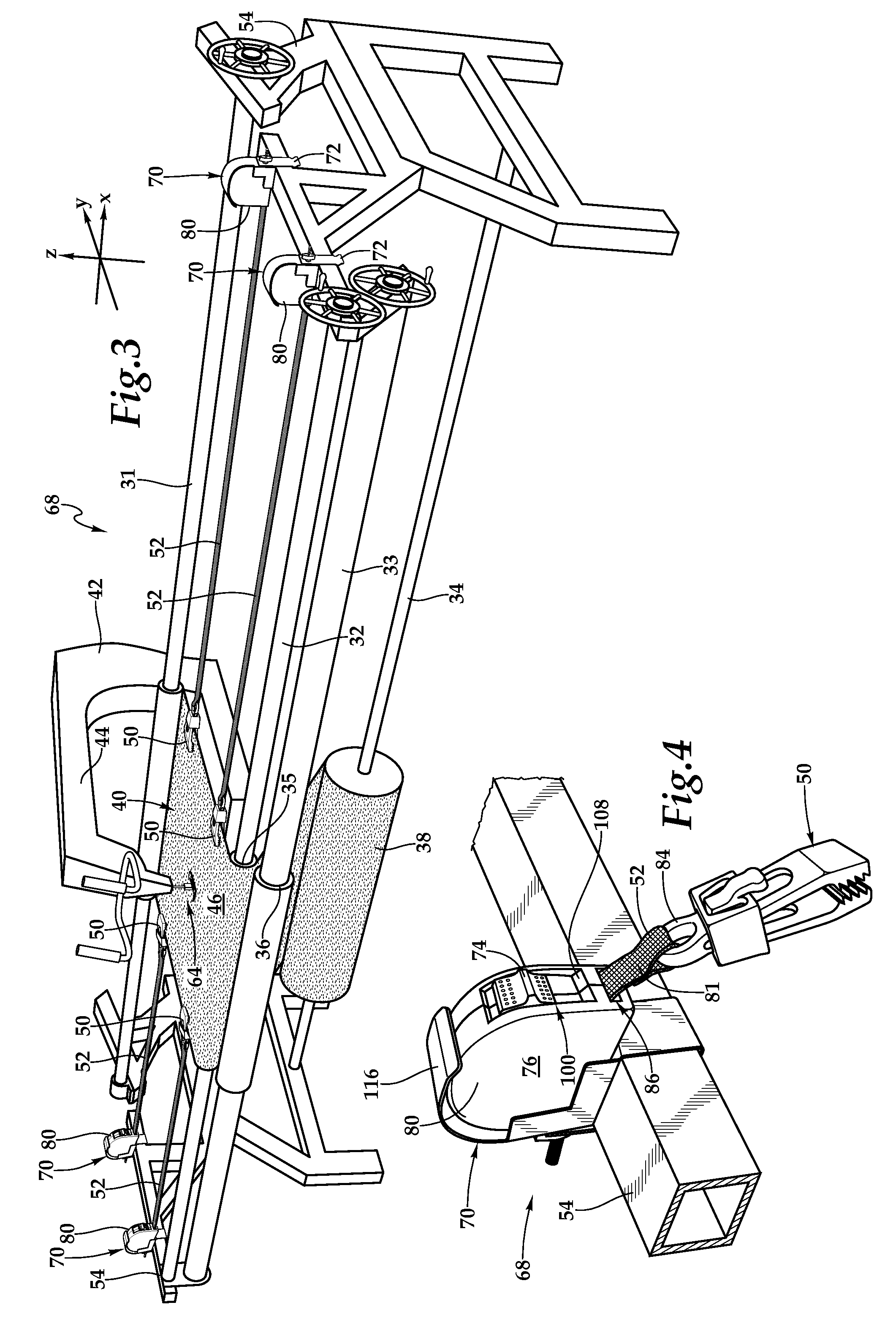
Some users clamp it to the quilting frame 54, but many quilting frames are not conducive to allowing the clamp to be attached (e.g., when the quilting frame is larger than the maximum bit opening size of the clamp).
Furthermore, a strap 52 hanging down onto the floor during use can create a trip
hazard, such as when one end of the quilting frame is at or close to a walkway or doorway.
Few users have enough extra space in their
studio to prevent an end of the quilting frame from being at or near a walkway or doorway.
Hence, the use of straps that rely on hook-on-loop fasteners may have many disadvantages that are undesirable to many users.
One of the disadvantages of heavy clamps (e.g., those made from
metal and those that are large) is that the weight of the clamp itself may induce sagging of the workpiece 46, which is typically undesirable.
A
disadvantage for some clamps, in the viewpoint of some quilters, is that the clamp is too hard to squeeze for the typical quilter or too complicated to lock and unlock, thereby requiring two hands to operate the clamp itself A
disadvantage of some clamps is that they are too bulky or too large in the Z direction relative to the X-Y plane.
This can cause problems for the user when trying to sew at or near the lateral edge because the
sewing machine can bump or hit the clamp 50 causing the workpiece to move and / or the clamp 50 can prevent the sewing head 64 from reaching the full extent in the X direction desired or needed during sewing.
Such collisions can cause an intended sewing path to be hindered and altered, often requiring the user to stop, remove threads, and reset the sewing head (which may be very difficult and
time consuming, as well as frustrating and discouraging).
Often customers send to quilters a partially completed quilt (e.g., designs and patterns stitched, embroidered, or formed in a quilt top but not yet formed with the other
layers to make a quilt) which does not have a large enough backing material layer because they do not have experience or knowledge of the need for larger backing material for longarm quilting systems.
Hence, in the opinion of many users, there are many disadvantages and undesirable aspects of currently available clamps and clamp / strap combinations for use with quilting frames and / or longarm quilting systems.



 Login to View More