Check patentability & draft patents in minutes with Patsnap Eureka AI!

Apparatus and method for tissue adhesion

a tissue adhesion and applicator technology, applied in the field of tissue modification and wound closure, can solve the problems of difficulty for some operators in tying and placing a proper knot in the suture, high degree of experience and manual dexterity, and each of these technologies has notable limitations

Active Publication Date: 2015-02-19
MICROKOLL
View PDF33 Cites 8 Cited by
  • Summary
  • Abstract
  • Description
  • Claims
  • Application Information

AI Technical Summary

Benefits of technology

The patent describes an array of small posts made of shape memory material that can be used to mechanically capture tissue and hold it in place. The posts have a smooth and continuous outer surface and can be activated to transform from a straightened state to an engaged state, where they capture the tissue. The transformation is triggered by various methods such as heat, electrical current, pH change, or ultrasonic energy. The array can be used for wound closure or to occlude a tissue site. The technical effect of this invention is to provide a reliable and effective method for securely closing wounds or occluding tissue sites.

Problems solved by technology

Each of these technologies has notable limitations.
For example, a suture may be deployed into an incision, but tying and placing a proper knot in the suture may require a high degree of experience and manual dexterity and may be difficult for some operators.
If the suture knot is not properly tightened, the incision may bleed or be otherwise compromised.
Staples, however, may not always completely close the wound and may not be re-adjusted, if such adjustment is required, after deployment.
In addition, staples tend to be deployed in discrete locations due to their bulk and may produce concentrated stress and strain points within tissue adjacent the deployed staples.
Biological adhesives may be applied into a wound, but the presence of blood will often hinder an effectiveness of the adhesion strength between the adhesive and tissue.
Also, biological tissue adhesives often tend to be rigid after they have cured, so as to cause stiffness at the point of contact and reduce flexibility of the wound when stress is applied thereto.
Such a relatively stiff joint may even fracture or crack when stressed causing the wound to reopen and hemorrhaging to occur.

Method used

the structure of the environmentally friendly knitted fabric provided by the present invention; figure 2 Flow chart of the yarn wrapping machine for environmentally friendly knitted fabrics and storage devices; image 3 Is the parameter map of the yarn covering machine
View more

Image

Smart Image Click on the blue labels to locate them in the text.
Viewing Examples
Smart Image
  • Apparatus and method for tissue adhesion
  • Apparatus and method for tissue adhesion
  • Apparatus and method for tissue adhesion

Examples

Experimental program
Comparison scheme
Effect test

Embodiment Construction

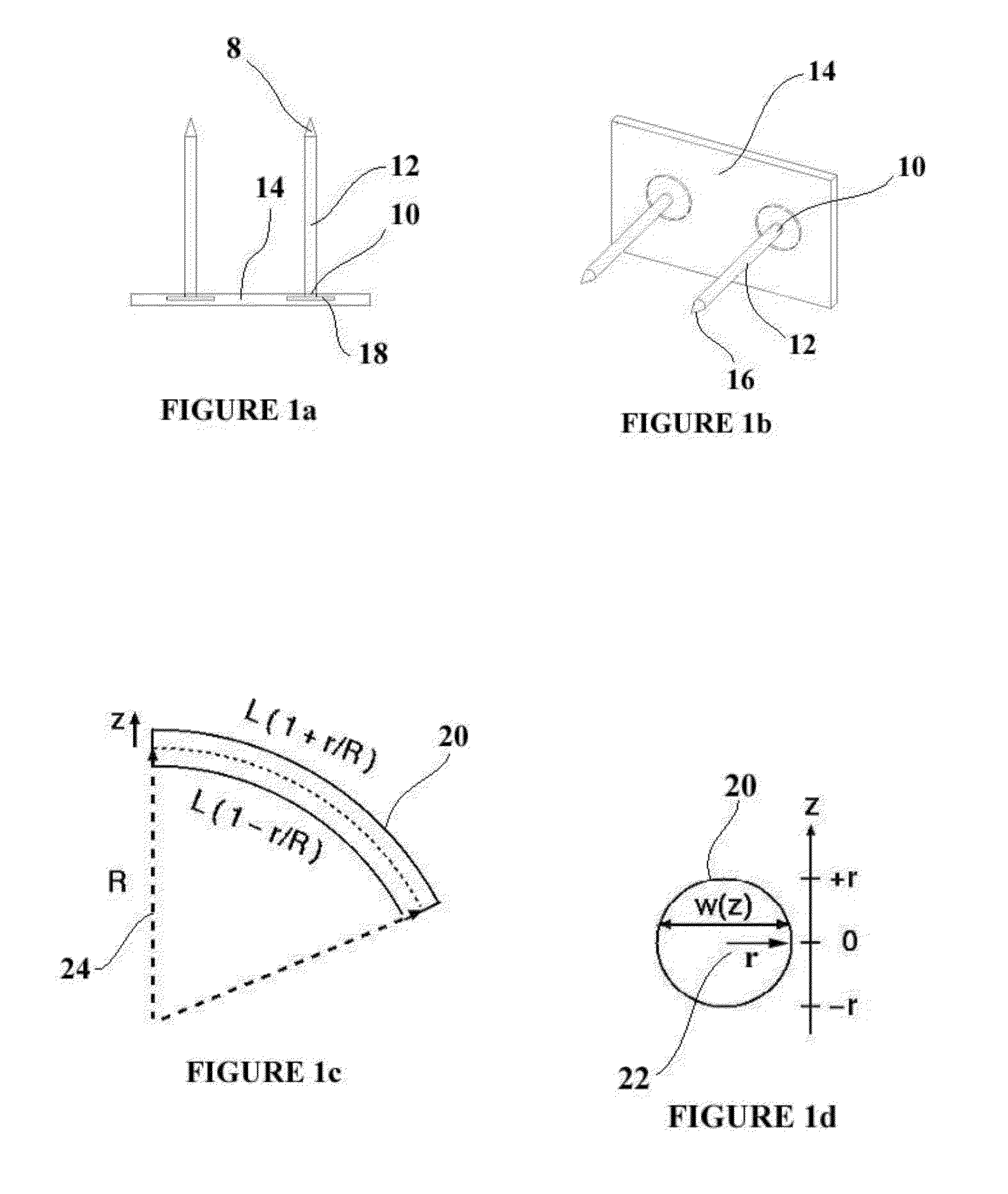
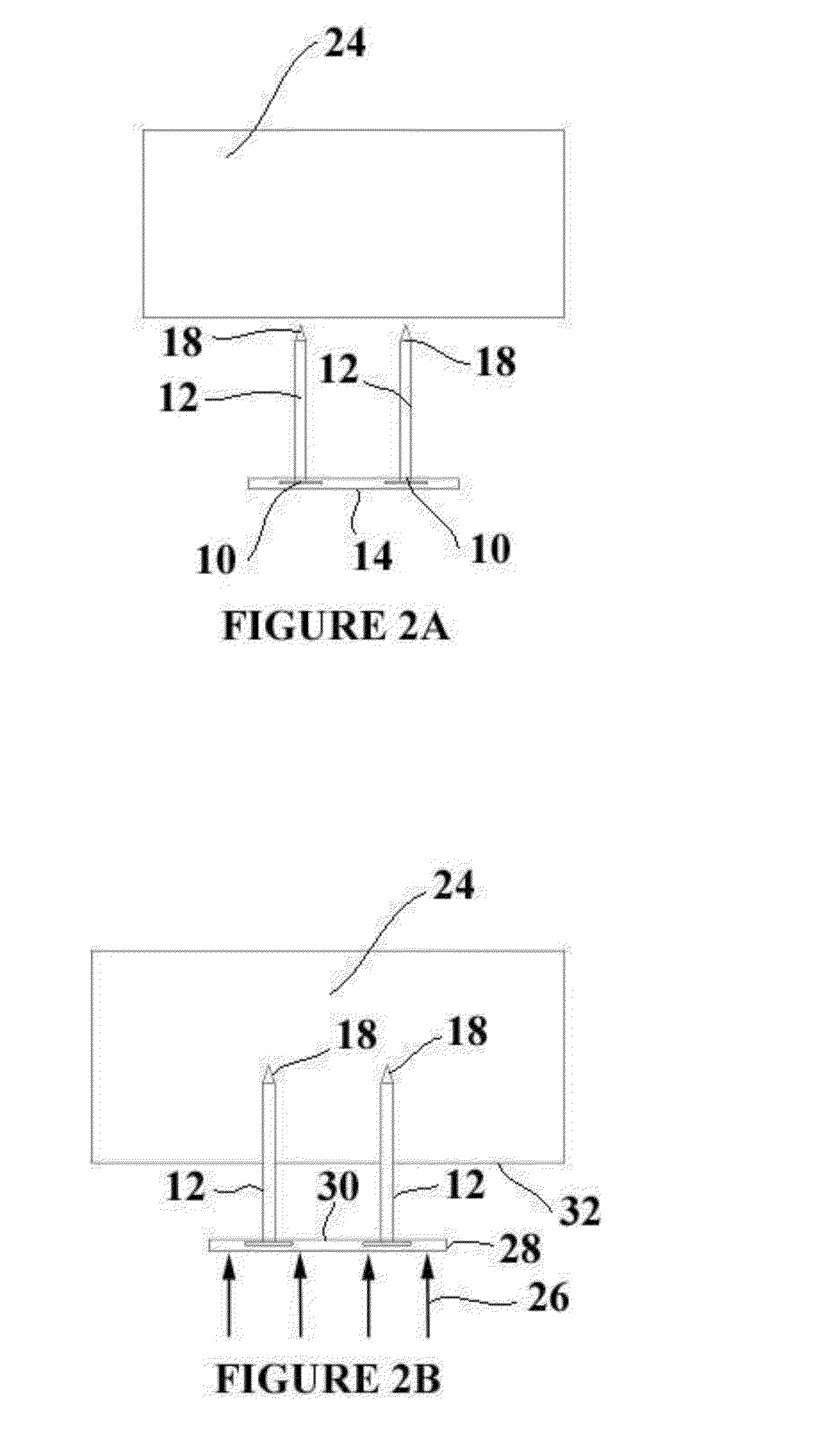
[0054]Embodiments of the invention include a composite structure with a flexible sheet or substrate and a plurality of substantially parallel shape memory microposts secured thereto. For some embodiments, the microposts may be integral with the substrate. The substrate may serve to confine and position the shape memory microposts for some embodiments as generally illustrated in FIGS. 1A and 1B. FIG. 1A shows the proximal end 10 of a pair of microposts 12 secured to a substrate 14. For the embodiment shown in the drawings, the proximal end incorporates a lateral flange 16 for engagement within the substrate to resist extraction. The microposts have a sharpened distal end 18. Because the substrate may be flexible or elastomeric, it may have the ability to conform to any irregular surface that it is forced against. For the embodiments shown in the drawings a circular cross section for the microposts is shown. In alternative embodiments, a non-circular cross section may be employed. The...

the structure of the environmentally friendly knitted fabric provided by the present invention; figure 2 Flow chart of the yarn wrapping machine for environmentally friendly knitted fabrics and storage devices; image 3 Is the parameter map of the yarn covering machine
Login to View More

PUM

No PUM Login to View More

Abstract

An array of a plurality of shape memory material microposts have a proximal end configured to be secured to a substrate with a tissue penetrating distal end. The microposts further have a deployment state with the microposts in a substantially straightened configuration with a substantially smooth and continuous outer surface which is substantially parallel to adjacent microposts and an engaged state wherein at least a section of the microposts assume a configuration that is not substantially parallel to adjacent microposts or is not substantially straight with a substantially smooth and continuous outer surface so as to mechanically capture tissue adjacent thereto

Description

REFERENCE TO RELATED APPLICATIONS[0001]This application is a divisional application of U.S. patent application Ser. No. 13 / 119,540 which is a national filing under 35 U.S.C. §371 of Patent Cooperation Treaty (PCT) application serial no. PCT / US2009 / 057348 having an international filing date of 17 Sep. 2009 claiming priority of U.S. provisional patent application Ser. No. 61192652 filed on 20 Sep. 2008 by inventor Steven Craig Anderson entitled APPARATUS AND METHOD FOR TISSUE ADHESION the disclosures of which are incorporated herein by reference.BACKGROUND[0002]1. Field[0003]This application relates generally to the field of tissue modification and wound closure and more particularly to a substrate supporting a plurality of substantially parallel shape memory microposts for insertion into tissue adjacent a wound or tissue modification site with activation of the shape memory properties of the microposts to deform for adherence to the tissue.[0004]2. Related Art[0005]Tissue adhesion de...

Claims

the structure of the environmentally friendly knitted fabric provided by the present invention; figure 2 Flow chart of the yarn wrapping machine for environmentally friendly knitted fabrics and storage devices; image 3 Is the parameter map of the yarn covering machine
Login to View More

Application Information

Patent Timeline
no application Login to View More
IPC IPC(8): A61F2/04A61B17/12A61B17/00
CPCA61F2/04A61B17/12136A61B17/12113A61B17/0057A61B17/064A61B17/0644A61B17/08A61B17/11A61B17/12118A61B17/12131A61B17/12145A61B2017/00579A61B2017/00632A61B2017/00668A61B2017/00862A61B2017/00867A61B2017/00951A61B2017/0641A61B2017/0647A61B2017/0649A61B2017/1107A61B2017/1132A61B2017/12063A61B2017/12072A61B2017/1209A61F2/0063A61F2/848A61F2002/0081A61F2002/8483A61F2013/00357A61F2210/0014A61F2220/0016
Inventor ANDERSON, STEVEN CRAIG
Owner MICROKOLL
Features
  • R&D
  • Intellectual Property
  • Life Sciences
  • Materials
  • Tech Scout
Why Patsnap Eureka
  • Unparalleled Data Quality
  • Higher Quality Content
  • 60% Fewer Hallucinations
Social media
Patsnap Eureka Blog
Learn More