Unlock instant, AI-driven research and patent intelligence for your innovation.

Systems and methods for determining document section types

a document section and system type technology, applied in the field of systems and methods for determining document section types, can solve the problems of often ambiguous presence of a particular section type, difficulty in automatically discovering the type of section,

Active Publication Date: 2022-07-28
FLORIDA INTERNATIONAL UNIVERSITY
View PDF31 Cites 0 Cited by
  • Summary
  • Abstract
  • Description
  • Claims
  • Application Information

AI Technical Summary

Benefits of technology

The patent text describes a system and method for automatically discovering and determining section types of documents. This is challenging because there is often ambiguity in the section headers and sections can be included within other sections. The system uses a modified Bayesian model merging algorithm and an Analogical Story Merging (ASM) algorithm to discover section types. The system can be used on a wide variety of document types, including clinical and IP documents. The technical effect of this invention is that it provides a solution for automatically labeling documents with section types, which can save time and improve efficiency in data-driven labeling.

Problems solved by technology

Automatically discovering types of sections is challenging; for a document class (e.g., a psychiatric evaluation or a U.S. Patent), the presence of a particular section type is often ambiguous.

Method used

the structure of the environmentally friendly knitted fabric provided by the present invention; figure 2 Flow chart of the yarn wrapping machine for environmentally friendly knitted fabrics and storage devices; image 3 Is the parameter map of the yarn covering machine
View more

Image

Smart Image Click on the blue labels to locate them in the text.
Viewing Examples
Smart Image
  • Systems and methods for determining document section types
  • Systems and methods for determining document section types
  • Systems and methods for determining document section types

Examples

Experimental program
Comparison scheme
Effect test

example 1

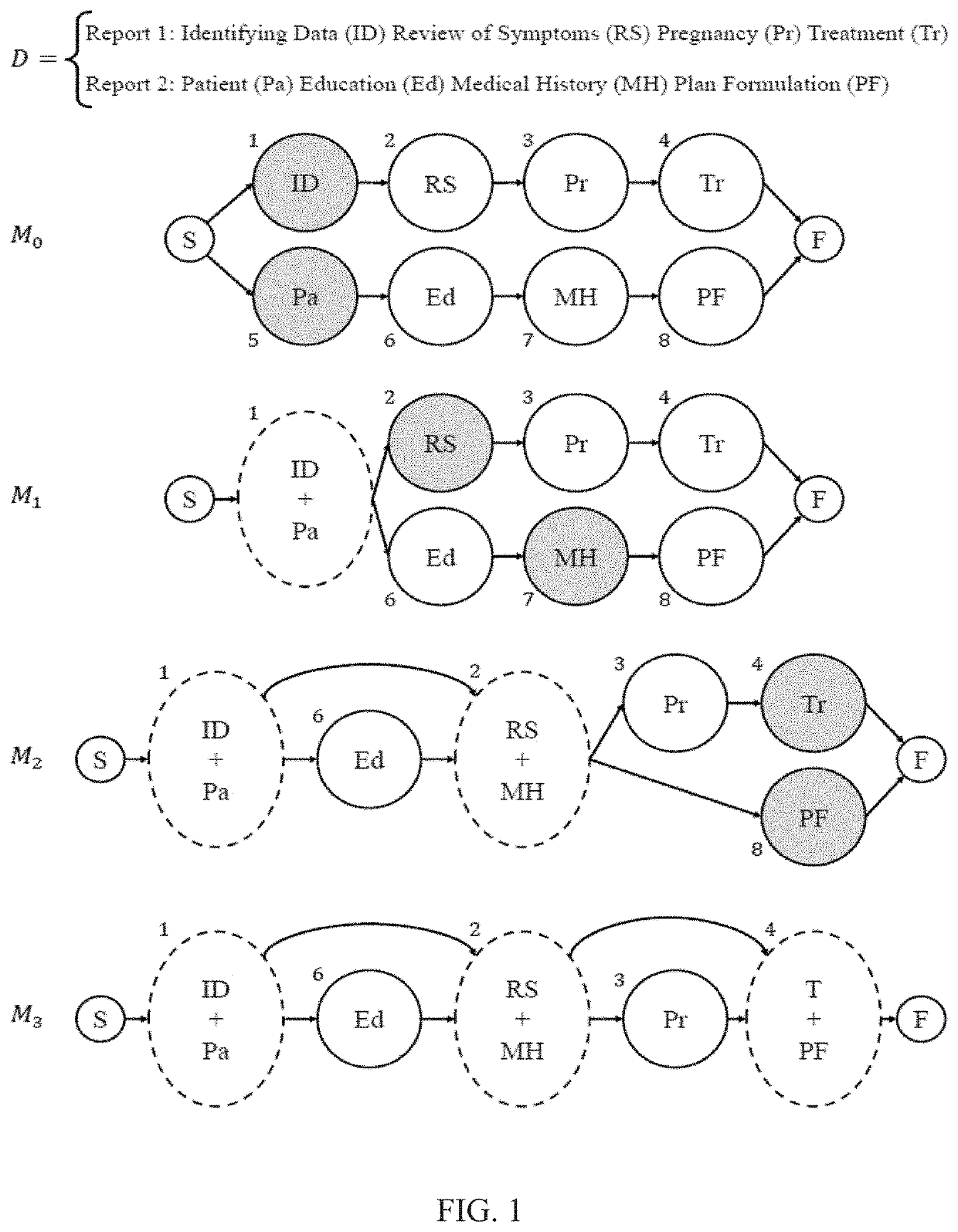
[0047]Systems and methods of embodiments of the subject invention utilize an approach that aims to identify a section structure that reflects the underlying statistics of the corpus. Thus, the output model can result in: (1) a set of pro-posed section types; and (2) a finite state machine modeling the order for those sections. In the examples, these two results can be evaluated separately. The ontologies discussed herein were used for the section types and used to annotate the corpora, and this ground truth (which was not provided to the models) was used for the evaluation. Additionally, section types were given a preferred label (header) following a majority vote of merged sections in each state.

[0048]In order to evaluate section type discovery (i.e., identifying the set of possible section types) it was treated as a document clustering task, with each section a separate document. The models of embodiments of the subject invention were compared against three document clustering bas...

example 2

[0052]The models discussed in Example 1 were also evaluated for performance on each section type individually using precision, recall, and F1 (see also FIGS. 3-6). Compared against ground truth, the models of embodiments of the subject invention performed significantly better for sections with highly distinctive content (than most other sections): e.g., “Diagnosis” in psychiatric evaluations, “Discharge Instructions” in discharge summaries, “Exam” in radiology reports, and “Description of Drawings” in patent documents. Similarly, the models of embodiments performed better in beginning and ending sections in general (e.g., “Treatment Plan” in psychiatric reports, and “Discharge Medications” in discharge summaries). It is speculated that this is because those sections typically display minimal variability in position. On average the precision was higher than recall reflecting the explicit choice to bias toward precision (see also the discussion herein with respect to defining the prio...

the structure of the environmentally friendly knitted fabric provided by the present invention; figure 2 Flow chart of the yarn wrapping machine for environmentally friendly knitted fabrics and storage devices; image 3 Is the parameter map of the yarn covering machine
Login to View More

PUM

No PUM Login to View More

Abstract

Systems and methods for discovering and / or determining section types for a given document class in a data-driven manner are provided. A modified Bayesian model merging algorithm can be used, along with extending an Analogical Story Merging (ASM) algorithm. The systems and methods can learn the section structure of documents without a pre-existing ontology of sections or time-intensive annotation efforts.

Description

BACKGROUND[0001]Many types of documents have an explicit section structure, that is, headers that delimit blocks of the text and set expectations about the content and purpose of that block. Automatically labeling sections with a pre-defined ontology of section types is useful for document understanding and has been shown to improve tasks as varied as information extraction, data mining, and document search. Automatically labeling sections with their types requires not just a list of possible sections, but also what different headers are used for each, their usual order (with possible exceptions), and the type of language normally found within. Also, manually creating this knowledge is laborious and error prone.BRIEF SUMMARY[0002]In view of the above, there is a need in the art for a solution to automatically discovering the information needed for automatic labeling of documents sections (e.g., automatically discovering from examples). Automatically discovering types of sections is ...

Claims

the structure of the environmentally friendly knitted fabric provided by the present invention; figure 2 Flow chart of the yarn wrapping machine for environmentally friendly knitted fabrics and storage devices; image 3 Is the parameter map of the yarn covering machine
Login to View More

Application Information

Patent Timeline
no application Login to View More
IPC IPC(8): G06F16/28G06F17/18G06F7/14G06N20/00G16H10/60G16H15/00
CPCG06F16/285G06F17/18G16H15/00G06N20/00G16H10/60G06F7/14G06F7/32G06F16/353G06F40/131G06F40/216G06F40/30G06F40/247G06N7/01
Inventor BANISAKHER, DEYARISHE, NAPHTALIFINLAYSON, MARK
Owner FLORIDA INTERNATIONAL UNIVERSITY
Features
  • R&D
  • Intellectual Property
  • Life Sciences
  • Materials
  • Tech Scout
Why Patsnap Eureka
  • Unparalleled Data Quality
  • Higher Quality Content
  • 60% Fewer Hallucinations
Social media
Patsnap Eureka Blog
Learn More