
Tunable cantilever apparatus and method for making same
a cantilever and apparatus technology, applied in the direction of digital storage, instruments, semiconductor devices, etc., can solve the problems of increasing the friction of the surface layer, and achieve the effect of altering the surface characteristics and mass distribution
- Summary
- Abstract
- Description
- Claims
- Application Information
AI Technical Summary
Benefits of technology
Problems solved by technology
Method used
Image

Examples
Embodiment Construction
[0014]The present invention generally relates to PMC technology which is based on the electrodeposition of metal and / or metal ions from a solid solution upon application of a suitable electric field. More specifically, the present invention relates to programmable surface control devices whose physical features, such as surface characteristics and mass distribution, are controlled by the presence or absence of a metallic electrodeposit upon application of a bias.
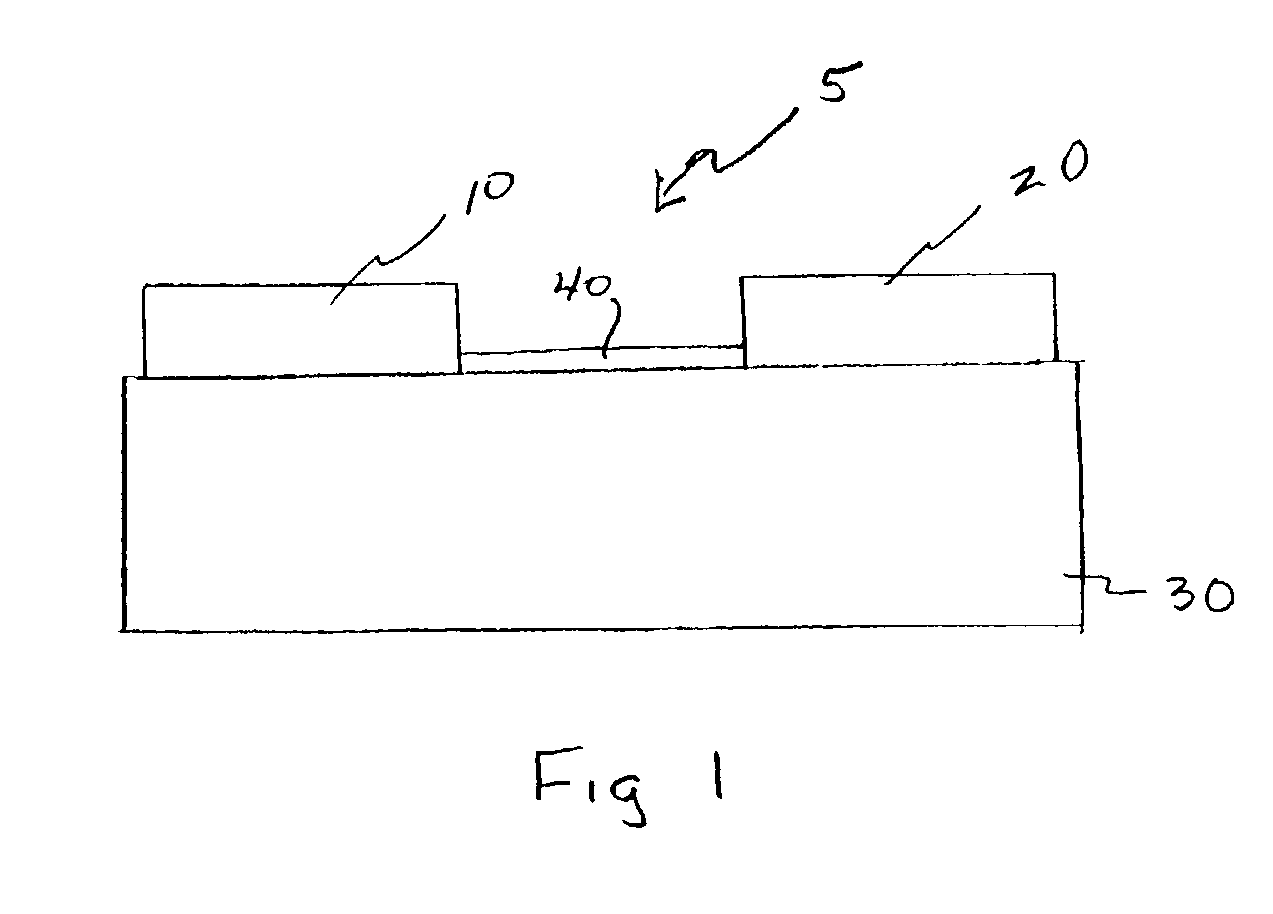
[0015]FIG. 1 illustrates a cross-sectional view of an exemplary embodiment of a programmable surface control device 5 in accordance with the present invention. Device 5 includes electrodes 10 and 20 formed on a surface of a layer of a solid electrolyte solution 30. Solid electrolyte solution layer 30 is formed from a material that conducts ions upon application of a sufficient voltage. Suitable materials for solid electrolyte solution layer 30 include chalcogenide glasses with dissolved conductive materials, such as dissolve...
PUM
 Login to View More
 Abstract
Description
Claims
Application Information
 Login to View More