
Fluid delivery control system
a control system and internal combustion engine technology, applied in the direction of machine/engine, engine revolution, lubrication of auxiliaries, etc., can solve the problems of increased force on the engine bearing, increased wear of the engine bearing, and insufficient measurement method of sensing engine rpm
- Summary
- Abstract
- Description
- Claims
- Application Information
AI Technical Summary
Benefits of technology
Problems solved by technology
Method used
Image

Examples
Embodiment Construction
[0019]Reference will now be made in detail to the exemplary embodiments of the invention which are illustrated in the accompanying drawings. Wherever possible, the same reference numbers will be used throughout the drawings to refer to the same or like parts.
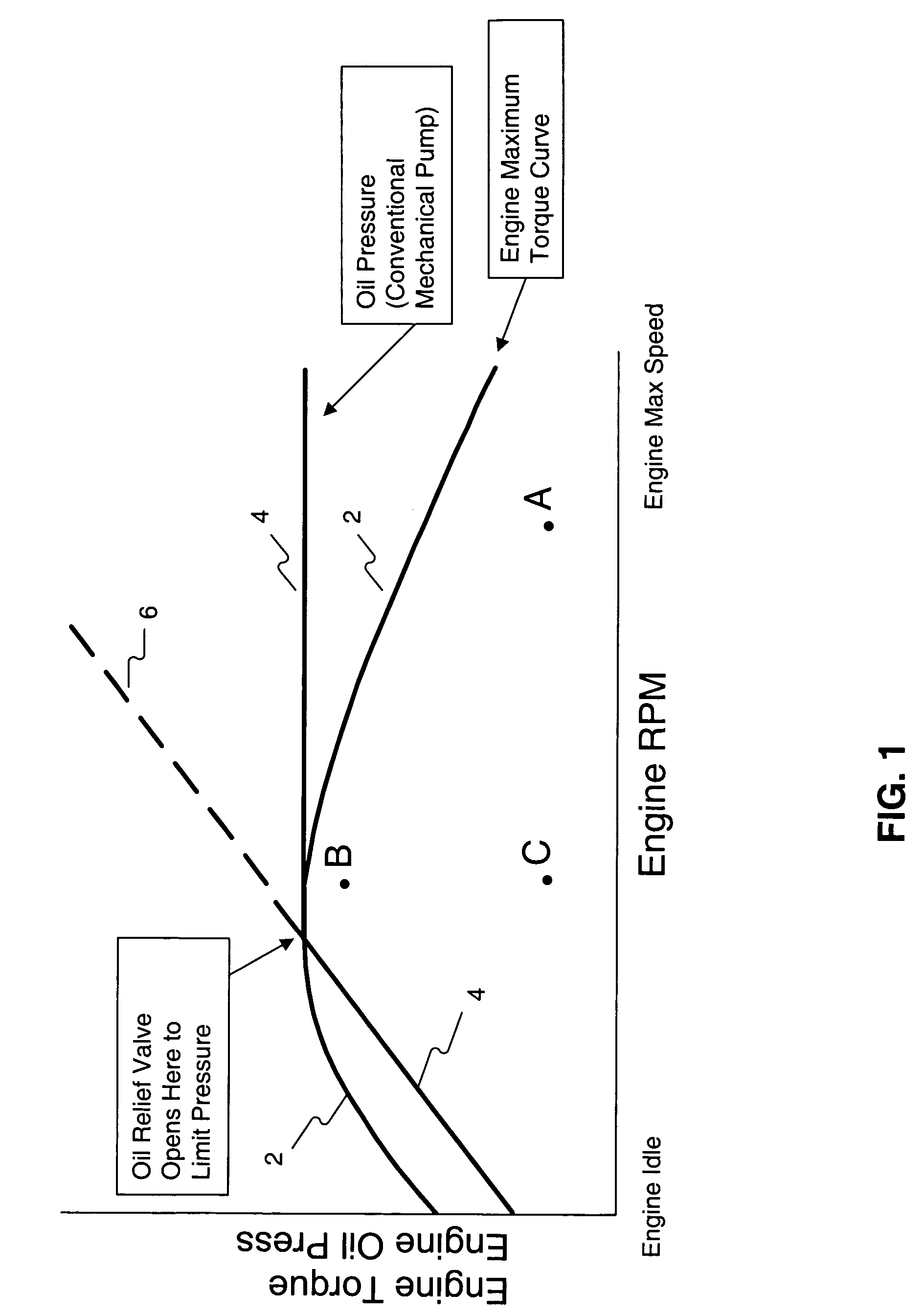
[0020]FIG. 1 depicts a set of curves illustrating the relationship between maximum engine torque and the engine oil pressure provided by a conventional mechanical oil pump. Maximum engine torque curve 2 illustrates the maximum engine torque that can be provided by a particular engine as a function of engine RPM. As engine RPM increases from an idle condition, the maximum engine torque initially increases until it reaches a peak and then decreases as engine RPM further increases.
[0021]As mentioned previously, a conventional internal combustion engine is typically lubricated with a mechanical oil pump powered by the engine via belts or gears. The mechanical oil pump speed is thus proportional to engine speed. Curve 4 illustrates t...
PUM
 Login to View More
 Abstract
Description
Claims
Application Information
 Login to View More