
Seek trajectory generation using adaptive filtering
a trajectory generation and adaptive filtering technology, applied in the field of hard disk drive control, can solve the problems of increasing the settle time, degrading disk performance, and unsatisfactory head variations and tracking errors, so as to minimize the seek time and minimize vibration and/or acoustic noise
- Summary
- Abstract
- Description
- Claims
- Application Information
AI Technical Summary
Benefits of technology
Problems solved by technology
Method used
Image

Examples
Embodiment Construction
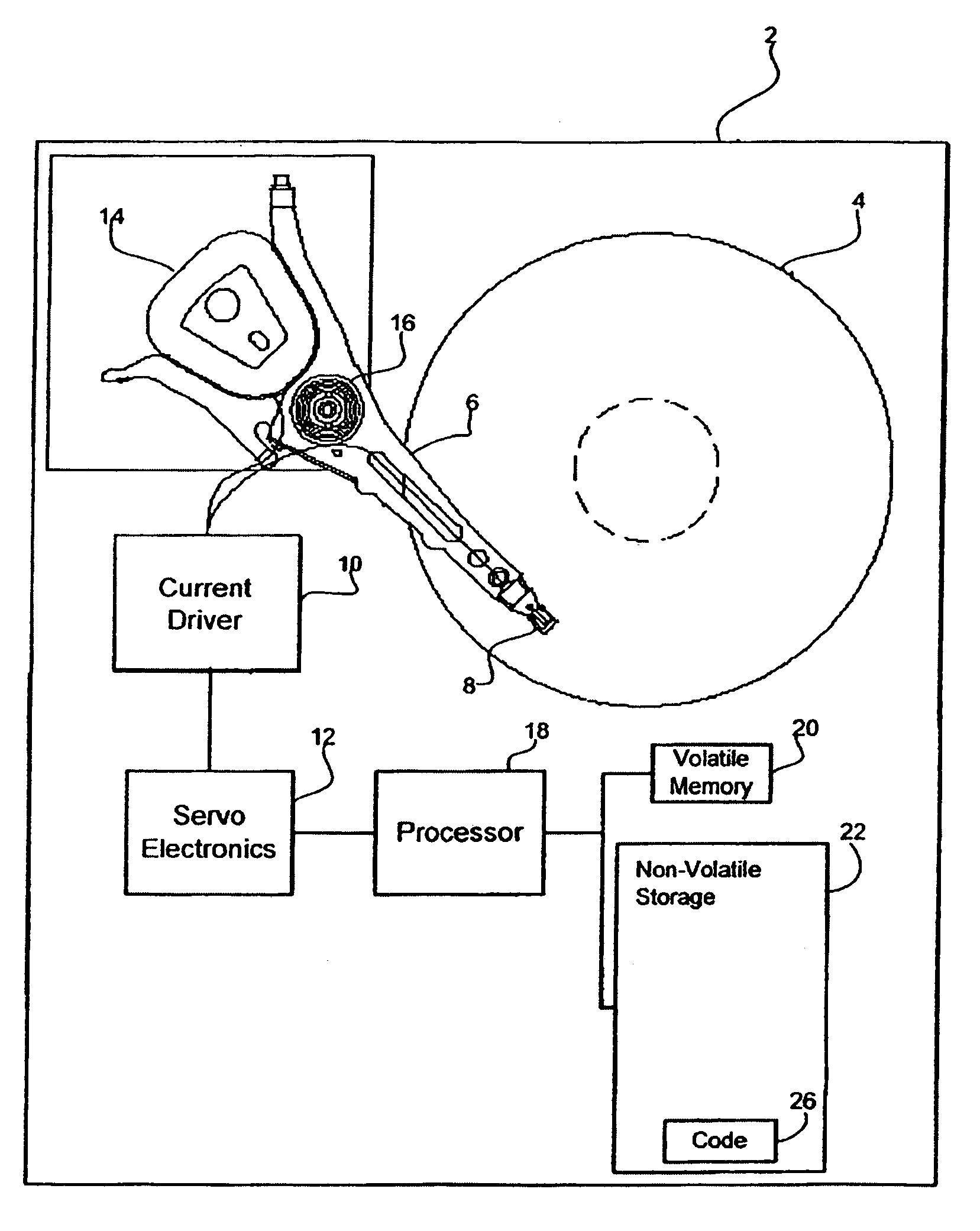
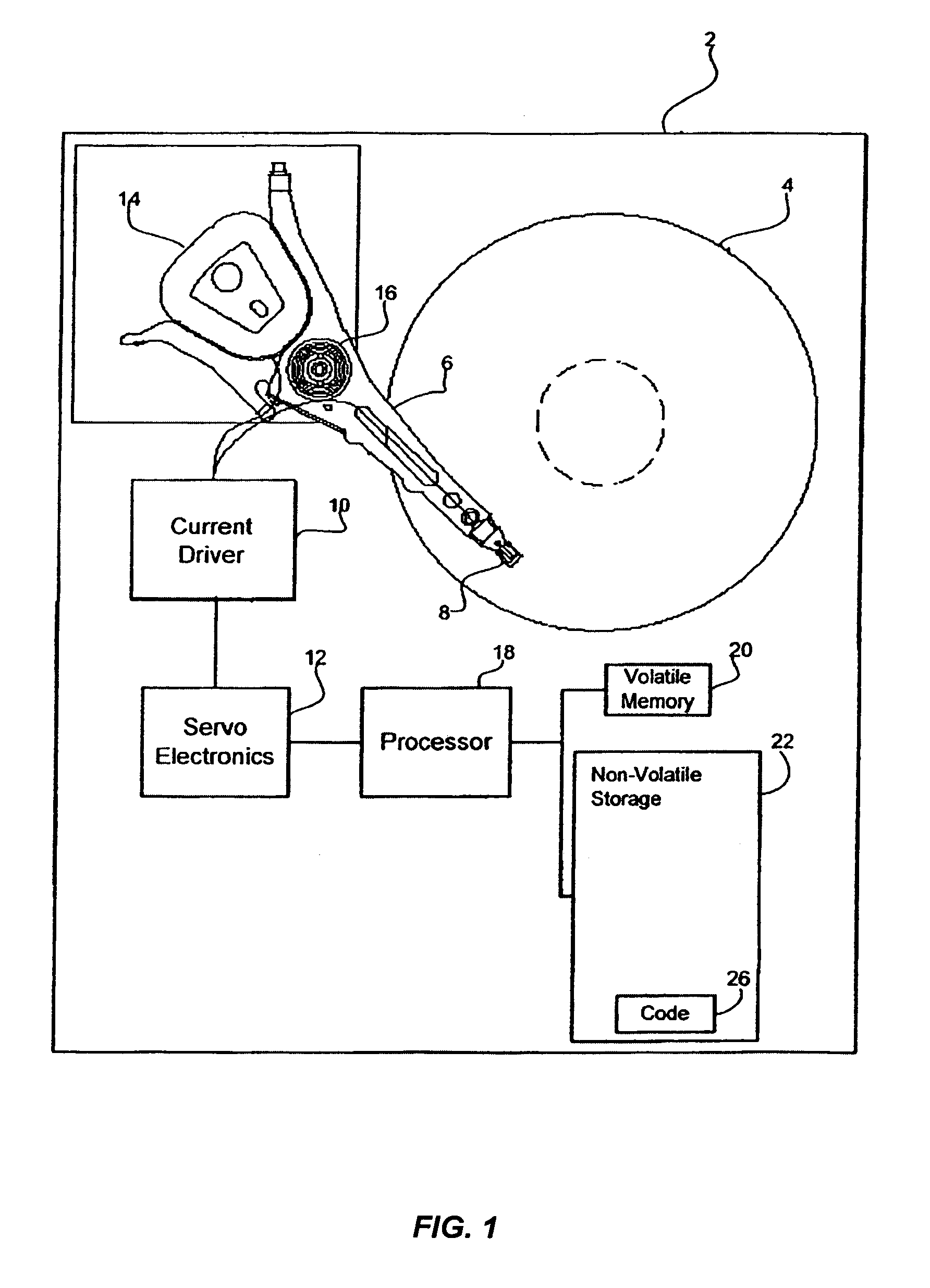
[0024]FIG. 1 shows a disk drive system 2, including one or more rotating disks 4 (only one is shown), an actuator assembly 6 to move a head assembly 8 across the disk 4 surface. The disk drive system 2 further includes a current driver 10 that converts the digital signal of a calculation from servo electronics 12 or processor 18 to actual current that is applied to a voice coil motor (VCM) 14. The VCM 14 comprises a coil that sits between two magnets. The current driver 10 applies current to the VCM 14 to cause the coil to react and move through a magnetic field to move the actuator 6.
[0025]In certain implementations, the head 8 is a magnetoresistive (MR) head device. However, in alternative implementations, the head 8 may be constructed of other materials known in the art. The servo electronics 12 provides a closed loop feedback system to ensure that the head follows the tracks accurately and to control smooth transitions when the head “seeks” from one track location to another tra...
PUM
| Property | Measurement | Unit |
|---|---|---|
| length | aaaaa | aaaaa |
| seek lengths | aaaaa | aaaaa |
| seek length | aaaaa | aaaaa |
Abstract
Description
Claims
Application Information
 Login to View More