In many cases, automated teller machines (ATM) for automatically paying / receiving money are installed in a relatively small area within a
bank or the like, where money is handled, and therefore there is a high possibility that a criminal activity such as larceny might occur.
However, in many cases, ATMs are installed in a relatively small area, and therefore a target for monitoring cannot be sufficiently distanced from the location where a monitoring camera is installed.
Therefore, there is a possibility that a view field area for an image obtained by the monitoring camera might be limited.
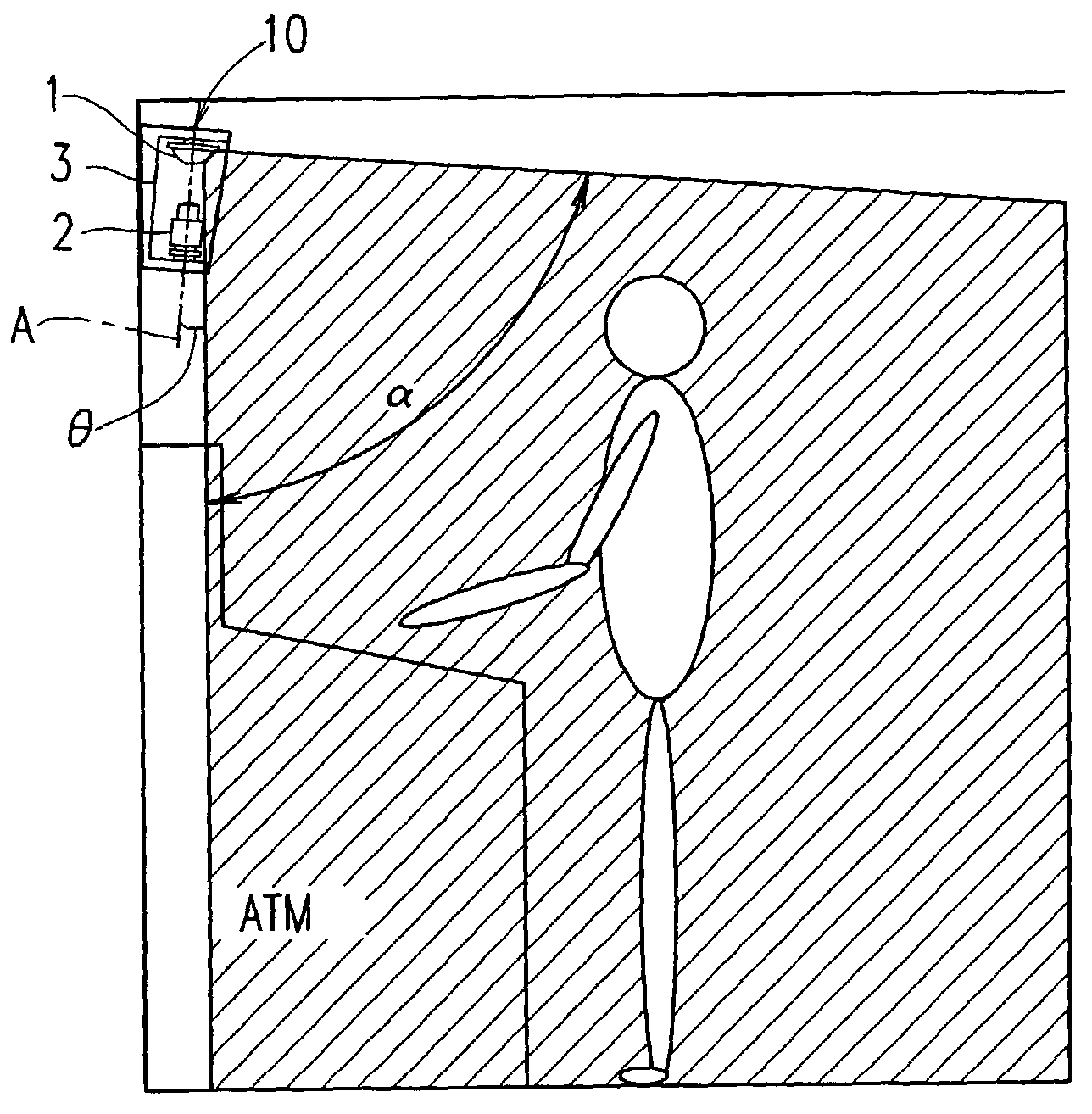
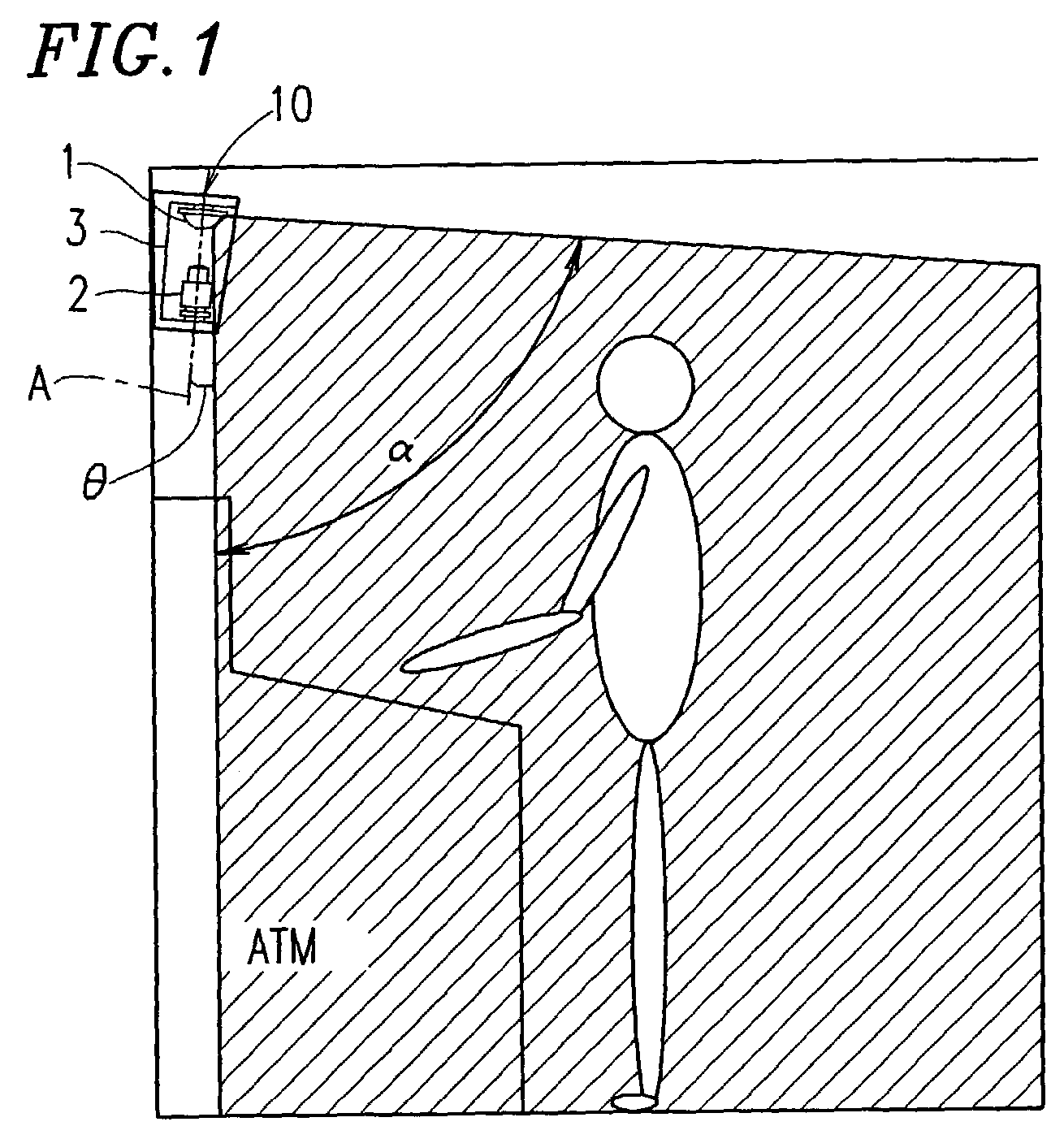
In particular, a monitoring camera using an industrial television (ITV) camera has a problem that an angle α of view which enables monitoring is predetermined by an optical system of the monitoring camera, and therefore part of the target for monitoring is located out of an area defined by the
angle of view, i.e., the target for monitoring is partially located in a blind area.
Such a blind area cannot be monitored, i.e., an operation panel of the ATM cannot be monitored.
On the other hand, although not shown in the figures, when an installation angle of the monitoring camera is adjusted so as to monitor the operation panel of the ATM, it is not possible to obtain an image of a sufficiently widely
ranging area for monitoring the ATM operator.
However, in such a case, it is necessary to provide, in addition to the ITV camera, the turntable for turning the ITV camera and the driving device or the like for pivotably driving the turntable, and therefore the configuration of the
monitoring system becomes complicated.
However, in such a case, there is a problem in that a large wide-angle lens causes the ITV camera to be increased in size.
Further, the ITV camera becomes expensive by the cost of the wide-angle lens.
Specifically, it is necessary to adjust an installation angle, etc., of the ITV camera while viewing an image displayed on a monitor during the installation of the ITV camera, and this is a complicated and time-consuming task.
This increases the size of the imaging section, and thus an area located in a direction vertically downward from the camera apparatus, where obtaining an image is not possible, is also increased.
As a matter of course, the device is restricted in its design.
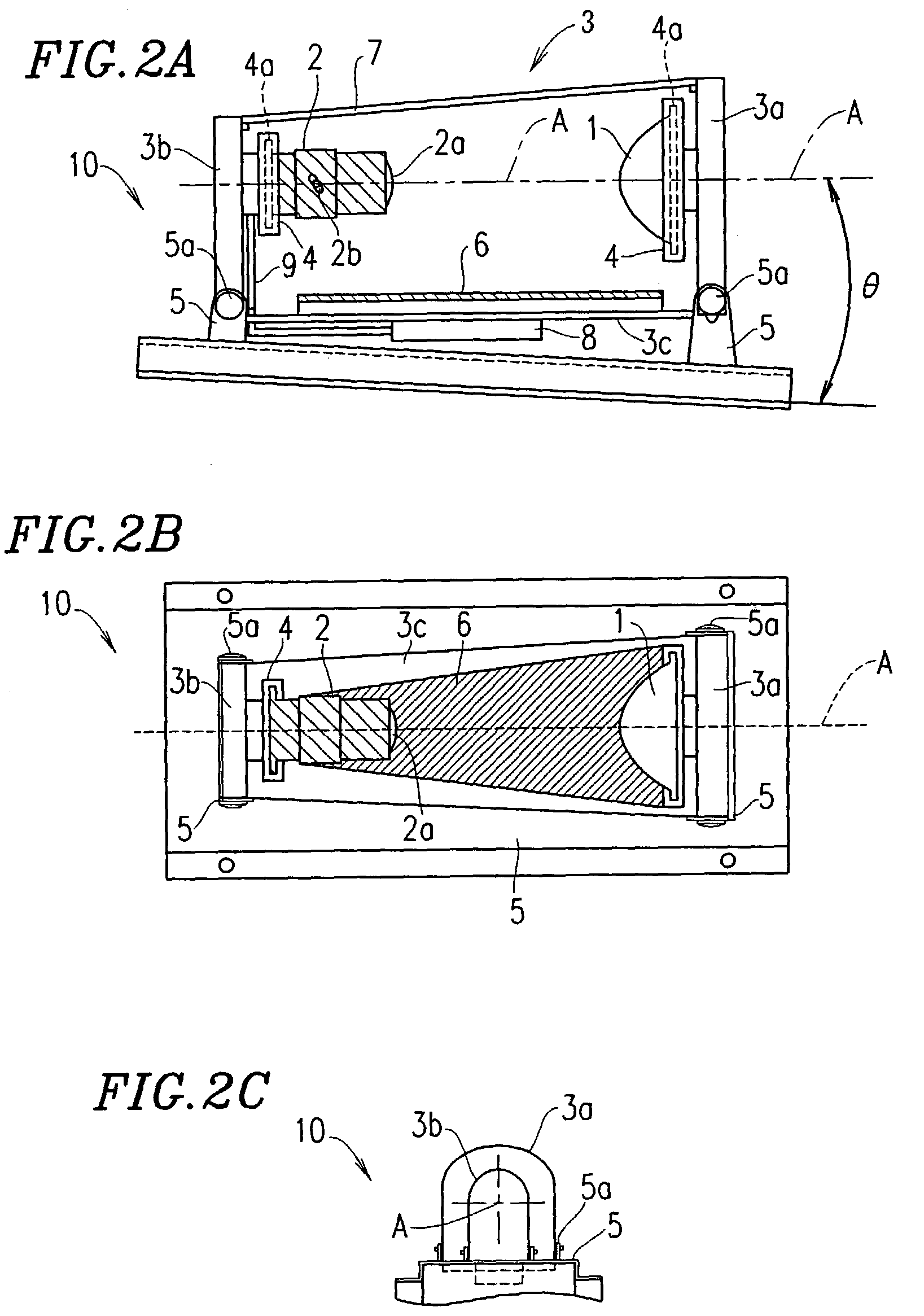
Further still, the panoramic imaging apparatus described in Japanese Laid-Open Patent Publication No. 2000-206635 does not have a mechanism for maintaining the camera in the state of being opposed to a reflecting surface of the hyperboloidal convex mirror.
Although a positional relationship between the hyperboloidal convex mirror and the camera is important in order to obtain a clear and
high resolution image, it is difficult to separately install the hyperboloidal convex mirror and the camera in a place where an image obtaining operation is performed, such that the positional relationship between the hyperboloidal convex mirror and the camera is adjusted so as to bring the camera into focus.


 Login to View More
  Login to View More