Unlock instant, AI-driven research and patent intelligence for your innovation.

Application layer ingress filtering

a filtering and application layer technology, applied in the field of communication networks, can solve the problems of complete disruption of targeted service, loss of sales and advertising revenue, and increase in malicious attacks on communication networks

Inactive Publication Date: 2010-01-12
RPX CORP
View PDF3 Cites 2 Cited by
  • Summary
  • Abstract
  • Description
  • Claims
  • Application Information

AI Technical Summary

Benefits of technology

[0017]Another advantage of the invention is that it does not rely on deployment of IP anti-spoofing mechanisms by other service providers.
[0018]Still further, the solution proposed by the invention does not consider Layer 2 / 3 data (as VLAN tags or source IP address) and thus it works in the presence of network address translation (NAT) or Proxies outside the respective network provider's domain.

Problems solved by technology

In recent years, however, the incidence of malicious attacks on the communication networks has grown to alarming proportions.
Among various classes of malicious attacks recognized today, denial of service (DoS) attacks often lead to a complete disruption of the targeted service.
DoS attacks can particularly harm e-commerce providers by denying them the ability to serve their clients, which leads to loss of sales and advertising revenue; the patrons may also seek competing alternatives (Amazon, E*Trade, and eBay are among recent victims).
Thus, an attacker may flood a victim network or server with a large volume of traffic, consuming critical system resources such as bandwidth, CPU capacity, etc.
A large number of connection requests received in a short period of time will consume the allotted memory space making the system unable to respond to legitimate requests and potentially causing the system to crash due to buffer overloads.
Distributed DoS (DDoS) attacks can be even more damaging, as they involve creating artificial network traffic from multiple sources simultaneously.
A notable form of DDoS attack is access link flooding that occurs when a malicious party directs spurious packet traffic over an access link connecting an edge network of an enterprise to the public Internet.
This traffic flood, when directed at a victim edge network, can inundate the access link, usurping access link bandwidth from the VPN tunnels operating over that link.
As such, the attack can cause partial or total denial of the VPN service and disrupt operations of any mission-critical application that relies on that service.
This makes often attack mitigation techniques inefficient.
However, the currently available solutions are deficient in that they use proprietary solutions and are usually threat-specific.
Each of the above identified solutions has its own limitations in terms of applicability, performance or types of attacks it could mitigate or detect.
Furthermore, false positives may be produced as a result of identity correspondence verification between L3 and L5 / 7 identities; the mere fact of discrepancy between L3 and L5 / 7 data may not always serve as a sign of malicious spoofing.
In the second case, statistics-based decisions do not identify individual malicious flows but simply detect abnormal behavior in a given time period, which may not always indicate a malicious attack.
However, operators are generally reluctant to use this type of authentication, or to use it for every protocol message type due to performance impact, and authentication keys management burden.

Method used

the structure of the environmentally friendly knitted fabric provided by the present invention; figure 2 Flow chart of the yarn wrapping machine for environmentally friendly knitted fabrics and storage devices; image 3 Is the parameter map of the yarn covering machine
View more

Image

Smart Image Click on the blue labels to locate them in the text.
Viewing Examples
Smart Image
  • Application layer ingress filtering
  • Application layer ingress filtering
  • Application layer ingress filtering

Examples

Experimental program
Comparison scheme
Effect test

Embodiment Construction

[0022]This invention is directed to an application layer ingress filtering of flows incoming in a given domain, which extends the common ingress filtering based on the IP header only, as defined by the “Network Ingress Filtering: Defeating Denial of Service Attacks which employ IP Source Address Spoofing”, IETF RFC 2827.

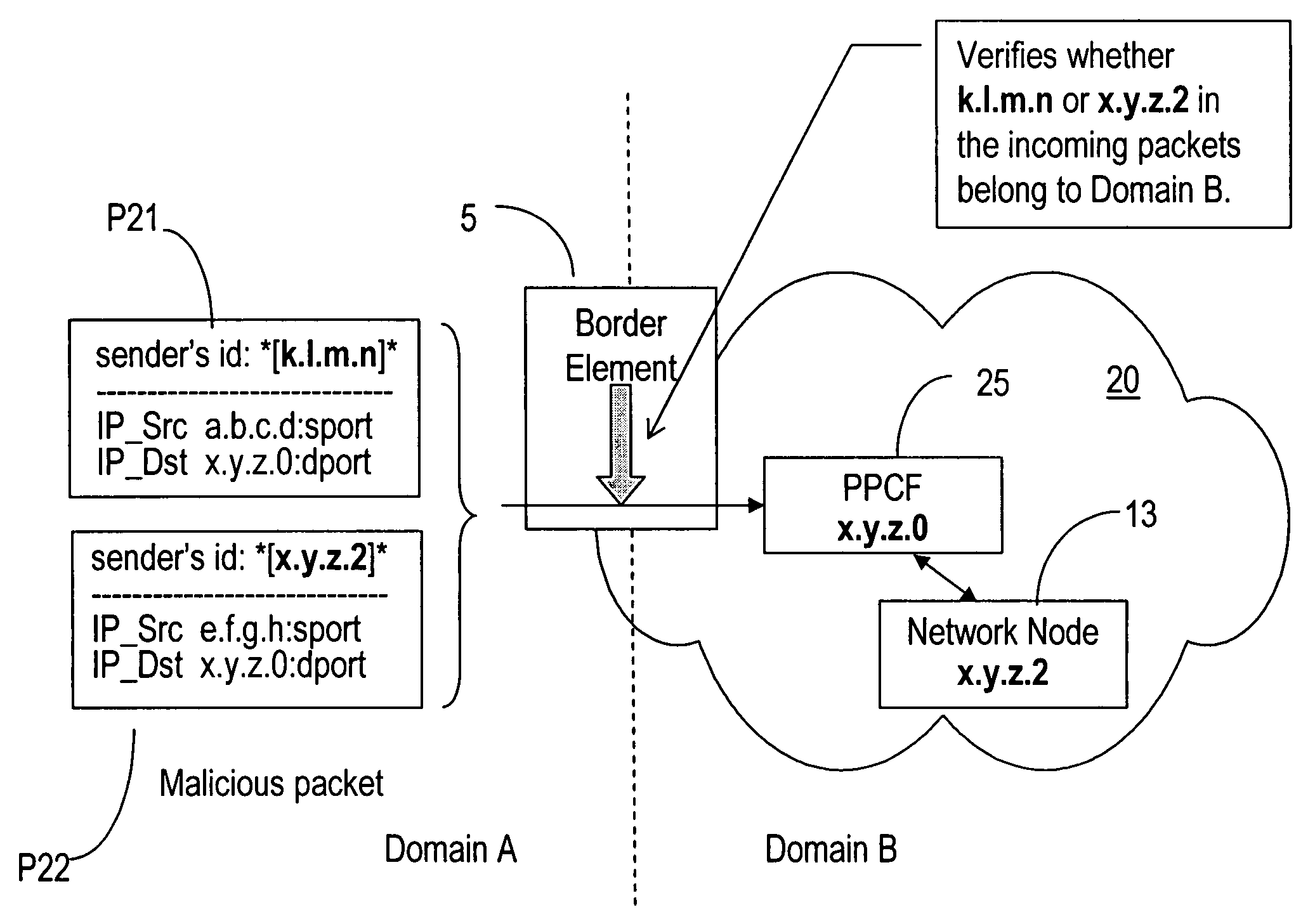
[0023]FIG. 1 depicts principal entities and communication links for a possible attacking scenario, where the attacker is outside the service provider (SP) network / domain. In this example, one or more nodes 11, 13 in the service provider domain B are targeted by an attacker 22 located in domain A. Domain B generically represents any network / entity in domain B for obtaining a certain communication service from the respective SP. Domain A generically represents any other legitimate and / or illegitimate source of data packets outside domain B. More broadly, domain A refers to the communication environment other than domain B from where service requests to SP may originate...

the structure of the environmentally friendly knitted fabric provided by the present invention; figure 2 Flow chart of the yarn wrapping machine for environmentally friendly knitted fabrics and storage devices; image 3 Is the parameter map of the yarn covering machine
Login to View More

PUM

No PUM Login to View More

Abstract

A method and system for filtering malicious packets received at the edge of a service provider (SP) domain is provided. A protocol aware border element identifies the protocol used by any ingress packet, and then determines which domain-specific information is used in the application payload of the packet to form the source identity. If this packet pretends to come from the SP domain, and no domain entity is allowed to roam, the packet is identified as illegitimate and is subjected to a given security policy. The border element also identifies as legitimate the SP domain entities that are allowed to roam, and legitimate sources outside said SP domain that communicates customary with entities in the SP domain.

Description

FIELD OF THE INVENTION[0001]The invention is directed to communication networks and in particular to an application layer ingress filtering.BACKGROUND OF THE INVENTION[0002]The reliability and security of an IP network is essential in a world where computer networks are a key element in intra-entity and inter-entity communications and transactions. The original Internet protocols were designed on the basis that system users would connect to the network for strictly legitimate purposes; as a consequence, no particular consideration was given to security issues at that time. In recent years, however, the incidence of malicious attacks on the communication networks has grown to alarming proportions.[0003]Among various classes of malicious attacks recognized today, denial of service (DoS) attacks often lead to a complete disruption of the targeted service. DoS attacks can particularly harm e-commerce providers by denying them the ability to serve their clients, which leads to loss of sa...

Claims

the structure of the environmentally friendly knitted fabric provided by the present invention; figure 2 Flow chart of the yarn wrapping machine for environmentally friendly knitted fabrics and storage devices; image 3 Is the parameter map of the yarn covering machine
Login to View More

Application Information

Patent Timeline
no application Login to View More
Patent Type & Authority Patents(United States)
IPC IPC(8): H04L29/06G06F12/14G06F12/16G06F15/16G06F15/173
CPCH04L63/0245H04L63/1458H04L63/0236H04L2463/141
Inventor ROBERT, JEAN-MARCVINOKUROV, DMITRI
Owner RPX CORP