
Noribogaine in the treatment of pain and drug addiction
a technology of pain and drug addiction, which is applied in the direction of drug compositions, biocide, heterocyclic compound active ingredients, etc., can solve the problems of ineffective insufficient treatment of prior art, and inability to completely satisfy the treatment of polydrug abuse or addiction, so as to achieve the effect of substantially eliminating withdrawal symptoms
- Summary
- Abstract
- Description
- Claims
- Application Information
AI Technical Summary
Benefits of technology
Problems solved by technology
Method used
Image

Examples
examples
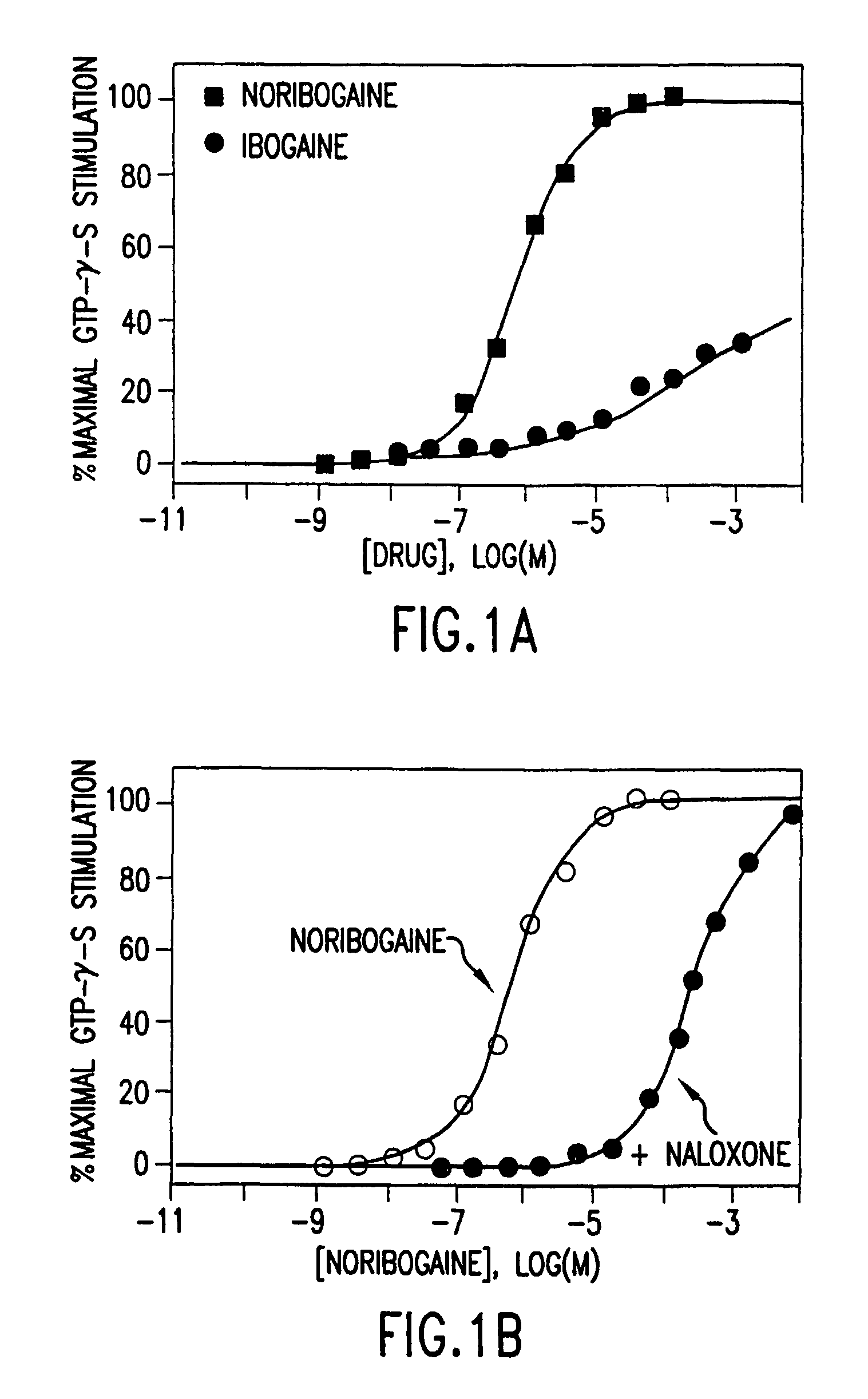
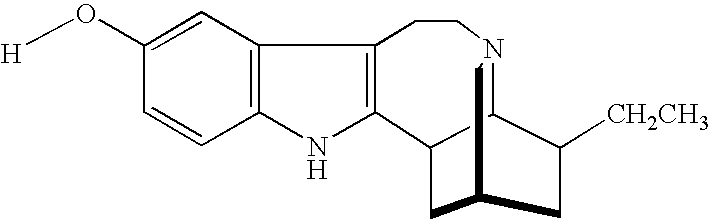
[0033]Noribogaine-stimulated [35S]GTPγS binding to rat thalamic membranes was used to measure receptor activation of G proteins and results are shown in FIG. 1 and Table 1. The percent maximal stimulation (10 μM DAMGO, EC50=7.4+ / −0.1 nM) of [35S]GTPγS binding stimulated by noribogaine was determined in the presence of an excess of GDP. The EC50 value for noribogaine-stimulated binding was 0.324+ / −0.015 μM. In contrast, ibogaine caused a weak stimulation of [35S]GTPγS binding even at concentrations above 100 μM. Noribogaine-stimulated binding was blocked in the presence of naloxone (competitive antagonist, EC50=35+ / −1.8 μM), demonstrating further that the effect of noribogaine was μ-receptor mediated. The rightward shift of the concentration / effect relationship of noribogaine-stimulated binding with increasing concentration of naloxone was similar to that measured for DAMGO in the presence of competitive antagonist. The level of [35S]GTPγS binding stimulated by noribogaine was in clo...
PUM
| Property | Measurement | Unit |
|---|---|---|
| body weight | aaaaa | aaaaa |
| body weight | aaaaa | aaaaa |
| concentration | aaaaa | aaaaa |
Abstract
Description
Claims
Application Information
 Login to View More